
2026 Arizona Non-Binary Affirming Support Guide
What if the most affirming space you find in the desert isn't a physical location, but a community that finally mirrors your internal reality? For many, the search for resources for non-binary individuals in Arizona feels complicated by a social landscape that often demands binary choices. You might feel like you aren't "trans enough" for certain spaces or worry about how to move through conservative areas while staying true to yourself. We believe that your path is valid exactly as it is, though we recognize that the way you engage with support often depends on your individual experience and personal safety needs.
We want to offer a flexible framework for finding community, healthcare, and therapeutic support tailored to the non-binary experience. You'll find a curated list of categories designed to foster a sense of belonging and provide clear steps for accessing mental health care. We'll explore the 2026 legal landscape for name changes, the availability of "X" gender markers on state IDs, and the vital role of community hubs like Fluxx Productions. This guide serves as a gentle bridge between your current reality and a future where you feel fully acknowledged.
Key Takeaways
- Learn to navigate the unique landscape of Arizona by identifying spaces that align with your personal sense of safety and belonging.
- Understand how to distinguish between clinical guidance and peer connection, as the value of each often depends on your individual experience and current needs.
- Explore the 2026 legal and social environment, including how to approach name changes and identity markers in a way that respects your specific context.
- Discover a flexible framework for identifying resources for non-binary individuals in arizona that acknowledges your role as the expert on your own life.
- See how therapeutic support can act as a bridge to wider community resources, providing a stable and non-judgmental environment for self-discovery.
The Evolving Landscape of Non-Binary Resources in Arizona
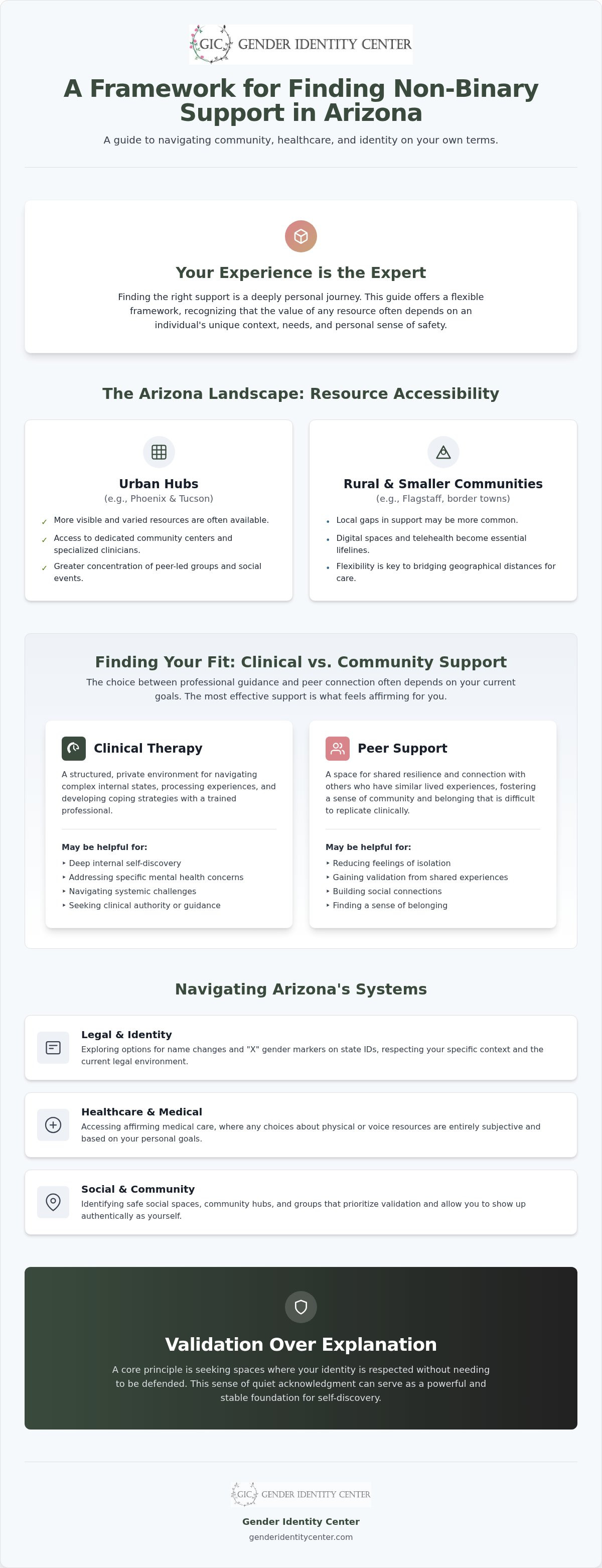
Living in the Southwest often brings a unique set of reflections. The desert landscape is vast, and so is the variety of ways you might experience your identity here. Finding resources for non-binary individuals in arizona isn't a one-size-fits-all process; it's a journey that depends on your specific context and comfort level. While some find the "Grand Canyon State" to be a place of radical self-discovery, others may feel the weight of social expectations that don't quite fit. We believe that you are the expert on your own life. The value of any specific support system is often a subjective matter that depends on each individual's experience.
A foundational part of this journey is often understanding non-binary identities and how they intersect with our local culture. This understanding helps us see that there's no single "correct" way to exist outside the binary. Whether you're just beginning to explore your internal states or you've been walking this path for years, the landscape in Arizona is constantly shifting. This evolution is driven by a mix of social changes and the growing strength of community advocates who work to create more secure environments where everyone can feel acknowledged.
Validation as a Starting Point
What does safety look like to you? For some, it's a clinic that uses correct pronouns without being asked. For others, it's a quiet group of peers who understand the nuance of "not being trans enough." Moving toward expansive support means looking for spaces that prioritize validation over explanation. We believe that your identity shouldn't have to be defended to be respected. This sense of quiet resilience grows when you find a community that acknowledges your lived experience as the ultimate truth. If you're looking for professional guidance that centers your agency, connecting with affirming therapists can be a helpful step in your progression.
Urban vs. Rural Resource Accessibility
Arizona's geography creates a distinct divide in how you might access support. Phoenix and Tucson serve as concentrated hubs where resources for non-binary individuals in arizona are more visible and varied. In these cities, you might find dedicated community centers or specialized clinicians. However, we know that many of you live in smaller communities where local gaps in support are more common. In these instances, digital spaces and telehealth often become essential lifelines. Whether you're in Flagstaff or a small border town, your ability to connect with affirming care often depends on how you choose to bridge these geographical distances. This flexibility allows you to find support that feels right for your current reality.
While your search may be focused on local Arizona options, knowing how to identify inclusive primary care models in other regions is also valuable; for instance, you can explore Walk-in Clinic Services at Sage Creek Medical Center to see how they prioritize a welcoming and respectful patient experience.
Categorizing Your Support: From Mental Health to Community Care
Finding the right combination of support is a deeply personal endeavor that reflects your unique path. Because identity is nuanced, the "job" a resource does for you might change over time. Some individuals prioritize clinical spaces for deep internal work, while others find their strength through social connection. Organizing your search into categories helps you identify which resources for non-binary individuals in arizona will best meet your current emotional and physical needs. This framework isn't a set of rules, but rather an invitation to explore what feels most affirming for you today. We recognize that the value of any specific system depends on your individual experience and personal comfort.
Clinical Therapy vs. Peer Support
Deciding between professional guidance and community connection often depends on your individual experience and what you hope to achieve. Professional gender counseling offers a structured, private environment to navigate complex internal states or systemic challenges. This can be particularly helpful for those seeking clinical authority or a steady hand through the psychological process of self-discovery. Conversely, peer-led circles provide a sense of shared resilience that is difficult to replicate in a clinical setting. For younger folks or their families, exploring PFLAG Arizona Resources can be a helpful starting point for finding these vital community networks.
Navigating Medical and Voice Resources
The choice to pursue medical or expressive changes is entirely subjective. There's no requirement to undergo specific procedures to be "valid" in your identity. However, for those who feel that physical or vocal alignment is part of their progression, Arizona offers several paths. You might look for providers who utilize informed consent models, which center your agency in the decision-making process. Additionally, specialized voice therapy for transgender Arizona residents can assist in finding an expressive tone that feels authentic. This type of support focuses on your comfort and resonance rather than adhering to rigid binary standards.
Furthermore, for those interested in a holistic approach to wellness, completehealthatgreenoaks.com specializes in medical weight loss and hormone therapy, offering another layer of support for those seeking to align their physical health with their personal goals.
Beyond clinical and medical needs, your resource map might include legal advocacy for name changes or social spaces for collective joy. Organizations like Fluxx Productions in Southern Arizona provide cultural anchors that celebrate lived experience as much as professional expertise. These spaces offer a chance to be acknowledged in a secure environment without the pressure of explanation. If you feel ready to begin a deeper exploration of your identity in a compassionate setting, you might consider scheduling a consultation to discuss your unique goals and future self.
Navigating Arizona Systems: Healthcare, Legal, and Social Spaces
Moving through institutional systems in the Southwest often requires a blend of patience and careful preparation. In 2026, the way you interact with these structures often depends on your personal context and the specific county where you reside. Finding resources for non-binary individuals in arizona involves understanding that these systems aren't always intuitive, but there are established paths to help you feel more seen and respected. Whether you're navigating a workplace in Phoenix or a community event in Tucson, your comfort level in these spaces is a subjective experience that reflects your unique journey. We believe that having the right information can act as a steady, guiding hand as you interface with these broader social and legal structures.
Legal and Identity Documentation
Updating your legal identity is a significant milestone for many, though the necessity and timing of this process are highly subjective. In Maricopa County, the filing fee for a name change is approximately $320, while other counties typically range between $236 and $350. If you're seeking to update a gender marker to "X" on an Arizona driver's license, you'll generally need to present a government-issued ID, like a U.S. passport, that already reflects that marker. Because these requirements can feel like a labyrinth, many find that having a WPATH letter is a helpful tool for navigating certain administrative or medical hurdles. This documentation serves as a professional bridge, acknowledging your commitment to your process in a way that institutions often require for progression.
Arizona Healthcare Networks
Navigating healthcare in the Grand Canyon State involves more than just finding a doctor; it's about finding a partner who respects your lived experience. The alignment of identity, hormones, and healthcare is a personal choice where the "right" path depends on each individual's experience. While some hospital systems in our larger cities have developed more affirming policies, insurance coverage remains a complex area where nuances in your specific policy will determine what is accessible. Advocacy is a skill that grows over time. We believe that being informed about your rights and the available resources for non-binary individuals in arizona empowers you to navigate traditional medical environments with a sense of agency. Whether you're exploring options for future self-realization or managing current care, your voice is the most important one in the room. This steady flow of information helps ensure you remain the expert on your own life as you move through these systems.
How to Build Your Personal Resource Map in Arizona
Creating a personal support network is a dynamic process that evolves alongside your self-discovery. Because your needs are unique, building a map of resources for non-binary individuals in arizona isn't about following a rigid checklist. Instead, it's an invitation to curate a collection of supports that resonate with your current reality. We believe that you are the expert on your own life, and the value of any specific resource often depends on your individual experience and personal sense of safety. This progression allows you to move at your own pace, ensuring that every connection you make feels like a step toward a more acknowledged future.
- Step 1: Identify your immediate needs. Focus on what would help you feel most secure right now, whether that's emotional support or physical safety.
- Step 2: Choose your mode of connection. Determine if you currently prefer the clinical authority of a professional or the shared resonance of a peer group.
- Step 3: Vet for inclusive signals. Look for language on websites and intake forms that explicitly acknowledges non-binary identities.
- Step 4: Gauge the fit. Reach out for an initial conversation to see if the "vibe" aligns with your internal state.
- Step 5: Reassess regularly. Your identity is a journey, and it's okay to change your support map as you grow.
Vetting Providers for Non-Binary Competency
When you're looking for a clinician, it's helpful to ask specific questions to ensure they understand the nuances of non-binary life. You might ask about their experience with gender-expansive clients or how they handle mistakes regarding pronouns. Looking for signs of inclusion, such as gender-neutral options on intake forms, can serve as a verbal signal of their commitment. Ultimately, we encourage you to trust your intuition. If a space doesn't feel right, that's a valid observation. Finding a professional who acts as a wise mentor often depends on your individual experience of their approach and presence.
Leveraging Telehealth for Flexibility
For those living outside our major urban centers, digital support systems provide a vital bridge to care. The benefits of online gender therapy include both privacy and the convenience of accessing specialized help from the comfort of your own home. This flexibility is particularly meaningful in a state as geographically diverse as Arizona, where local gaps in support can sometimes feel isolating. Digital platforms allow you to maintain a sense of stability while exploring your identity in a secure environment. If you feel ready to take the next step in your progression, you might consider scheduling a consultation to see how our team can support your unique goals.
Finding Your Sanctuary: Therapeutic Support with the Gender Identity Center
We believe that finding a secure environment is a vital first step toward self-realization. At the Gender Identity Center, we prioritize radical acceptance and clinical expertise to ensure you feel seen and respected from your very first interaction. Whether you're in Phoenix or Tucson, our team acts as a bridge between your current reality and your future self. Therapy is often a foundational piece in the puzzle of resources for non-binary individuals in arizona, providing the stability needed to navigate social or medical transitions. The way you choose to engage with these services is a subjective decision that depends on your individual experience and current emotional needs. We're here to offer a steady, guiding hand as you explore what authentic living looks like for you.
Individual and Family Counseling in Arizona
We provide support for every stage of the journey, acknowledging that the process of exploration is a lifelong endeavor that looks different for everyone. For some, this means working with a specialized therapist to address gender-related trauma or the weight of systemic exclusion. Others find that family therapy offers a way to build a more supportive home environment where every member feels acknowledged. Our approach is designed to be holistic, offering various paths for healing and progression:
- Individual therapy for focused, private identity exploration.
- EMDR therapy to process past hardships with sensitivity and care.
- Speech therapy for those seeking vocal alignment and resonance.
- Group therapy to foster a sense of partnership and shared resilience.
The value of each service depends on each individual's experience and what they hope to achieve in their personal development. We don't rush you toward specific outcomes; instead, we flow with a cadence that mirrors the pace of a therapeutic conversation.
Taking the Next Step Toward Connection
Reaching out for support can feel like a significant leap, but we've designed our process to be as gentle as possible. When you first contact us, you'll encounter a voice that is calm and unhurried, reflecting our commitment to your personal timeline. We offer both in-person sessions and telehealth options, ensuring that resources for non-binary individuals in arizona remain accessible regardless of your geographical location. Scheduling a session is a straightforward step that centers your agency and autonomy. We invite you to explore your identity at a pace that feels right for you, knowing that you are the expert on your own life. Whether you're seeking clinical authority or a compassionate advocate, our goal is to facilitate your progress in a way that feels safe and affirming.
Your Path Toward Authentic Living in Arizona
We believe that finding your place in the Southwest is a deeply personal endeavor. The value of any specific support network depends on your individual experience and your current goals for self-realization. By learning to categorize your needs and vet for inclusive signals, you can build a map of resources for non-binary individuals in arizona that feels both secure and empowering. Whether you're navigating the complexities of legal documentation or seeking vocal resonance, your journey is valid exactly as it is. We recognize that systems can be challenging, but they don't have to be navigated alone.
Our team provides specialized clinical expertise in gender-expansive identities through empathetic, WPATH-compliant care. With offices in Phoenix and Tucson and statewide telehealth options, we're ready to support your unique progression. Begin your journey with a supportive partner; explore our therapists today. You are the expert on your own life, and we're honored to walk beside you as you move toward a more acknowledged and authentic future.
Frequently Asked Questions
Where can I find non-binary support groups in Phoenix?
Phoenix offers several community-led spaces, such as one•n•ten for youth and various adult peer circles hosted at local community centers. Finding the right fit often depends on your individual experience and what stage of life you're in. These resources for non-binary individuals in arizona provide a chance to connect with others who share similar paths, fostering a sense of partnership and collective resilience in a non-judgmental environment.
How do I know if a therapist in Arizona is truly non-binary affirming?
You can often gauge a provider's competency by looking for inclusive markers on their website and intake forms. Truly affirming clinicians usually move beyond binary language and explicitly mention experience with gender-expansive identities. It's helpful to ask directly about their approach during an initial consultation. Ultimately, whether a therapist feels like a good fit is a subjective decision that depends on each individual's experience and personal sense of safety.
Can I get a WPATH referral letter for HRT in Tucson?
Yes, you can access WPATH-compliant referral letters through specialized clinicians in Tucson or via telehealth. This process usually involves a professional consultation to discuss your goals and ensure you feel prepared for medical transitions. We recognize that the need for these letters is a personal choice. Having a steady, guiding hand can make navigating the requirements of medical systems feel more manageable and less overwhelming for you.
Are there specific resources for non-binary people of color in Arizona?
Support for non-binary people of color can be found through organizations like the Black LGBTQ+ Alliance of Arizona and other intersectional advocacy groups. These spaces prioritize the unique lived experiences of those at the intersection of multiple identities. Finding a community where you feel fully seen often depends on your individual experience and your specific cultural context. We believe that intersectional support is essential for holistic healing and self-realization.
What legal resources exist for name changes in Arizona?
Legal guidance is available through programs like the Name Change Clinic at Fluxx Productions and various LGBTQ+ legal aid resources. These organizations help navigate the paperwork and court requirements for updating your identity markers in Arizona. Because the process varies slightly by county, having access to community-rooted expertise provides a sense of stability. This support helps lower defenses for those navigating systemic structures that weren't built with non-binary identities in mind.
How much does gender-affirming therapy cost in Arizona?
The cost of therapy depends on your insurance provider, your specific policy nuances, and whether you choose an in-network or out-of-network clinician. Many people find that their coverage for mental health services helps facilitate progress without unexpected financial strain. It's always a good idea to check with your insurance company directly to understand your benefits. This ensures you can plan your therapeutic journey in a way that feels sustainable for your current reality.
Is telehealth a viable option for non-binary individuals in rural Arizona?
Telehealth is a highly viable and often essential way to access resources for non-binary individuals in arizona for those living in rural areas. It bridges the geographical gap, allowing you to connect with specialized clinicians in Phoenix or Tucson from your own home. This option provides both privacy and a secure environment for those who may not have affirming local support. Whether telehealth is the right choice for you depends on your personal comfort with digital connection.
What is the difference between peer support and clinical gender therapy?
Peer support focuses on shared lived experience and community connection, while clinical gender therapy provides professional, structured guidance for internal emotional work. Both paths offer valuable support, but the one you choose often depends on your individual experience and current needs. Peer groups offer a sense of belonging, while therapy acts as a bridge to deeper self-discovery and personal growth. We believe that both can play a role in your progression.