
Genderfluid Support Groups for Adults in Phoenix

A genderfluid support group in Phoenix can bring gender-diverse adults together to explore transition with peer connection and professional support. The Gender Transitions Support Group in Phoenix is for adults aged 18 and up.
Finding a space where your identity is respected can matter, especially when your path doesn’t fit someone else’s expectations. Your experience is your own, and support can make room for questions, changing feelings, and decisions made at your pace.
Here, you’ll learn what to look for in a professionally facilitated group, how peer connection may complement individual support, and how to find gender-affirming mental health care in Phoenix. We’ll also explore what transition support can include, so you can consider which kind of space feels right for you.
Key Takeaways
- Learn what transition support for gender-diverse adults in Phoenix may involve, and consider which forms of support feel relevant to you.
- Understand how mental health professional facilitation can help create space for reflection alongside peer connection.
- Explore ways to connect with qualified professionals and peers, including questions that can help you understand a therapist’s approach.
- See how individual therapy at Gender Identity Center may complement group support when you want a more personal space to explore your experiences.
Gender-diverse adult transition support in Phoenix
Phoenix has a Gender Transitions Support Group for gender-diverse adults. The group’s stated eligibility begins at age 18, so adults can look for peer connection while exploring what transition support means to them.
Transgender identity concerns gender identity, which is separate from sexual orientation. Social transition may involve a name, pronouns, gender expression, or identity documents; your choices can reflect what feels comfortable to you.
In-person, online, and hybrid formats
Meeting formats can differ between Phoenix groups, and the available facts don’t identify a format for the Gender Transitions Support Group. For a useful comparison, look at each current listing’s meeting location or online access details, then consider what suits your schedule, privacy needs, and comfort with joining a group. A remote option may feel easier to try; an in-person meeting may better suit someone seeking face-to-face conversation.
Privacy, confidentiality, and safety rules
Privacy agreements and safety practices can vary by group, so don’t assume every Phoenix group follows the same rules. Before attending, look for expectations about sharing personal stories, using names and pronouns, and keeping members’ information private. You may also want to know how the facilitator handles interruptions or disrespectful language. These details can help you decide whether the group’s approach feels supportive.
Phoenix LGBTQ+ group providers
The Gender Transitions Support Group is a named option for gender-diverse adults in Phoenix. The Phoenix Center offers guidance about discussing transition with a mental health professional, medical providers, and other transgender people; this does not establish that it organizes the group. To find current listings, search the group name and review the organizer’s event details, including eligibility and meeting format. A mental health professional can also help you consider what kind of peer setting may suit your needs.
Groups for teens, adults, and families
The Gender Transitions Support Group has an adult age requirement: participants must be at least 18. That makes it distinct from a teen group, and younger people should look for listings that clearly identify their intended age range. Family support may also be organized separately from peer groups for gender-diverse adults. Check each listing’s eligibility before attending, since a group’s age range and who can participate shape the kind of conversation it offers.
Facilitation by a mental health professional
A mental health professional can guide group conversation while making room for each person’s perspective. For example, a facilitator may help members take turns, keep discussion focused, and explore identity or transition questions without treating one person’s experience as universal. The group’s purpose and the facilitator’s approach shape what participants discuss, including relationships, sexual identity, or practical decisions.
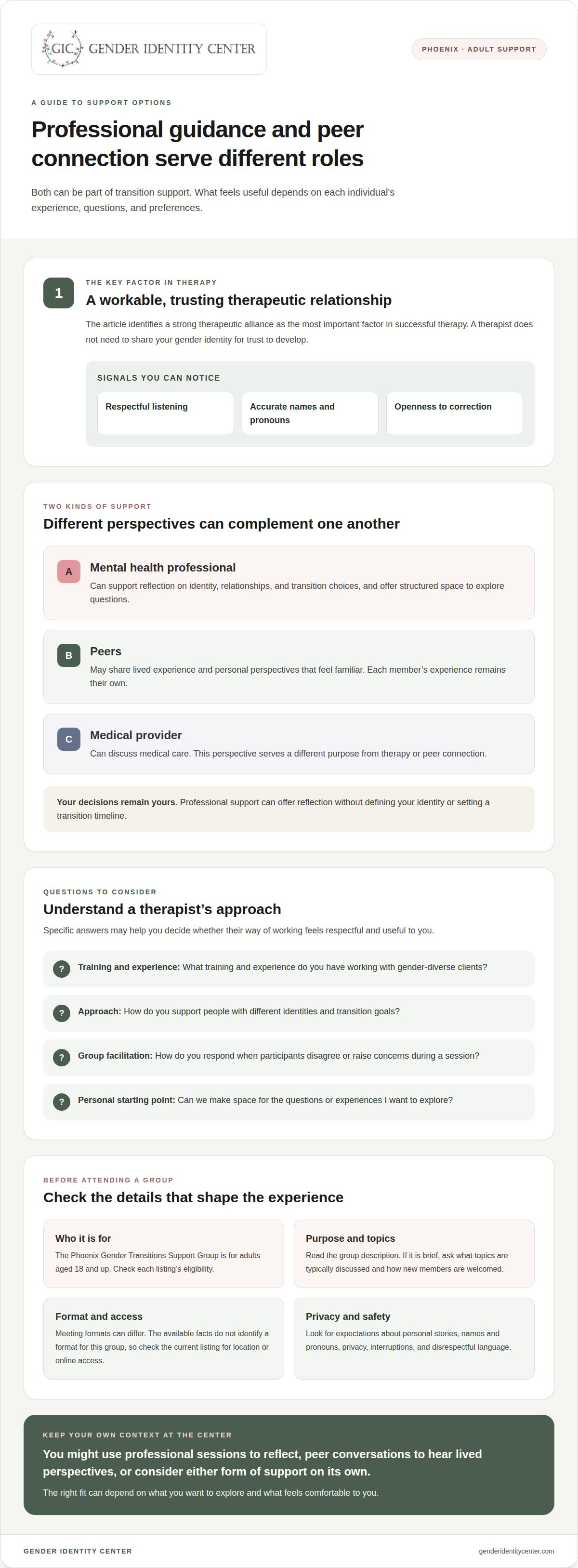
A strong therapeutic alliance is the most important factor in successful therapy, including when a therapist doesn’t share a client’s gender identity. Shared identity isn’t the only way to build trust. Respectful listening, accurate use of names and pronouns, and openness to correction can help you assess whether the relationship feels workable for you.
Before joining a group or beginning therapy, ask about the professional’s training, experience with gender-diverse clients, and approach to transgender support. You might ask how they respond when participants disagree, make space for different transition goals, and address concerns raised during a session. Specific answers can help you understand the facilitation style.
According to the Phoenix Center, transition decisions can be discussed with a mental health professional competent in transgender issues, medical providers, and other transgender people. Each perspective may serve a different purpose. A mental health professional can support reflection, a medical provider can discuss medical care, and peers can share lived experience. You remain the decision-maker.
Professional support doesn’t have to define your identity or set a transition timeline. It can offer structured space to consider what matters to you, such as whether a social change feels right or what questions you want to bring to a provider. To explore who may be a fit for that conversation, review therapist profiles.
Finding support from qualified professionals and peers
Professional guidance and peer connection can offer different kinds of support. A therapist can help you reflect on identity, relationships, or transition choices; peers may share personal perspectives that feel familiar. Neither role needs to replace the other. Consider which conversations you want with a trained professional and which you’d prefer to have with people who share lived experience.
Start by naming what you hope support will help you explore. For example, you might want space to discuss pronouns at work, uncertainty about social transition, or how to talk with family. A clear starting point can help you describe your needs to a mental health professional or decide whether a peer group’s focus feels relevant.
As you consider a therapist, ask about their training, experience with gender-diverse clients, and approach to transgender support. You can also ask how they respond to different identities and transition goals. Their answers may help you understand whether their way of working feels respectful and useful to you.
Peer groups vary in who attends and what members discuss. Before joining, read the group description for its intended audience and focus. If the listing is brief, ask about the topics typically discussed and how new members are welcomed. You can decide whether to participate, listen first, or continue looking for a better fit.
Interested in both forms of support? You might use professional sessions to prepare questions, then bring reflections from peer conversations back to therapy. Or you may prefer to begin with one setting and consider another later. The pace and combination depend on your needs, comfort, and goals; you remain in control of what you share and which support feels right.
Which Phoenix LGBTQ+ organizations offer support groups for genderfluid or nonbinary people?
One named adult peer option in Phoenix is the Gender Transitions Support Group. It serves gender-diverse adults aged 18 and up, which gives readers a specific starting point when looking for community. The Phoenix Center also provides information about gender identity and transition, but that guidance does not identify it as the group’s organizer. Keeping those roles distinct can help you understand whether you’re looking for peer meetings, information, or both.
Group details can change, so use the organizer’s current listing to understand what participation involves. Search the exact group name, then look for its intended audience, meeting format, and stated focus. For example, a listing that describes adult transition support may be more relevant than a general LGBTQ+ social event. Check the listing date and organizer name before making plans.
Genderfluid and nonbinary people may describe their identities differently, so a group’s wording matters. Read the description for language about gender-diverse participants rather than assuming every LGBTQ+ group addresses the same topics. A group may focus on peer connection, transition questions, or another shared interest. Its stated purpose can help you decide whether the conversation matches what you want right now.
Use a simple approach: identify the group name, review the organizer’s current information, and compare its audience and purpose with your needs. If a listing leaves you unsure whether genderfluid or nonbinary participants are included, use its listed contact method to ask about the group’s focus. You can also consider whether you prefer peer discussion, professionally facilitated group support, or individual conversations. These are different settings, and your choice can depend on what you hope to explore.
Gender Identity Center: Individual Therapy
Gender Identity Center offers Individual Therapy for people who want a private space to explore identity, relationships, or transition questions. You might consider it if group conversations feel helpful but you also want time focused on your own goals and experiences. Sessions can center what matters to you, without assuming that every genderfluid person follows the same path.
Depending on what kind of support feels useful, Family Therapy or Group Therapy may also provide space for shared conversations. You can explore these options as part of your support plan, at a pace that feels comfortable.
Contact Gender Identity Center to discuss whether Individual Therapy may fit what you’re looking for.
Take the Next Step at Your Own Pace
Choosing support doesn’t mean you need to have every question answered first. You can begin with one small intention, such as finding space to speak openly, exploring what you want from a genderfluid support group in Phoenix, or deciding what you’d like to discuss privately. Let your needs guide the next step, and give yourself room to adjust as they change.
If you’d like support shaped around your own experiences, Gender Identity Center offers Individual Therapy, Family Therapy, and Group Therapy in Phoenix and Tucson, with telehealth for clients located in Arizona. You can reach out to discuss the kind of support you’re seeking and whether it feels like a good fit for this part of your journey.
Contact Gender Identity Center when you’re ready to explore your options. You deserve space to move forward in a way that feels true to you.
Frequently Asked Questions
Are there genderfluid support groups in Phoenix, Arizona?
Yes. Phoenix has a named adult option, the Gender Transitions Support Group, for gender-diverse people aged 18 and up. If you’re genderfluid or nonbinary, review the group’s stated audience and discussion focus to see whether its peer setting aligns with what you want. A general LGBTQ+ gathering may offer social connection, while a transition-focused group may center identity-related experiences.
What are the meeting locations and schedules for genderfluid support groups in Phoenix?
Use the organizer’s latest event notice for the meeting address and time, rather than assuming one permanent venue or schedule. Before setting out, note the event date, location, start time, and arrival instructions. If an event is online, follow its posted access steps. When multiple notices appear, rely on the one that corresponds to the upcoming meeting.
Are genderfluid support groups in Phoenix free, and are donations required?
Whether attendance is free, donation-based, or fee-based depends on the organization hosting each group. Look for an explicit cost or donation note in the event’s registration information. Don’t assume a donation is required simply because contributions are mentioned. If payment details aren’t included, use the organizer’s listed contact route to clarify before deciding whether to attend.
Who can attend Phoenix genderfluid support groups, and are there age or residency requirements?
The named Phoenix adult group is intended for gender-diverse people aged 18 and older. That age criterion identifies the group as an adult setting; it doesn’t establish a requirement to live within Phoenix city limits. If you live elsewhere in the Valley or plan to travel into Phoenix, review the event’s eligibility details for any geographic limits separately from its age requirement.
How do I join or register for a genderfluid support group in Phoenix?
Start with the exact name, Gender Transitions Support Group, and find the organizer’s current event or group listing. Follow any posted RSVP or registration steps, and note attendance instructions. If the listing gives no sign-up route, use the organizer’s listed contact channel to ask whether advance registration is needed. You can decide what personal information feels comfortable to share.