
Help for Agender Individuals in Tucson and Their Families
Being agender doesn’t come with one required path to support. Help for agender individuals in Tucson may be useful whether you’re exploring your identity, seeking affirming care, or hoping your family can better understand you. The support that feels right depends on your experience.
You deserve to be met with respect, without pressure to explain or define yourself in a particular way. If you’re wondering who affirming support can serve or how to find care that fits your needs, knowing what to expect and which questions to ask can help.
This article explores who may seek support, what to discuss with a gender-affirming therapist, and how family education and advocacy can fit in. It also considers how mental health care may coordinate with medical providers, while leaving you room to choose the pace and type of support that feel right.
Key Takeaways
- Consider what helps you feel respected and understood when exploring gender-affirming therapy, and use those priorities to guide your questions.
- Family support can take different forms; education and advocacy may help loved ones find ways to offer support that fit your needs.
- Think through practical details such as location and hours as part of finding a care arrangement that works for you.
- Clear communication between mental health and medical providers can help care reflect your goals and personal circumstances.
Questions to ask when choosing a gender-affirming therapist
Ask how a therapist supports agender, nonbinary, transgender, and queer people without assuming everyone wants the same outcomes. You might ask how they use your name and pronouns, respond to identity-related concerns, and help sessions feel supportive. Their answers can help you decide whether their approach feels respectful and welcoming.
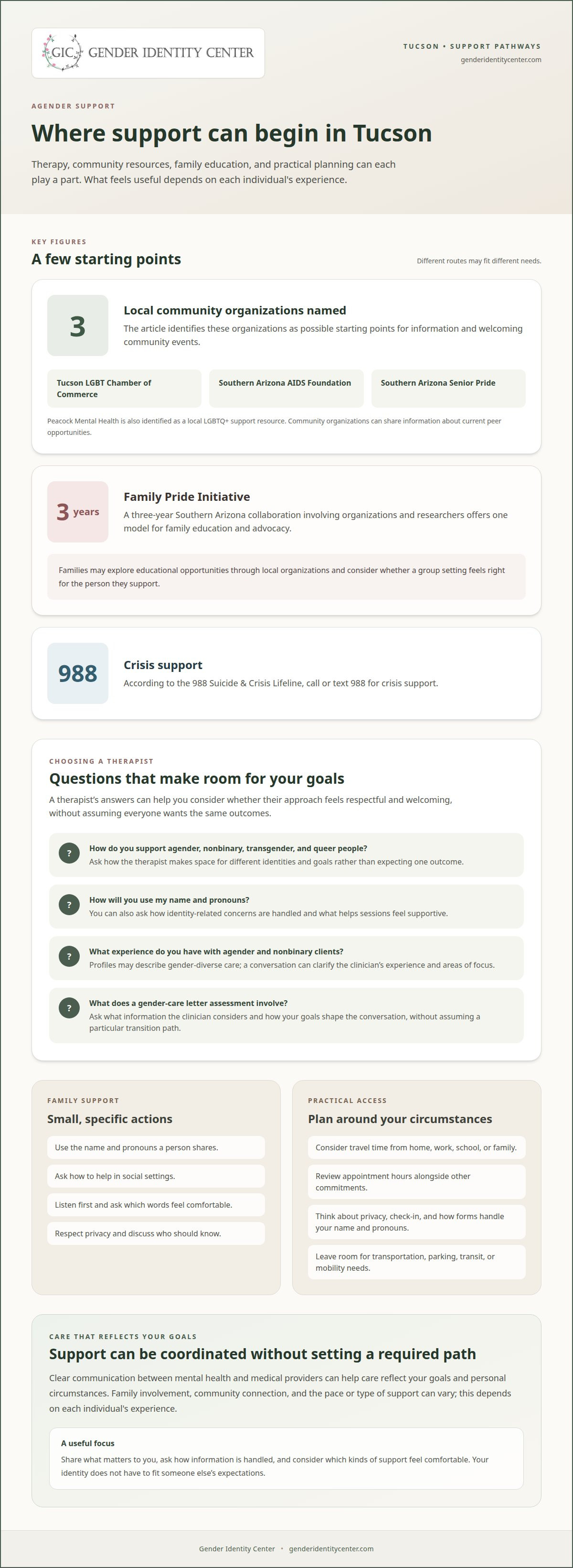
For help for agender individuals in Tucson, local LGBTQ+ resources include Tucson LGBT Chamber of Commerce, Southern Arizona AIDS Foundation, and Southern Arizona Senior Pride. Peacock Mental Health is also identified as a local LGBTQ+ support resource. Community organizations can share information about current peer opportunities. Whether a group or meetup feels right depends on your preferences.
To explore therapists’ experience with agender and nonbinary clients, look for profiles that discuss gender-diverse care. Then ask about their experience and how they make space for different identities and goals. The therapist profiles can help you review clinicians’ areas of focus.
For gender-care letter assessments, ask what the assessment involves, what information the clinician considers, and how your goals shape the conversation. This can help you understand whether the process makes room for your circumstances without assuming a particular transition path.
Gender-affirming music education is separate from therapy. In lessons or ensembles, inclusive practices might include respecting names and pronouns, offering repertoire choices, and discussing vocal goals without assumptions. The right approach depends on the learner’s experience.
Tucson community organizations, including the LGBT Chamber, Southern Arizona AIDS Foundation, and Southern Arizona Senior Pride, can be starting points for finding welcoming events. For legal aid with name or gender-marker changes, seek guidance relevant to the document involved. Arizona identity documents may have different update processes, so identify the document and consult the issuing agency’s instructions.
For crisis support, according to the 988 Suicide & Crisis Lifeline, call or text 988. For financial assistance with gender-affirming care, contact the organization coordinating that care to ask about available support and eligibility.
Family support, education, and advocacy
Family support can begin with small, specific actions. A parent might use the name and pronouns a person shares, then ask how to help in social settings. A sibling could speak up when relatives make incorrect assumptions, if that feels welcome. These steps leave room for changing needs and different family relationships.
Education can help relatives distinguish gender identity from sexual orientation. An agender person may identify as lesbian, queer, straight, or use another description; one does not determine the other. Families can listen first, avoid treating one person’s experience as universal, and ask which words feel comfortable. A shared conversation can focus on practical support, such as respecting privacy or discussing who should know.
In Southern Arizona, the Family Pride Initiative is a three-year collaboration involving organizations and researchers. Its model shows one way family education and advocacy can bring community groups and research partners together. Families can contact local organizations to learn about educational opportunities and consider whether a group setting feels right for the person they support.
Therapy can provide a structured place to discuss family communication, social pressures, or uncertainty about how to show support. For example, relatives might bring a specific disagreement about names, family gatherings, or disclosure to a session. The person whose identity is being discussed should have room to set boundaries and decide what participation feels comfortable. Family involvement can reflect those preferences.
Advocacy may also mean making everyday spaces more respectful. A family member could ask a school, workplace, or community group to use someone’s stated name, or help plan how to handle an upcoming gathering. If shared support feels like a useful next step, you can explore scheduling options and consider what kind of conversation would feel supportive.
Clinic location and hours
In Tucson, Arizona, location and appointment hours can affect whether care fits your daily routine. Consider travel time from home, work, school, or a family member’s address. A midday appointment, for example, may take different planning than one before work. Your schedule depends on your circumstances, transportation, and other responsibilities.
Before an appointment, review the location details provided during scheduling and plan a route that works for you. A map can help estimate travel time, while a calendar reminder can leave room for parking, transit, or mobility needs. If someone is accompanying you, agree on a meeting point and arrival plan. These practical steps can make getting to a mental health appointment feel more manageable.
The environment matters, too. For someone discussing gender identity, a welcoming LGBTQIA setting may include respectful communication and privacy at check-in. You might notice whether forms make room for your name and pronouns, or whether staff explain how personal information is handled. These details can shape how comfortable and respected you feel, though preferences differ.
Clinic hours also affect how care fits around school, work, caregiving, or other appointments. If you have a recurring commitment, review your calendar before choosing a session time. For example, someone coordinating care with a medical appointment may prefer to avoid a rushed trip across Tucson. Leaving time between commitments can make the day feel less pressured.
For agender support in Tucson, location and hours are practical parts of access, not measures of whether care is affirming. Consider what makes an appointment workable for you, including travel, privacy, timing, and the surrounding environment. A quiet arrival, a familiar route, or a time that protects work and family responsibilities may each matter. The right balance is personal.
Coordination with medical providers
Coordinated care can help connect conversations about your identity across mental health and medical settings. You might discuss with your therapist what you want a medical provider to understand, such as your name, pronouns, priorities, or concerns. The focus can stay on your goals rather than assumptions about what an agender person wants.
Before sharing information, clarify what you’re comfortable disclosing and to whom. For example, you may want a therapist to share a care summary with a clinician while keeping family or workplace details private. Agreeing on the purpose and boundaries of communication can help focus each session. You can revisit those choices as your needs change.
It may also help to clarify each provider’s role. A therapist can support reflection, emotional wellbeing, and communication; a medical provider can discuss medical questions within their role. If you’re bisexual, lesbian, or use another description alongside agender, you can choose whether those parts of your experience matter to a particular conversation. Culturally responsive care makes room for context without treating one identity as the whole story.
For an upcoming appointment, consider bringing a short list of topics you want to address. Examples include how a treatment discussion relates to your goals, what questions remain, and what support would make the conversation more comfortable. If a provider uses language that doesn’t fit, you can explain your preference or ask your therapist to help plan how to raise it. Your priorities can guide the pace.
Coordination doesn’t have to mean every provider receives every detail. You can decide what feels relevant and discuss that choice with the professionals involved. If you’d like support exploring your goals and preparing for conversations across care settings, connect about gender-focused therapy.
Gender Identity Center: Individual Therapy
Gender Identity Center offers Individual Therapy for people seeking space to explore identity, relationships, or personal goals. This support may suit you if you want to discuss questions at your own pace or find family conversations and care coordination difficult to manage alone. Your priorities can guide what you choose to discuss.
Family Therapy can offer a shared setting for relatives who want to work through communication together. Group Therapy can provide a space to connect with others, and EMDR Therapy is another available option. The most relevant approach depends on your needs and preferences; you can decide what fits your circumstances.
You don’t need to have every question settled before starting a conversation. If you’re considering Individual Therapy or another form of support, contact Gender Identity Center to discuss a possible next step.
Choose a next step that fits your life
Finding help for agender individuals in Tucson can be a gradual process, not a decision you need to make all at once. You might begin by naming what you want more of, such as space to reflect, support in a relationship, or help preparing for a conversation. Your priorities may shift as you learn what feels useful, and that’s a valid part of finding your way.
The right next step depends on your experience and what feels manageable now. You can bring questions, uncertainty, or a clear goal to an initial conversation. You don’t need a complete plan before reaching out. A supportive setting can make room for your perspective and let you decide what to explore next.
If you’d like to discuss what kind of support could fit, contact Gender Identity Center. You deserve to move forward at a pace that feels like your own.
Frequently Asked Questions
Who do you work with?
Gender Identity Center works with people of any age who identify as transgender, nonbinary, gender fluid, gender queer, or LGBTQ+, as well as people exploring gender. Families, partners, and parents may also seek support. Someone exploring their identity, for example, could attend individual therapy, while relatives may want space to discuss how to offer support. The right type of care depends on each person’s situation.
Do I need to identify as 2SLGBTQIA+ to access these services?
No specific label is needed to be exploring gender or seeking support related to that experience. Gender Identity Center’s services include people who are questioning or exploring, as well as family members and partners. You might not use a 2SLGBTQIA+ identity, or you may still be finding words that fit. You can describe what brings you to therapy in your own terms.
How can I recognize a good therapist for working with gender-diverse clients?
A therapist may be a good fit if you can speak openly and feel your perspective is taken seriously. Notice how they respond when you correct a name or pronoun, describe uncertainty, or explain that your goals differ from someone else’s. After a session, consider whether you felt heard and whether the conversation left room for your choices.
How might I inquire about a therapist’s experience working with transgender clients?
You can ask directly: “What experience do you have supporting transgender and agender clients, and how do you adapt your approach to each person?” You might also ask how they respond when a client’s goals change or family concerns arise. A clear answer should help you understand their approach without requiring you to share personal details before you feel ready.
Still Have Questions?
For questions about whether individual, family, or group therapy may suit your circumstances, contact Gender Identity Center. You can mention what you’re considering, such as exploring identity, communicating with relatives, or finding space to reflect. You don’t need to prepare a complete account of your experience before reaching out; a starting question is enough.
Where can agender youth and their families find support in Tucson?
In Tucson, families can explore youth-focused community connections such as THEM Youth Ensemble, which launched in January 2019. Whether a particular group feels comfortable depends on the young person’s needs and preferences. Families may also consider therapy as a space to discuss support at home, school, or in other relationships, with the young person’s privacy and choices kept in view.