
Insurance for Gender Therapy in Arizona: 2026 Guide

What if exploring your behavioral health benefits felt less like deciphering confusing paperwork and more like an intentional step toward self-discovery? For many people across the state, looking into insurance coverage for gender therapy arizona plans can bring up genuine anxiety about policy jargon, potential claim denials, and finding a therapist who truly honors your identity. You might already feel that seeking supportive mental health care shouldn't feel so exhausting, and that frustration is entirely valid.
In this guide, you'll discover how health plans often approach gender therapy in Arizona, clarify essential coverage questions to ask your insurer, and explore affirming care options across Phoenix, Tucson, or through telehealth. Every journey is unique, and much of this depends on each individual's experience with their specific network and personal goals. Ahead, we outline foundational behavioral health concepts so you can evaluate your choices with clarity and confidence.
Key Takeaways
- Exploring insurance coverage for gender therapy arizona plans provide often begins with understanding how general outpatient behavioral health parity principles apply to your care.
- Specific benefit structures, documentation requirements, and authorizations vary widely, as this depends on each individual's experience and unique policy terms.
- Reaching out directly to member services with targeted questions allows you to clarify office visit copays, coinsurance, and telehealth allowances.
- Flexible financial options, such as utilizing pre-tax health accounts, can help you manage out-of-pocket expenses while prioritizing your personal well-being.
- Affirming providers like Gender Identity Center provide compassionate guidance through individual therapy, group support, speech therapy, and telehealth across Phoenix and Tucson.
Understanding Insurance Coverage for Gender Therapy in Arizona
Gender therapy is a specialized form of outpatient behavioral healthcare centered on identity exploration, self-acceptance, and emotional well-being. Whether someone is seeking individual therapy, exploring family dynamics, or reflecting on their personal journey, these sessions provide a secure space for authentic growth. When looking into insurance coverage for gender therapy arizona plans offer, people frequently find a wide variety of approaches across commercial policies and public programs. Foundational resources on understanding transgender health care illustrate how mental health professionals support individuals through diverse stages of life. While many health plans recognize outpatient psychotherapy as an essential component of wellness, the degree of financial support can vary widely. Ultimately, this depends on each individual's experience with their specific carrier and policy guidelines.
The Role of Behavioral Health Parity
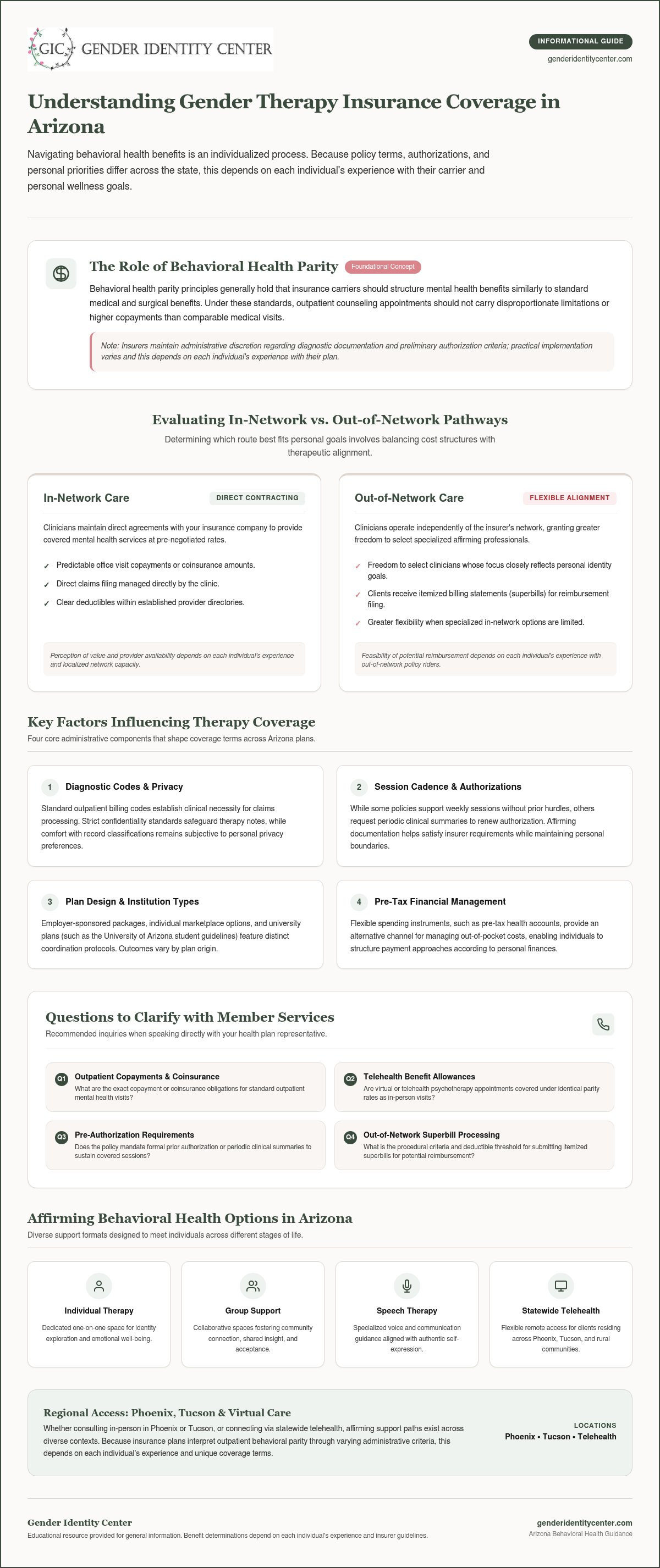
Behavioral health parity rules generally state that insurance carriers should treat mental health benefits similarly to medical and surgical benefits. Under these standards, outpatient counseling sessions should not carry disproportionate limitations, higher copayments, or stricter treatment caps than comparable medical appointments. Even with parity guidelines in place, insurers still have discretion in how they evaluate claims. Some carriers might request specific diagnostic documentation or require preliminary authorization before covering ongoing sessions. How parity standards translate into day-to-day coverage is rarely identical across different policies, and this depends on each individual's experience with their insurer's administrative criteria.
In-Network vs. Out-of-Network Considerations
Choosing between an in-network provider and an out-of-network clinician represents a balance between direct cost predictability and therapeutic alignment. Working with an in-network professional usually means paying predetermined copayments or coinsurance amounts negotiated directly by your insurer. Alternatively, seeking out-of-network care allows you the freedom to choose specialized mental health clinicians whose affirming focus closely mirrors your personal goals. In out-of-network scenarios, clients often submit itemized statements, sometimes known as superbills, to their insurance company to pursue potential reimbursement. How comfortable or advantageous either route feels is entirely subjective, shaped by your specific financial situation, provider availability, and personal comfort.
Key Factors That Influence Your Therapy Benefits
Understanding how behavioral health benefits function involves looking at several moving pieces. Benefit structures largely reflect employer package choices, individual marketplace selections, and regional plan criteria. Because of these distinct layers, insurance coverage for gender therapy arizona residents maintain can look quite different from one policy to the next. For instance, public institutional programs such as the University of Arizona's student insurance benefits outline specific coordination steps that differ from standard corporate plans. The exact scope of what an insurer approves often rests on administrative requirements, diagnostic classifications, and individualized treatment planning. Truly, this depends on each individual's experience with their coverage terms.
Diagnostic Codes and Clinical Documentation
To process claims for outpatient counseling, insurance companies generally require licensed clinicians to submit standard diagnostic billing codes. Mental health professionals provide necessary clinical summaries to establish medical necessity, while strict confidentiality laws protect your personal disclosures and session notes. How comfortable someone feels having a specific diagnostic code placed on their health record is deeply subjective, and this depends on each individual's experience and privacy preferences.
Session Frequency and Pre-Authorization Nuances
Certain health plans place parameters on the cadence or total count of covered therapy sessions. While some policies permit ongoing weekly individual therapy without preliminary hurdles, others might ask for periodic updates to continue validating coverage. Navigating these checks requires clear communication between client and provider:
- Insurers may request periodic clinical summaries to renew authorization for ongoing outpatient visits.
- Clinicians can offer affirming documentation that respects your privacy while meeting necessary administrative standards.
- Specific documentation pathways vary widely, making direct policy verification a helpful preliminary measure.
WPATH Standards and Insurance Recognition
Many insurance carriers reference guidelines established by the World Professional Association for Transgender Health when determining criteria for gender-affirming care. People preparing for next steps in their medical journeys may work with a therapist for a WPATH referral letter assessment. While these evaluations are recognized therapeutic services, how each insurer covers documentation visits remains individualized. When you feel ready to connect with experienced professionals who understand these processes, you can review scheduling options that suit your schedule.
How to Verify Your Gender-Affirming Mental Health Benefits
Looking at the back of your physical card is often the simplest place to begin. There, you'll find a dedicated member services phone number that connects you directly to policy representatives. When exploring your insurance coverage for gender therapy arizona options, entering this conversation with clear notes can turn an overwhelming phone call into an organized step forward. Keeping track of the call date, the representative's name, and a specific reference number gives you a reliable paper trail. Approaching these checks with calm patience helps you stay grounded, recognizing that personal circumstances shape every insurance conversation.
Essential Questions to Ask Member Services
Asking focused questions helps clarify how outpatient behavioral healthcare is processed under your specific plan tier. When speaking with a representative, you might consider asking:
- "What is my deductible, copayment, or coinsurance requirement for outpatient psychotherapy sessions?"
- "Does my plan require formal pre-authorization or a primary care referral prior to meeting with a specialized counselor?"
- "Are secure telehealth therapy appointments covered at the exact same benefit level as in-person office visits?"
"Taking time to verify benefits in advance helps prevent unexpected bills," allowing you to focus your energy on personal growth rather than financial friction.
Understanding Superbills and Direct Reimbursement
If you choose to work with an out-of-network clinician, you might receive a superbill after your session. A superbill is an itemized receipt that includes standard billing codes, service dates, and payments made. Many people submit these documents through their insurer's digital portal or mail them directly to pursue out-of-network benefits. Processing timelines and eligible reimbursement percentages are never uniform across insurance carriers. Truly, this depends on each individual's experience with their plan deductible and specific out-of-network allowances.
Navigating Out-of-Pocket Expenses and Alternative Care Paths
Investing in mental health is an adaptable process that can flex alongside your evolving life. While evaluating insurance coverage for gender therapy arizona plans offer, many find that out-of-pocket alternatives open doors to highly personalized care. Rather than viewing counseling expenses as rigid obligations, you might look at them as customizable investments in your ongoing well-being. Scheduling frequency can shift between weekly, bi-weekly, or monthly meetings to align with your personal pace and budget. Above all, this depends on each individual's experience and financial priorities.
Utilizing Health Savings and Flexible Spending Accounts
Many individuals utilize pre-tax benefit accounts to offset their out-of-pocket healthcare expenses. Setting aside pre-tax dollars helps manage therapy costs without straining day-to-day budgets:
- Health Savings Accounts (HSAs) and Flexible Spending Accounts (FSAs) frequently recognize licensed behavioral health counseling as qualified medical care.
- Paying with pre-tax account cards or seeking reimbursement simplifies tracking your clinical wellness expenses throughout the year.
- Eligible expense rules can vary by employer plan, making a quick confirmation with your account administrator a practical first step.
Choosing Between In-Person and Telehealth Access
Therapeutic delivery options also influence how accessible your care feels over time. Statewide telehealth services allow people residing anywhere in Arizona to connect securely with experienced practitioners right from home. This virtual model removes transportation barriers and broadens your selection of affirming counselors. Conversely, meeting inside a dedicated office provides a grounding, neutral retreat away from daily routines. Those exploring localized care can read our resource on affirming care in Phoenix to understand how physical spaces nurture connection. Whichever pathway you choose, the right environment is the one where you feel safest being yourself.
When you feel ready to design a therapeutic routine that aligns with your personal goals, you can explore available appointment times through our convenient online portal to schedule a session today.
Finding Affirming Care with Gender Identity Center
Finding a welcoming environment where you can freely express yourself is central to meaningful therapy. Gender Identity Center is designed to be a gentle, supportive home for self-discovery and personal growth. Our experienced clinicians understand that exploring identity is rarely linear. We provide specialized transgender counseling, individual therapy, and gender therapy in an environment grounded in quiet resilience and acceptance. While clarifying insurance coverage for gender therapy arizona policies provide can feel complex, having a supportive team makes the paperwork more manageable. We collaborate closely with you to supply necessary administrative documents, such as detailed superbills, so you can pursue eligible benefits with confidence. Ultimately, this depends on each individual's experience and personal goals.
Our Affirming Practice Across Phoenix and Tucson
Our team includes specialized mental health clinicians who walk alongside clients through various stages of self-realization. Whether you are exploring individual counseling, family therapy, group sessions, EMDR therapy, or speech therapy, we tailor our clinical support to your personal pace. You can connect with our affirming Arizona therapists to find a practitioner whose background resonates with your story. Both our Phoenix and Tucson offices are created as calm sanctuaries where you can pause, reflect, and unpack life's complexities without judgment. For those who prefer connecting from home, our telehealth services extend the same warm, intentional care to residents across the state.
Taking Your Next Step Toward Support
Beginning therapy should feel like an invitation rather than a chore. We have structured our intake process to honor your personal readiness, giving you complete agency over how and when we begin. Our administrative team helps streamline documentation questions, providing itemized statements for those seeking out-of-network reimbursement through their insurance coverage for gender therapy arizona plans. Whenever you feel ready to take that next step, you can explore our calendar and consider scheduling an intake to begin a collaborative partnership centered entirely on your well-being.
Embracing Your Path Toward Affirming Care
Understanding insurance coverage for gender therapy arizona options allows you to advocate for your behavioral healthcare with greater confidence. While policy terms and pre-authorization criteria differ across plans, familiarizing yourself with outpatient benefits and alternative financing tools provides a steady foundation. Whether you access care through network benefits or choose out-of-network flexibility, the ideal pathway depends on each individual's experience and personal timeline.
At Gender Identity Center, our dedicated clinicians specialize in transgender and gender-diverse mental health, offering warm guidance without judgment. Through welcoming offices in Phoenix and Tucson, alongside convenient statewide telehealth, we support your identity exploration while providing helpful assistance with superbills and WPATH-aligned clinical documentation. You don't have to decipher these details on your own. When you feel ready to take that next step, Connect with our compassionate clinicians today to begin exploring care that truly honors who you are.
Frequently Asked Questions
Can health insurance in Arizona completely deny coverage for gender therapy?
Outpatient mental health therapy is generally recognized under behavioral health parity standards, making blanket denials for counseling sessions uncommon. Even so, individual plans can establish unique clinical criteria, exclusions, or documentation guidelines that affect how claims are processed. While state and federal rules encourage fair access to outpatient mental health support, this depends on each individual's experience with their specific carrier, plan type, and regional network.
How do I know if my therapy sessions will require prior authorization?
Reviewing your plan's schedule of benefits or calling the member services number on your card is the most direct way to check. Some insurance carriers allow direct access to licensed outpatient behavioral health clinicians, while others may ask for preliminary authorization or a referral from a primary provider. Requirements vary across different employer plans and individual policies throughout Phoenix and Tucson.
What is the difference between in-network benefits and using a superbill?
In-network benefits apply negotiated rates directly, typically leaving you responsible only for a predetermined copayment or coinsurance at your visit. Using a superbill involves paying for out-of-network therapy directly and submitting an itemized receipt to your insurer for potential reimbursement. Evaluating insurance coverage for gender therapy arizona options often involves weighing network convenience against the specialized focus of an out-of-network provider.
Can I use an HSA or FSA card to pay for gender-affirming counseling?
Pre-tax accounts like Health Savings Accounts and Flexible Spending Accounts typically recognize licensed mental health visits as qualified medical expenses. You can often use these funds to cover copayments, session fees, or specialized family and individual therapy. Because eligible expense determinations can occasionally differ among third-party account administrators, checking your account guidelines beforehand is a practical step.
Does insurance cover WPATH assessment sessions for referral letters?
Insurance carriers frequently cover clinical assessment sessions under standard behavioral health diagnostic and therapy codes. Clinicians utilize these consultations to explore your goals and provide supportive documentation aligned with established standards of care. Whether your carrier covers the entire evaluation or requests additional diagnostic notes depends on each individual's experience with their specific policy terms.
Is virtual or telehealth gender therapy covered the same as in-person visits in Arizona?
Most commercial and public plans in Arizona provide parity for virtual behavioral healthcare, reimbursing telehealth sessions similarly to in-person office visits. This flexible format allows clients across Tucson, Phoenix, and surrounding communities to connect with affirming clinicians from home. Checking whether your insurer mandates specific telehealth software or network platforms helps ensure seamless claim processing.
What steps can I take if my health plan denies a mental health claim?
Requesting an itemized explanation of benefits is the first step toward clarifying why a denial occurred. Many administrative issues stem from simple billing discrepancies, diagnostic code updates, or missing pre-authorizations. Navigating insurance coverage for gender therapy arizona disputes often involves submitting a formal appeal with supportive clinical documentation, though the outcome depends on each individual's experience with their insurer's review process.