
Self-Care During Transition: A 2026 Well-Being Guide

What if the most vital part of your journey isn't the milestones you reach, but the grace you extend to yourself along the way? Transitioning is a deeply personal evolution, and there's no single right way to move through it. Understanding how to practice self-care during transition often means moving away from rigid checklists and toward a rhythm that honors your specific needs. This depends on each individual's experience, as the emotional weight of social shifts or medical wait times can feel different for everyone.
We recognize that the exhaustion from social transitions and the anxiety surrounding healthcare can feel overwhelming, especially when general resources don't quite see the whole you. In this guide, we'll explore a flexible, empathetic framework designed to nurture your mental and emotional health through every unique stage of your path. You'll discover actionable strategies to sustain your resilience and learn how specialized professional support can act as a steady, guiding hand when the road feels steep. This process is rarely linear, and we're here to help you explore what feels most affirming for your current reality.
Key Takeaways
- Understand that self-care is an evolving, personal practice where the most helpful strategies often depend on each individual's experience and current needs.
- Learn how to practice self-care during transition by creating a flexible framework that honors your emotional well-being alongside physical changes.
- Discover how specialized resources, including WPATH referral letters and gender counseling, can help ease the logistical weight of your journey.
- Explore the value of finding a secure environment and community support to help you navigate the social aspects of your transition with resilience.
- Consider how professional therapy can act as a steady, guiding hand while you explore the nuances of your own self-realization.
What Does Self-Care Mean During a Gender Transition?
Self-care is often described as a set of simple habits like getting enough sleep or eating well. While these are foundational, they don't always capture the unique cognitive and emotional load that comes with a gender transition. For many, self-care is an evolving, active practice of prioritizing your authentic self while you manage the complexities of social and medical changes. It's a way to protect your energy as you move through a world that may not always reflect who you are back to you. Understanding how to practice self-care during transition involves recognizing that your needs will shift as you progress, and that's perfectly okay.
This depends on each individual's experience. For some, self-care might mean setting firm boundaries with family; for others, it could be finding a quiet space to process the day's interactions. Because your journey is your own, there's no objective standard for what "good" self-care looks like. It is a subjective, day-to-day commitment to your own well-being that honors where you are in this moment.
The Subjective Nature of Your Journey
Transitioning is rarely a linear path. It's a deeply personal evolution that can feel like a series of peaks and valleys rather than a straight line from point A to point B. Because of this, "one-size-fits-all" wellness advice can often feel inadequate or even dismissive of the specific hurdles you face. You may find it helpful to view a comprehensive overview of gender transition to see the many legal, social, and medical layers involved, each of which requires its own kind of emotional support.
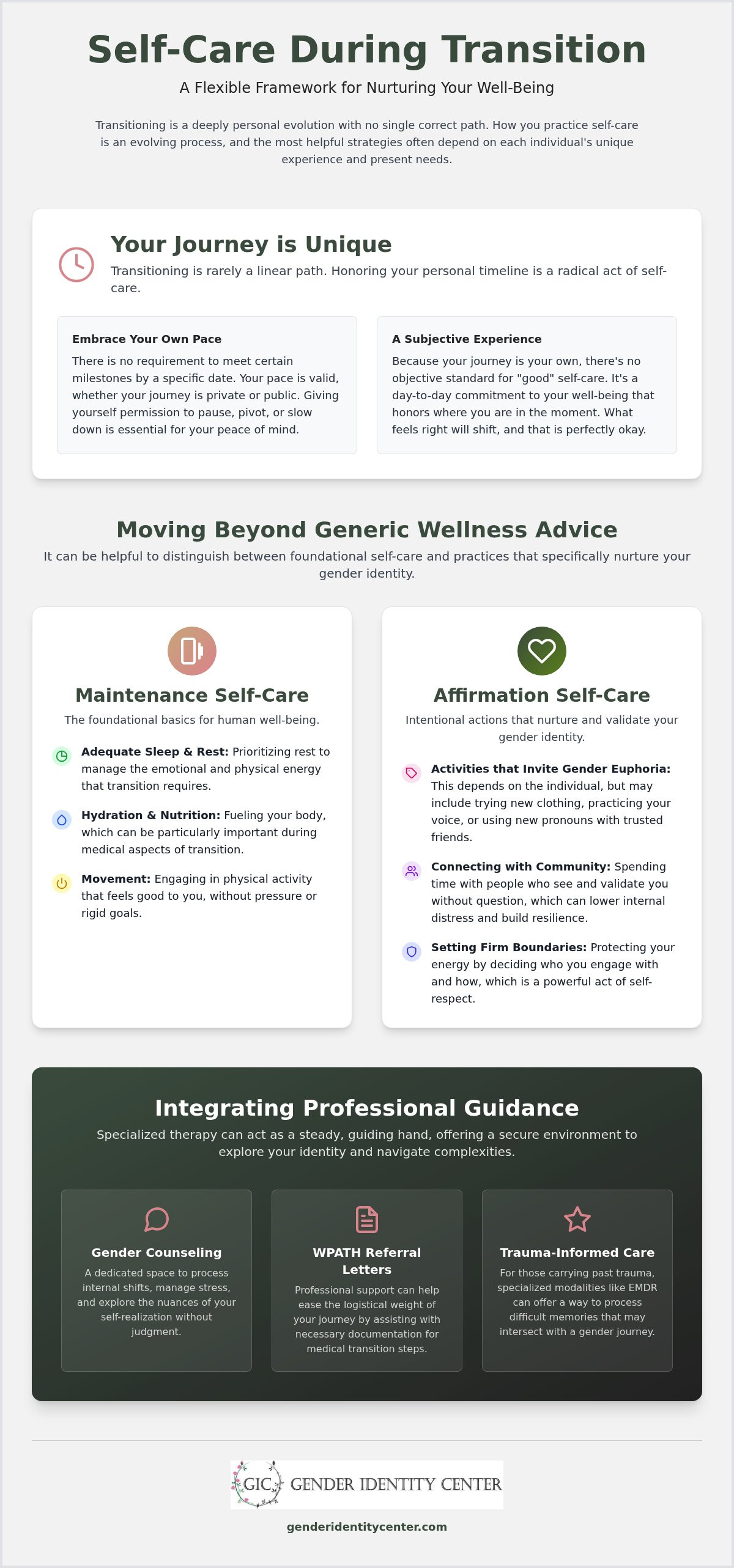
Honoring your own timeline is a radical act of self-care. There's no requirement to meet certain milestones by a specific date. Whether you're exploring your identity privately or moving through public changes, your pace is valid. Learning how to practice self-care during transition means giving yourself permission to pause, pivot, or slow down whenever it feels necessary for your peace of mind.
Moving Beyond Generic Wellness Advice
It's helpful to distinguish between "maintenance" self-care and "affirmation" self-care. Maintenance involves the basics of human survival, like hydration and rest. Affirmation self-care, however, is the intentional work of nurturing your gender identity. This might involve activities that invite gender euphoria, such as trying new clothing, practicing your voice, or spending time with people who see and validate you without question.
Affirmation self-care is a powerful tool to help manage gender dysphoria. This depends on each individual's experience, but many find that identifying specific actions that make them feel seen can lower the volume of internal distress. We invite you to consider what activities feel most grounding for you. Is it a specific hobby, a certain type of community connection, or even seeking spiritual insight through a psychic full life reading? Identifying these anchors can turn self-care from a chore into a sustainable long-term strategy for your resilience.
Nurturing Your Mental and Emotional Well-Being
Transitioning involves a profound psychological recalibration that often mirrors the visible changes in your life. While external milestones are significant, the internal work of aligning your identity with your lived experience is equally vital. Understanding how to practice self-care during transition involves creating a dedicated space to process these shifts without judgment. This depends on each individual's experience, as some may find the emotional landscape of transition brings up past challenges that require specific attention. For many, engaging in gender identity therapy in Phoenix offers a secure environment to explore these internal movements with a steady, guiding hand.
Radical acceptance can be a supportive tool during this time. It involves acknowledging your current feelings and circumstances without the pressure of immediate resolution. This approach doesn't mean you must like every situation, but rather that you accept the reality of the moment to reduce internal conflict. For those who carry the weight of past trauma, specialized modalities like EMDR therapy may offer a way to process difficult memories that intersect with your gender journey. Research has shown that aligning your life with your authentic self is linked to positive mental health outcomes, and prioritizing your emotional health is a key part of reaching that sense of peace.
Managing Transition-Related Stress and Anxiety
Common stressors, such as the logistics of coming out or the anticipation of medical appointments, can create a heavy cognitive load. Mindfulness techniques, such as grounding exercises that focus on your immediate physical surroundings, can help anchor you when anxiety feels high. These practices are not about fixing everything at once but about finding a moment of stability. This depends on each individual's experience, as emotional resilience is a subjective quality that grows through personal context and the strength of your support network.
The Role of Affirming Mental Health Support
A specialized therapist does more than offer general advice; they act as a compassionate advocate who understands the nuances of identity. Group therapy can also be a meaningful resource, helping to reduce the isolation that sometimes accompanies social shifts by connecting you with others on a similar path. Seeking professional guidance is not a sign of weakness but a proactive act of self-preservation. If you're looking for a partnership in this process, you might consider scheduling a conversation to see what support feels right for you.
Practical Self-Care for Social and Physical Shifts
While the internal work of self-discovery is foundational, the physical and social aspects of your journey often require their own set of intentional practices. Physical changes, whether subtle or significant, can be a source of both excitement and vulnerability. Integrating these shifts into your daily routine is a meaningful way to honor your body's evolution. Understanding how to practice self-care during transition involves recognizing that your relationship with your physical self is a dynamic process. It's helpful to explore how identity, hormones, and healthcare intersect with your daily well-being, as these elements often shape your comfort and energy levels.
Social transition, which involves sharing your authentic self with the world, can be equally demanding on your emotional reserves. Practical acts of self-care in this area might include:
- Experimenting with new names or pronouns in safe, trusted circles.
- Curating your social media environment to prioritize affirming content.
- Practicing "mirror work" to acknowledge and celebrate the changes you see.
- Setting clear boundaries regarding which parts of your journey are public and which are private.
Patience is a vital component of this process. Physical changes take time to manifest, and your body's timeline is uniquely its own. You might find it useful to review self-care tips for gender-affirming care to help manage the expectations and logistical steps involved in medical milestones. This depends on each individual's experience, as some may feel a sense of urgency while others prefer a more gradual pace.
Exploring Voice and Expression with Compassion
For many, the voice is a primary tool for self-expression and a common source of social dysphoria. Specialized speech therapy can be a powerful form of self-care, providing you with the skills to align your vocal resonance with your identity. This isn't about meeting a specific standard, but about finding a voice that feels like home. Progress in expression depends on each individual's goals and comfort level, and we invite you to explore this at a pace that feels sustainable for you.
Setting Boundaries During Social Transition
Deciding who to share your journey with, and when, is an act of self-preservation. You aren't obligated to explain your identity to everyone you meet. Energy management is key here; some days you may have the capacity to navigate name changes and pronouns in various social circles, while other days you might need to prioritize your privacy. Learning how to practice self-care during transition means recognizing that you are the expert on your own safety and social needs. Your right to privacy is a boundary that deserves respect, and choosing where to invest your emotional energy is a sign of quiet resilience.
Cultivating a Supportive Environment in Arizona
Creating a secure environment is more than just a matter of convenience; it's a fundamental part of your well-being. When you're considering how to practice self-care during transition, the spaces you inhabit and the people you surround yourself with play a significant role. In Arizona, where an estimated 41,200 people identify as transgender, finding places where your identity is celebrated can provide a necessary buffer against shifting social climates. Following the veto of SB 1095 on June 19, 2026, many in our community have found renewed strength in local advocacy and connection. This depends on each individual's experience, as what feels like a safe harbor for one person might feel different for another.
Logistical self-care is a key component of building a stable foundation. Navigating the requirements for medical steps can be taxing, especially as legal landscapes remain fluid. Having access to WPATH referral letters in Arizona is a valuable resource that can reduce the administrative weight of your journey. These letters act as a bridge to affirming care, protecting your agency and future peace of mind. Community support may look different for everyone, ranging from digital spaces to local meetups, and we encourage you to explore the connection style that honors your current needs.
Finding Community in Phoenix and Tucson
For those living in Phoenix or Tucson, the availability of local resources provides a unique opportunity to build a sense of belonging. Engaging with others who share lived experiences can be a powerful way to exchange resources and find mutual validation. Whether it's a structured support group or an informal gathering, these connections remind you that you aren't navigating this path alone. This process of community building is a dynamic way to share the resilience you've cultivated with others while discovering new ways to thrive.
Navigating Relationships and Family Dynamics
Relationships often undergo their own transition when you share your authentic self. Family therapy can be a helpful tool for some, providing a facilitated space to communicate needs and boundaries with loved ones in a way that prioritizes emotional safety. It's important to remember that the level of family involvement depends on each individual's experience and their personal sense of security. You have the right to decide who walks alongside you during this journey. If you're looking for a professional partnership to help navigate these dynamics, we invite you to reach out for an affirming consultation to explore what support feels right for you.
Integrating Professional Guidance into Your Self-Care Plan
Professional support can be a foundational pillar of your well-being. While general counseling often focuses on broad life stressors, specialized gender therapy centers your identity as the core of the work. It provides a space where you don't have to explain the basics of your experience; instead, you can dive straight into the nuances of your personal growth. Understanding how to practice self-care during transition often includes recognizing when an outside perspective can help lighten the emotional load. Connecting with qualified therapists who understand these complexities ensures that your support system is as resilient as you are. This type of guidance acts as a steady hand, helping you integrate your internal shifts with the external changes in your life.
When to Seek Specialized Gender Counseling
The decision to seek professional help is a personal one, and the right time to start depends on each individual's experience. You might find it beneficial if you're navigating persistent gender dysphoria or if social anxiety is beginning to impact your daily life. A specialized therapist also plays a vital role in helping you understand and navigate the complexities of WPATH standards, which can feel heavy when you're managing them alone. Whether you're looking for a one-time consultation or ongoing support, this partnership is designed to honor your agency and expertise over your own life. If you're ready to explore this path, online scheduling offers a discreet and straightforward way to begin.
Creating a Sustainable Support System
A sustainable plan for well-being usually combines professional guidance with your own personal self-care routines. It isn't a rigid structure; it's a living strategy that evolves as you do. We suggest checking in with yourself regularly to evaluate what's working and what might need to shift. This depends on each individual's experience, as some may find that their needs change significantly after medical milestones or social shifts. To explore how functional medicine experts support hormonal health and vitality through life's many stages, you can visit Living Well Dallas for additional insights. Regular reflection helps you stay aligned with your goals and ensures that your self-care remains a source of nourishment rather than another task on your to-do list.
Learning how to practice self-care during transition is an ongoing commitment to your own growth and happiness. It's about building a bridge between your current reality and your future self with patience and grace. By integrating professional support into your life, you aren't just managing stress; you're investing in the long-term vitality of your authentic self. This journey is yours to lead. Having a wise, patient mentor by your side can make the path feel much more navigable and less isolating. You deserve to be seen and supported throughout every stage of your evolution.
Honoring Your Path Forward
Self-care is a dynamic commitment to your own self-realization. It involves recognizing that your needs today might differ from your needs tomorrow. This depends on each individual's experience, as the rhythm of your evolution is uniquely yours. We've explored how a flexible framework helps you manage the cognitive load of social and medical shifts. By prioritizing your emotional health, you create a sustainable foundation for the years ahead. Learning how to practice self-care during transition means trusting your own timing and seeking environments where you feel truly acknowledged.
We're here to act as a steady, guiding hand. Whether you need WPATH-compliant assessments, specialized voice and speech therapy, or safe, telehealth-enabled care across Arizona, our team is ready to support your well-being. We invite you to schedule a session with an affirming therapist today to explore what feels most helpful for your current journey. You are the expert on your own life, and we're honored to walk alongside you as you move toward your future self.
Frequently Asked Questions
What are some quick self-care activities I can do when feeling gender dysphoria?
Grounding exercises and gender-affirming rituals are effective ways to manage sudden feelings of dysphoria. This might include the 5-4-3-2-1 technique to anchor yourself in the present or wearing a favorite accessory that aligns with your identity. This depends on each individual's experience, as some find comfort in physical sensations while others prefer quiet reflection. Identifying what centers you in your body can be a helpful way to navigate immediate distress.
How can therapy help me with the social aspects of my transition?
Therapy provides a secure environment to practice social interactions and develop boundaries for coming out to friends or colleagues. It offers a dedicated space to process the emotional impact of being misgendered or navigating public spaces for the first time. This depends on each individual's experience, but many find that having a professional to discuss these social shifts with helps build resilience and clarity during periods of uncertainty.
Is self-care different for non-binary people compared to binary trans people?
Self-care is a subjective practice that often looks different for everyone, regardless of whether they identify as non-binary or binary trans. For non-binary individuals, self-care might involve navigating a world that often operates on a strict gender binary and finding ways to validate their identity outside of those norms. Understanding how to practice self-care during transition means honoring your specific identity and the unique challenges it may bring to your daily life.
How do I know if I need a specialized gender therapist or just a regular one?
Choosing a specialized gender therapist is often helpful when you want a provider who understands the nuances of identity and WPATH standards without needing extra explanation. While a general therapist can offer support, a specialist centers your gender journey and understands the specific stressors associated with it. This depends on each individual's experience and whether they feel their current needs require a deeper level of specialized expertise to move forward.
Can speech therapy really be considered a form of self-care?
Speech therapy is often a significant act of self-care because it helps align your vocal expression with your internal identity. By working on vocal resonance and inflection, you can reduce social dysphoria and feel more confident in your daily interactions. This depends on each individual's experience, but many view voice work as a proactive step toward feeling more seen and acknowledged by the world in a way that feels authentic.
What if I don't have a supportive family or community in Arizona?
Seeking out telehealth services or online communities can be a helpful strategy when local support feels limited. Professional counseling can also serve as a vital anchor, providing a secure environment where you are fully seen and respected. This depends on each individual's experience, and we encourage you to seek out digital or professional spaces that prioritize your safety and validation even when your immediate surroundings don't yet feel supportive.
How much time should I dedicate to self-care during my transition?
There is no set amount of time required for self-care; instead, it's about integrating small, affirming practices into your life whenever they feel necessary. Some days might require more intentional rest, while others may only need a few moments of grounding. This depends on each individual's experience and the current emotional or physical load they are carrying. Learning how to practice self-care during transition is about listening to your own needs and responding with compassion.