
Support Groups for Parents of Trans Youth in Tucson

Support can begin with a place to talk, learn, and consider what your child needs. For parents seeking a support group for parents of trans youth in Tucson, the Parent Support Program helps parents and caregivers process feelings about their child’s gender, understand related terms and concepts, and practice ways to support their child. Each family’s experience is different, and finding the right kind of support can take time.
You may be looking for practical information as well as a welcoming space to ask questions without judgment. This guide covers membership and age requirements, transgender support groups in Arizona, and Tucson resources for transgender and LGBTQ+ families.
As you explore the options, you can learn what different programs are designed to offer and which may suit your family. Start by identifying what kind of support you’re looking for, then consider what feels comfortable.
Key Takeaways
- Consider whether a parent-focused group or broader LGBTQ+ support would feel like the most comfortable starting point for your family.
- Membership and age requirements can vary between programs, so the group’s intended participants matter when exploring options.
- Arizona offers different kinds of transgender support, including a Parent Support Program centered on helping caregivers understand and support their child.
- Explore Tucson listings with your family’s needs in mind; financial need may also be relevant to the Zak Ricci Memorial Mutual Aid Grant.
Age and membership requirements
To join a Tucson LGBTQ family support group, follow the enrollment steps set by that program. Requirements vary: some groups hold open meetings, while others ask parents or caregivers to register before attending.
Age rules may refer to the young person, the participating adult, or both. Check each listing for its stated age range and intended participants. A group for parents and caregivers, for example, may differ from one designed for transgender or nonbinary youth. Don’t assume your child must attend a parent-focused group.
Membership may also depend on your relationship to the young person. A listing might specify parents, guardians, foster caregivers, or other family members. If you’re a caregiver rather than a parent, look for wording that includes caregivers, and check whether the group’s focus fits your role and family’s needs.
The Parent Support Program is based on research about parenting behaviors that support the health and well-being of trans and nonbinary youth. It helps parents and caregivers process feelings about their child’s gender, learn related terminology and concepts, and practice ways to support their child. These aims can help you decide whether a parent-focused program fits what you hope to explore.
Financial circumstances may matter, too. The Zak Ricci Memorial Mutual Aid Grant lets individuals in financial need request resources to support their children. Consider it separately from group membership, age, or registration requirements.
Before choosing a support group for parents of trans youth in Tucson, compare its age range, intended participants, and enrollment process. Matching those details to your family’s situation can make the first step more manageable.
Transgender support groups in Arizona
Across Arizona, support ranges from parent and caregiver groups to groups focused on transgender people themselves. The Parent Support Program is based on research about parenting behaviors that support the health and well-being of trans and nonbinary youth. It focuses on caregivers’ understanding and support, rather than serving as a general discussion group for all LGBTQ+ participants.
That distinction can help you decide what kind of community to seek. A parent-focused group may make room for family communication and caregivers’ questions, while a group for transgender youth may center young people’s experiences. Listings may also differ in whether they offer peer connection, guided discussion, or education. Start by checking the stated audience and purpose.
Confidentiality and safety practices depend on each group’s guidelines; there is no single policy shared by all Arizona groups. Before sharing identifying details, review the facilitator’s privacy expectations and safety practices.
The Parent Support Program may suit caregivers looking for space to process feelings about their child’s gender, learn terminology and concepts, and practice supportive approaches. People’s needs differ: a caregiver seeking language for conversations at home may value the learning focus, while someone seeking peer connection may prefer a group centered on shared discussion.
Financial access may also shape a family’s choices. The Zak Ricci Memorial Mutual Aid Grant lets individuals in financial need request resources to support their children. It is separate from a group’s membership rules and discussion format. When comparing Arizona programs, note the intended participants, purpose, and privacy expectations to narrow your search to relevant support.
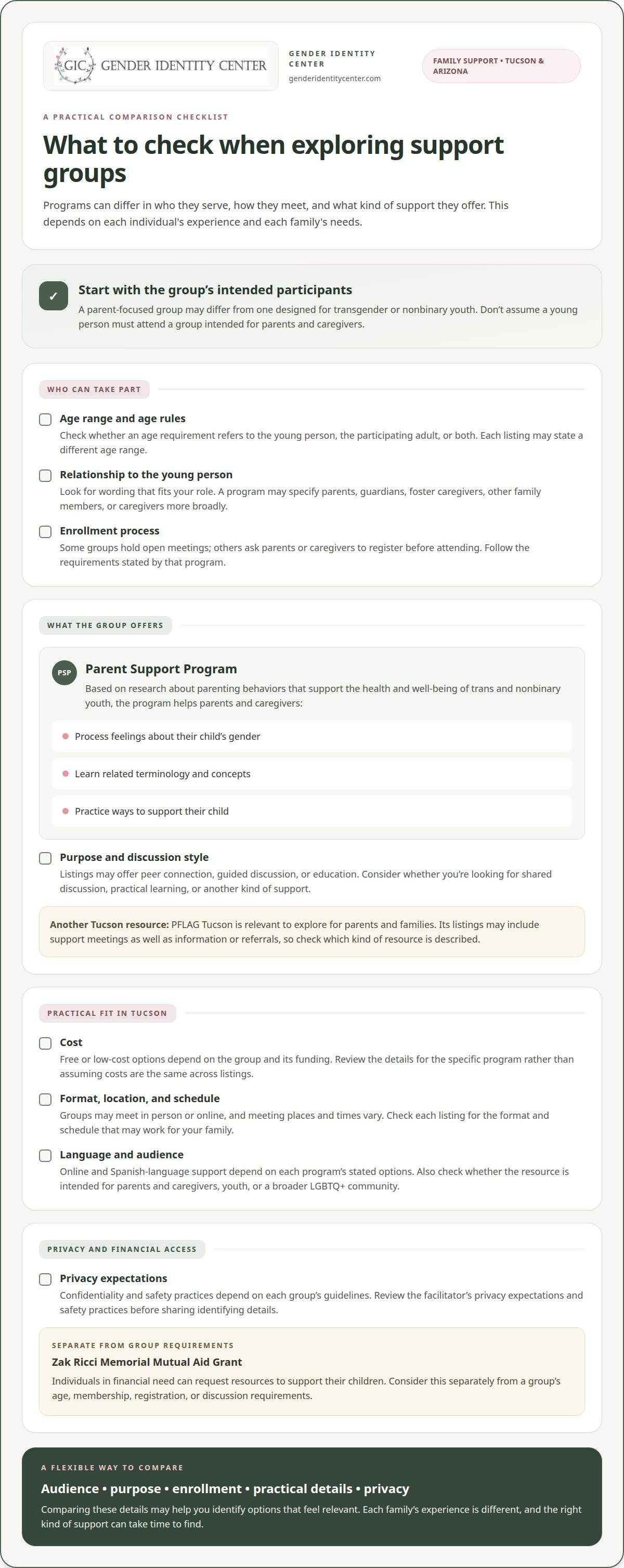
Tucson transgender and LGBTQ+ support listings
Tucson listings can differ in cost, format, language, and audience. Compare these details to find a resource that suits your family’s needs.
Group Availability and Cost
Free or low-cost options depend on each Tucson group and its funding. A listing might describe a peer support meeting, an educational program, or counseling, each with a different format and cost. Check the intended audience and purpose, too: a parent group is not necessarily the same as a group for transgender youth.
PFLAG Tucson is a relevant resource to explore for parents and families. When reviewing its listings, distinguish support meetings from other resources, such as information or referrals. The format matters: your family may be looking for shared discussion, practical learning, or another kind of support.
Meeting Locations and Times
Meeting places and schedules vary among Tucson groups. Listings may describe in-person or online gatherings, but no single location or schedule applies to every program. A parent-focused meeting and a broader LGBTQ+ event, for example, may serve different audiences.
Use each listing’s details to find a format, location, and schedule that work for your family. Online and Spanish-language support also depend on each program’s stated options, so check the listing before choosing.
For crisis or counseling support, distinguish immediate safety needs from ongoing care. In an immediate emergency, contact local emergency services. For non-emergency concerns, counseling provides a setting to discuss family questions and support needs. The Parent Support Program helps caregivers process feelings about their child’s gender, learn related terminology and concepts, and practice supportive approaches.
When comparing Tucson resources, consider the group’s audience, cost, format, language, and purpose. PFLAG Tucson and the Parent Support Program offer different kinds of family support, so the right fit depends on what you’re seeking. These details can help you choose a manageable next step.
What support groups for parents of transgender youth are available in Tucson, Arizona?
The Parent Support Program is an option for parents and caregivers of trans and nonbinary youth. It focuses on helping caregivers understand their feelings and find ways to support their child. For Tucson families considering parent-centered support, that focus offers a useful starting point.
The program helps parents and caregivers process feelings about their child’s gender, learn related terminology and concepts, and practice ways to support their child. Caregivers may have different goals: one might want language for family conversations, while another wants to reflect on their own response. The program centers on caregivers and their relationship with the young person.
A parent support program is distinct from a group intended for youth. A caregiver looking to discuss parenting questions may prefer a parent-focused setting, while a young person seeking peer connection has a different goal. Matching the group’s intended audience to the person attending can make the choice clearer.
As you consider the Parent Support Program, identify what kind of support matters most to your family. You might want to understand gender-related terms, process feelings, or consider supportive responses at home. The program’s stated focus can help caregivers decide whether its approach aligns with those goals.
Families can also consider the Zak Ricci Memorial Mutual Aid Grant, which lets individuals in financial need request resources to support their children. The grant serves a different purpose from a support group. Keeping these options distinct can help you consider emotional support and practical resources without expecting one to replace the other.
As a first step, write down whether the caregiver, the young person, or both are seeking support. Then compare that need with each program’s stated audience and focus. The Parent Support Program is caregiver-centered, a distinction that can help Tucson families decide what to explore.
Gender Identity Center: Group Therapy
Gender Identity Center offers Group Therapy for people who want to explore shared experiences in a therapeutic setting. If your family is also considering support alongside community groups, this may be an option. Group Therapy differs from an informal parent meeting, so consider which format best fits your needs.
Families may also consider Family Therapy to work through questions together. Individual Therapy or Transgender Counseling offers a different format for personal concerns. Each approach has a distinct purpose, so let your needs guide where you begin.
If you’d like to explore these options, contact Gender Identity Center.
Choose a Next Step That Fits Your Family
Finding a support group for parents of trans youth in Tucson can be one part of understanding what your family needs. You don’t have to settle every question before reaching out. Start with the kind of support that feels most useful now, whether that’s connecting with others or working through family conversations.
Gender Identity Center offers Group Therapy, Individual Therapy, and Family Therapy. Each provides a different setting for support, and the right place to start depends on your family’s experience and preferences. Take time to consider what feels comfortable and move forward at your own pace.
If you’re ready to explore support, contact Gender Identity Center. Every family’s path is its own, and taking one thoughtful step can help you find a way forward.
Frequently Asked Questions
What is the purpose of the program?
The Parent Support Program aims to help parents and caregivers support trans and nonbinary youth through learning and reflection. It offers space to work through feelings about a child’s gender, understand related language, and consider supportive responses. For instance, a caregiver unsure how to discuss identity at home can reflect on communication and the child’s needs.
What age groups and family members can attend Tucson trans youth parent support groups?
Age eligibility depends on the individual group. Parent-focused options are intended for parents and caregivers of trans or nonbinary youth, and the young person does not necessarily need to attend. A group specifically for caregivers is designed for adults; a youth-focused group serves a different audience. Check the group’s stated purpose to see whom it is intended to include.
What local organizations in Tucson provide support for transgender youth and their families?
Tucson families can explore the Parent Support Program, PFLAG Tucson, and Gender Identity Center as different points of connection. The Parent Support Program focuses on caregivers, while PFLAG Tucson is a community resource associated with family support. Gender Identity Center provides therapy options, including Group Therapy, Family Therapy, and Individual Therapy. The formats differ, so choose a starting point based on the support your family is seeking.