
Talking to Family About Transitioning: Affirming Dialogue

What if the most important part of sharing your identity isn't how others react, but how much you honor your own truth? For many people living in Arizona, the question of how to talk to family about transitioning often feels heavy with the fear of rejection or the exhaustion of constant explanation. You may feel a deep anxiety about navigating traditional viewpoints while trying to keep your family connections intact. We understand that this weight is real, and we believe your safety and peace are the highest priorities.
In this article, we'll explore a compassionate, flexible framework for sharing your transition journey with your loved ones. This approach is centered on your unique lived experience, recognizing that there's no single "right" way to have these conversations. We'll look at how to find a pace that feels safe for you and how to maintain relationships where possible. Ultimately, the way you choose to move forward depends on each individual's experience, and we're here to help you navigate that personal path with validation and care.
Key Takeaways
- Understand that there is no universal timeline for sharing your identity; the right moment depends on each individual's experience and comfort level.
- Discover practical strategies for how to talk to family about transitioning, including using "I" statements to center your personal truth and agency.
- Learn how to navigate the diverse social landscapes of Phoenix and Tucson while bridging generational gaps with patience and clarity.
- Explore how introducing name and pronoun changes can serve as an invitation for family members to validate your lived reality.
- Identify how professional support, such as individual or group therapy, can provide a secure environment to prepare for these meaningful conversations.
The Subjective Nature of Sharing Your Transition Journey
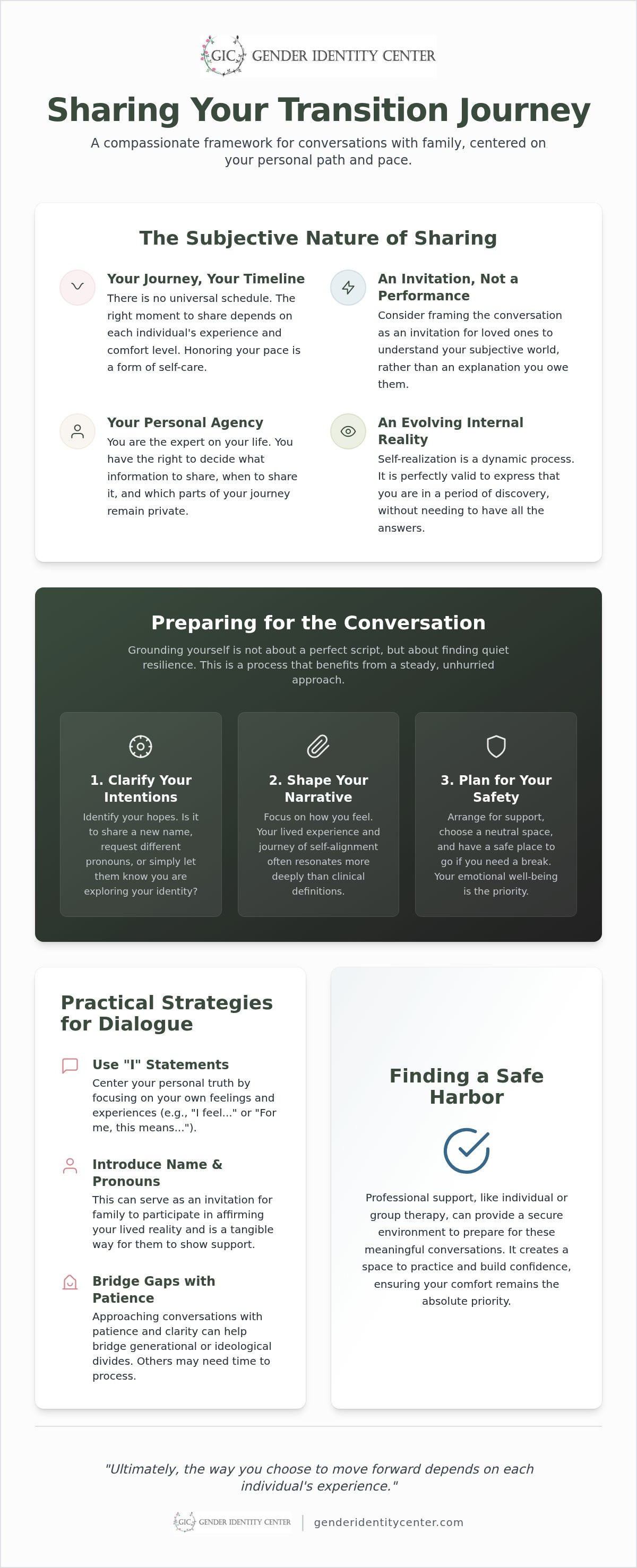
Deciding when and how to talk to family about transitioning is a deeply personal choice that doesn't follow a fixed schedule. There's no universal timeline because every family dynamic is unique. Some people feel a sense of urgency to share their truth immediately, while others find comfort in waiting until they've reached a specific level of internal clarity. This depends on each individual's experience. Instead of viewing this as a performance or an explanation you owe to others, you might consider framing the conversation as an invitation. You're inviting your loved ones into your subjective world, allowing them to see the person you've always been and the person you're becoming.
Your personal agency is the foundation of this process. You're the expert on your own life, which means you get to decide what information to share and which parts of your journey remain private for now. If you're feeling a sense of pressure to "come out" before you're ready, it's okay to step back. The right time to speak depends entirely on your personal sense of safety and emotional readiness. We believe that honoring your own pace is a radical act of self-care that sets the stage for more authentic connections later on.
Identity as an Evolving Internal Reality
Self-realization is rarely a static event; it's a dynamic and rhythmic journey of growth. When you begin Understanding Transgender Identities as a process of alignment rather than a race to a finish line, the pressure to have all the answers often begins to lift. You don't need to have a definitive list of "end goals" to start a conversation. It's perfectly valid to express that you're in a period of discovery. By framing your transition as a movement toward personal harmony, you help others see that your path is about expansion and authenticity. This shift in perspective allows your family to witness your progression without the weight of rigid expectations.
Creating a Safe Space for Dialogue
Sharing vulnerable parts of your identity requires a secure environment where you feel acknowledged and respected. We often suggest a "safe harbor" mindset, where the primary goal is to maintain your own emotional stability. This approach doesn't just protect you; it can also help lower the defenses of family members who may be feeling their own sense of uncertainty. If you find yourself needing extra support to establish this internal sense of safety, our clinicians in Phoenix and Tucson can help you prepare for these interactions. Your comfort is the absolute priority. If a specific setting or timing doesn't feel right, you have every right to wait for a moment that feels more supportive of your well-being.
Preparing for the Conversation: A Step-by-Step Approach
Before you sit down to speak, it's helpful to check in with your internal capacity. Preparation isn't about rehearsing a perfect script, but about grounding yourself in a sense of quiet resilience. Understanding how to talk to family about transitioning starts with identifying what you hope to achieve. You might want to share a new name, request different pronouns, or simply let them know you're exploring your identity. Thinking through how to talk to family about transitioning is a process that benefits from a steady, unhurried approach. This depends on each individual's experience.
Clarifying Your Personal Narrative
Your narrative is yours to shape, and it's okay if it feels like a work in progress. You don't need to have every answer about your future self to be worthy of respect today. Focusing on how you feel often resonates more deeply than using clinical definitions that might feel distant. For younger individuals, finding Guidance for Young People can provide a helpful starting point for framing these internal truths. By centering your lived experience, you remind your family that this is a journey of growth and self-alignment rather than a list of facts to be memorized.
Logistics and Safety in Arizona
Living in Arizona means navigating a variety of social landscapes. Whether you're in Phoenix, Tucson, or a more rural community, the local environment can influence how you feel about sharing your identity. It's often helpful to identify a "plan B" for the day of your conversation. This might include:
- Arranging a check-in with a supportive friend or partner immediately after.
- Identifying a neutral, unhurried space like a public park or a quiet cafe.
- Having a safe place to go if the conversation feels too heavy or if you need a break.
Establishing these support systems beforehand provides a sense of stability. It's about creating a safety net that allows you to focus on the dialogue itself. Choosing the right setting involves more than just a location; it's about the emotional atmosphere. A neutral space can help keep the conversation focused on connection rather than domestic distractions. Preparing for a variety of reactions requires patience. Some family members may respond with immediate warmth, while others might need time to process new information. If you're looking for a non-judgmental space to explore these preparations, you might consider scheduling a session with one of our specialized clinicians. We're here to help you build the tools needed for these significant life steps.
Navigating Diverse Family Dynamics in Phoenix and Tucson
Arizona presents a unique social landscape, where the vibrant urban centers of Phoenix and Tucson often sit alongside more traditional community values. This diversity means that your experience of learning how to talk to family about transitioning will likely be shaped by the specific cultural and social context of your household. You might find that some relatives are ready to embrace new concepts, while others feel more rooted in familiar, traditional structures. Recognizing that bridge-building is a collaborative, often slow process can help you manage your own expectations. You aren't just sharing facts; you're creating a path for mutual understanding through a steady, guiding hand.
Generational differences can significantly influence how gender identity is interpreted and discussed within a family unit. For some, the language of identity is a new and evolving territory. When you are considering how to talk to family about transitioning, it's helpful to approach these differences with a patient mindset. This depends on each individual's experience, as some families may find common ground quickly while others require more time to adjust to changes like a new name or different pronouns. These nuances are a vital part of your social transition, and they deserve to be handled with both sensitivity and firmness to ensure your truth is acknowledged.
Bridge-Building Through Family Therapy
Sometimes, the presence of a neutral, wise mentor can make all the difference in a complex family dynamic. Seeking family counseling in Tucson provides a clinical setting where every voice is acknowledged and respected. A therapist acts as a steady hand, helping families move away from initial conflict and toward a state of radical acceptance. These sessions provide a safe harbor where you can discuss the practicalities of your journey without the pressure of an immediate resolution. The focus remains on establishing a secure environment where progress can happen at a pace that feels sustainable for everyone involved.
Handling Varied Viewpoints with Empathy
It's natural for family members to have a range of reactions that are deeply tied to their own personal histories and contexts. While your well-being and safety must always come first, acknowledging that they may need their own time to process new information can sometimes lower the emotional temperature of the room. Maintaining your boundaries is an essential part of this process. You can remain open to future dialogue while still protecting your internal peace. If a particular interaction feels unhurried and calm, it might be a good time to share more. If not, you have the agency to pause the conversation and try again later. The rhythm of these talks should always follow your personal sense of readiness.
Practical Strategies for Respectful and Affirming Dialogue
Engaging in these conversations often feels more natural when you focus on your own felt reality rather than following a rigid script. Using "I" statements helps center your agency and personal experience. For example, saying "I feel more like myself when I'm addressed this way" invites your family into your world without sounding like a demand. This gentle approach models the respect you wish to receive, using a calm and measured rhythm to lower everyone's defenses. Learning how to talk to family about transitioning involves a balance of firmness and gentleness. Every interaction is a chance to establish your truth while maintaining the connection you value. This depends on each individual's experience.
The Language of Self-Realization
Explaining your social transition doesn't require academic terminology. You can use accessible language that describes your journey as a positive progression toward wholeness. For some, this might mean a change in name or pronouns to feel validated in their daily life. For others, it might involve different shifts in social expression or dress. The meaning of "transition" is not a fixed definition; it's a flexible concept that changes based on your own needs and goals. By inviting your family to see this as a journey of growth, you help them understand that your identity is an evolving, internal reality that deserves to be acknowledged.
Managing Expectations and Mistakes
It's common for family members to struggle with new terminology as they adjust to your shared truth. Adopting a "repair and move forward" approach can help keep the dialogue focused on support rather than linguistic perfection. If someone uses the wrong pronoun, a quick correction followed by continuing the conversation often feels less disruptive than a long, drawn-out apology. You might choose to focus on the intention of support behind their words. This doesn't mean your needs are less important, but rather that you're allowing space for the learning process to happen naturally. This depends on each individual's experience and the level of effort you see from your loved ones.
At the same time, it's vital to set clear, gentle boundaries about your privacy and medical history. You're the expert on your own life, and you get to decide which parts of your journey are shared and which remain private. If you're feeling exhausted by the process of explaining yourself repeatedly, scheduling a consultation with an affirming therapist can provide a secure space to process these emotions and refine your communication strategies. This professional support can help you maintain your internal peace while navigating the complexities of family dynamics in Arizona.
Finding a Safe Harbor: Professional Support in Arizona
The transition toward your future self is a meaningful endeavor that doesn't have to be traveled alone. Professional support in Arizona serves as a permanent and dependable resource, acting as a bridge between your current reality and your goals. Many individuals find that individual gender therapy in Phoenix provides the necessary tools to explore how to talk to family about transitioning with confidence. This specialized care creates a sense of stability, allowing you to process your emotions in a secure environment before bringing them into a family setting. Group therapy offers the additional benefit of hearing from peers who have navigated the diverse social landscapes of Arizona, from the urban centers of Phoenix and Tucson to our rural counties. Telehealth options ensure that this support remains accessible and private, regardless of your location within the state.
Therapeutic Approaches to Family Integration
Working with a professional allows you to explore the specific nuances of transgender counseling in Tucson. This type of support is often instrumental in mitigating gender-related trauma and lowering the defenses of those involved in the family dialogue. Finding a therapist who aligns with your specific needs is a fundamental step in ensuring your voice is acknowledged and respected. Whether you are focusing on social transition or simply seeking a non-judgmental space to exist, the path you take depends on each individual's experience. A compassionate advocate can help you frame your personal development as a dynamic and positive experience for your loved ones to witness. This collaborative approach moves the family unit toward radical acceptance at a pace that feels sustainable.
Taking the Next Step with Agency
We believe that you are the expert on your own life. When you feel a sense of readiness, we invite you to explore scheduling a consultation to discuss your unique path. Professional support isn't about rushing toward a specific outcome; it's about providing the gentleness required for internal emotional work. Because every family dynamic is different, your support should be tailored to your specific circumstances. This depends on each individual's experience and the level of safety you feel in your current environment. Your self-actualization remains the ultimate objective of all interactions, providing a steady flow of validation and guidance as you move forward. You deserve to be seen and respected throughout every stage of your journey.
Honoring Your Path Forward
Sharing your identity is a profound act of self-realization that centers your personal agency. We've explored how a flexible framework can help you navigate these dialogues, but the most important factor remains your own sense of safety and readiness. Whether you're choosing the right setting or deciding which parts of your story to share, the way you approach how to talk to family about transitioning is a unique process. This depends on each individual's experience, and there's no fixed timeline you're required to follow.
You don't have to navigate these complexities alone. Our specialized clinicians in Phoenix and Tucson provide WPATH-compliant clinical support designed to help you build a secure internal harbor. With telehealth available throughout Arizona, you can access a non-judgmental space from the comfort of your own home. If you're looking for a safe space to navigate these conversations, explore our affirming therapy services in Arizona. Your journey is valid, and we're here to offer a steady, guiding hand as you move toward your future self.
Frequently Asked Questions
When is the 'best' time to tell my family I am transitioning?
The best time to share your truth is whenever you feel a sense of internal safety and readiness. There is no universal schedule for this process, as it depends on each individual's experience. You might choose to wait until you have a support system in place or feel more certain about your personal goals. We believe that honoring your own pace is essential for your well-being when considering how to talk to family about transitioning.
What if my family refuses to use my new name or pronouns?
Navigating a refusal to acknowledge your name or pronouns can be deeply painful. You have the agency to set clear, gentle boundaries about how you wish to be addressed in your daily life. It's often helpful to focus on the intention behind the interaction while maintaining your own peace. If resistance persists, finding a secure environment like group therapy can provide validation from others in Arizona who have managed similar family dynamics.
How do I explain the difference between social and medical transition to them?
You can explain social transition as the process of aligning your name, pronouns, and expression with your internal truth. Medical transition involves healthcare steps that some individuals choose to pursue for further alignment. Our clinicians provide WPATH-compliant referral letters for those seeking medical care, though we don't provide HRT or surgery directly. This distinction helps family understand that your journey is a progression toward personal harmony, which depends on each individual's experience.
Should I bring a friend or therapist to the conversation for support?
Bringing a trusted friend or a professional can help create a safe harbor for the conversation. Having a neutral party present often lowers the emotional temperature and ensures your voice is acknowledged and respected. Our clinicians offer family therapy in Phoenix and Tucson to act as a steady, guiding hand during these talks. Whether you choose to include others depends on your specific needs and the level of support you feel is necessary.
What if I'm not sure about my identity yet but want to start the talk?
It's perfectly valid to share that you're in a period of discovery rather than having all the answers. You can frame the talk as an invitation into your subjective experience of self-realization. Sharing your questions can sometimes build a bridge of mutual understanding and allow your family to witness your growth in real-time. The depth of what you share depends on each individual's experience and your current sense of emotional capacity and safety.
How can I find a gender-affirming family therapist in Phoenix or Tucson?
Finding specialized support is a vital step in preparing for family interactions. The Gender Identity Center offers gender-affirming care through our offices in Phoenix and Tucson, alongside telehealth services across Arizona. Our clinicians specialize in transgender counseling and family therapy, providing a non-judgmental space for bridge-building. We prioritize creating an immediate sense of safety, ensuring that you and your loved ones feel seen and respected throughout the therapeutic process as you move forward.
Is it okay to set boundaries about what medical details I share with family?
You have full agency over your private medical information and aren't required to share specific details with family members. Setting gentle boundaries regarding your healthcare is a vital form of self-protection. You might choose to explain that certain aspects of your transition are personal and remain between you and your clinical team. This depends on each individual's experience and the level of trust within the relationship. Your comfort and privacy are the absolute priorities.
How do I handle family members who say they are 'mourning' my old self?
When family members speak of "mourning," it can feel like a rejection of your current self. You might gently redirect the conversation toward the positive progression and growth you're experiencing. Emphasizing that you're the same person, now living more authentically, can help shift the perspective toward radical acceptance. This process takes time and often benefits from a steady, unhurried pace. Ultimately, how you navigate these comments depends on each individual's experience and emotional resilience.