
Transgender Support Groups in Arizona: Finding Your Community in Phoenix and Tucson (2026)

What if the quiet weight of isolation you're carrying isn't a permanent state, but a temporary bridge to a room full of people who finally understand? It's true that the search for transgender support groups arizona can feel overwhelming when you're already managing the complexities of a personal transition. We recognize that finding a safe space in Phoenix or Tucson is more than a logistical task; it's an emotional search for a mirror that reflects your true self. You might worry about whether you'll fit into established circles, or if your specific identity will be held with the care it deserves.
In this guide, we'll explore the 2026 landscape of community resources to help you identify which path feels right for you. Whether you're seeking the structured guidance of clinical settings or the shared wisdom of peer led circles, the choice of where to land is deeply personal. We'll provide a clear list of Arizona resources and explain what to expect when you walk through those doors for the first time. Ultimately, this depends on each individual's experience, as there's no single correct way to be part of a community. We're here to help you explore these subjective choices so you can find a sense of empowerment on your own terms.
Key Takeaways
- Discover how local spaces in Phoenix and Tucson offer validation through shared lived experiences, though the way you choose to engage with these communities often depends on each individual's experience.
- Learn to distinguish between peer-led social spaces and clinical, therapist-led environments to find the transgender support groups arizona offers that best mirror your current needs.
- Gain insight into why the "right" fit is deeply subjective, as finding the ideal balance between social connection and deep emotional processing is a process that depends on each individual's experience.
- Navigate a curated overview of established organizations like Trans Spectrum of Arizona, providing a compassionate starting point for your journey toward finding a safe, affirming sanctuary.
- Explore the synergy between community belonging and professional gender therapy, recognizing that the decision to supplement peer support with clinical care is a personal choice that honors your authentic evolution.
The Role of Transgender Support Groups in Arizona’s Community
You're on a journey that's uniquely yours, but you don't have to walk it in isolation. When we talk about transgender support groups Arizona offers, we're looking at more than just a meeting. These are dynamic spaces where your lived experience is the primary teacher. Validation isn't just a goal here; it's the foundation of every interaction. These groups function as living rooms for the soul, where the masks we wear in the outside world can finally be set aside.
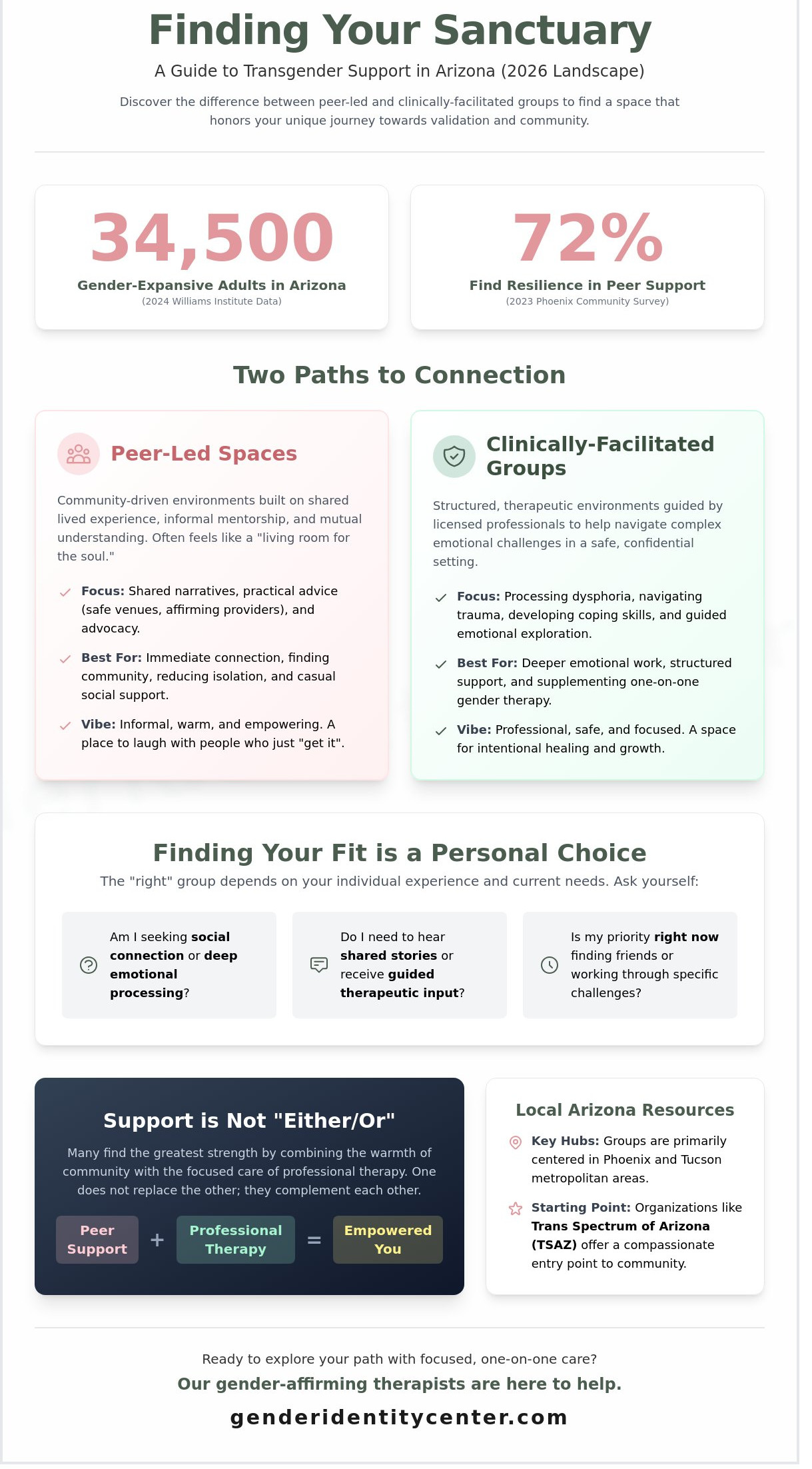
In 2025, legislative shifts highlighted the complex landscape of Transgender rights in the United States, creating a ripple effect in local Arizona communities. For the 34,500 gender-expansive adults living in the state as of the 2024 Williams Institute data, these groups act as a vital buffer against systemic stressors. They provide a sanctuary where the weight of societal expectations can be set down. In a 2023 community survey, 72% of participants in Phoenix reported that peer support was their primary source of emotional resilience when navigating public life.
We believe that the value of any group is inherently personal. It's all very subjective. What feels like a lifeline to one person might feel like a simple social hour to another. This depends on each individual's experience and what they hope to find in a shared space. If you're looking for more personalized guidance alongside community work, our gender-affirming therapists are available to help you explore your path with focused, one-on-one care.
Why Community Connection Matters in Arizona
Finding your people in the Southwest involves navigating a unique social landscape. In the Phoenix and Tucson metropolitan areas, the heat isn't the only thing that's intense. The social climate can feel polarized, making it essential to have a network that understands the specific context of living here. Shared local resources are the backbone of these groups. Members often exchange lists of safe social venues or healthcare providers who have proven themselves to be truly affirming. This local wisdom helps you bypass the trial and error that often accompanies a transition or a period of self-discovery.
Understanding the Purpose of a Support Space
Moving from isolation to a sense of belonging happens through shared narratives. It's the moment you hear someone else voice a fear or a triumph that you thought was yours alone. However, there's a distinct difference between finding a group and finding your community. One is a location on a calendar; the other is a feeling of being home. Whether a space is right for you depends on each individual's experience and their current emotional needs. Some might seek a group for clinical resources, while others just want to laugh with people who get it. Both are valid, and both are necessary parts of the journey toward your most authentic self.
Exploring Different Models of Gender-Affirming Support
Finding the right space for your journey involves exploring various paths, as there's no single correct way to seek connection. In Arizona, the landscape of community care is diverse, offering everything from casual coffee meetups in Phoenix to structured clinical settings in Tucson. This variety reflects the understanding that what feels supportive is all very subjective. You might find that your needs shift as you move through different stages of your transition or self-discovery. Accessing transgender support groups Arizona allows you to test these different environments until you find one that resonates with your current needs.
Peer-led spaces often center on shared advocacy and the wisdom of lived experience. These groups provide a unique form of informal mentorship where you can discuss the practicalities of life. For those seeking immediate connection or crisis support, the Trans Lifeline peer support hotline serves as a vital national bridge to these community-led models. On the other hand, clinically facilitated groups are led by licensed professionals who help you process dysphoria or trauma. Whether one is better than the other depends on each individual's experience at a given moment.
Developmental stages also shape how we gather. Youth groups for those under 18 focus on identity formation, while elder groups for the 50 plus demographic often navigate legacy and long-term resilience. In 2026, hybrid models have become essential for residents in rural areas like Yuma or Flagstaff. These digital spaces ensure that distance doesn't prevent you from accessing transgender support groups Arizona. This flexibility allows you to choose a pace that feels safe for you. If you're feeling unsure about which path to take, you might consider scheduling a brief consultation to talk through your options.
Peer-Led vs. Clinically Facilitated Groups
Peer groups are often volunteer-run and emphasize radical acceptance through shared stories. They offer a sense of partnership that feels less like a medical appointment and more like a gathering of friends. Clinical groups provide a steady, guiding hand for deep emotional work. Many people move between these models or utilize both simultaneously. This fluidity is a strength, as it acknowledges that your growth isn't a linear process.
Specialized Spaces for Families and Allies
Support isn't just for the individual; it extends to the entire support network. Family-focused groups in Tucson and Phoenix provide a non-judgmental sanctuary for parents and partners to process their own journeys. Exploring Affirming Family Counseling in Tucson can help your loved ones navigate their subjective experiences of understanding and connection. These spaces help bridge the gap between individual growth and family cohesion, ensuring everyone feels heard and respected.
Finding the Right Fit: Why the Choice of Support is Subjective
Searching for transgender support groups Arizona provides is a deeply personal task. We want to start by affirming that there's no single correct way to seek community or healing. Your path is your own, and what works for a friend or a peer might not be the right match for you. This depends on each individual's experience and what they hope to achieve through shared connection. Some people arrive at their first meeting looking for hard data and education about medical transitions. Others simply want a social hour where they can exist without explaining their identity. You might even find that your needs change from week to week, and that's perfectly okay.
The vibe of a room often matters as much as the topics discussed. Safety isn't a universal metric; it's a feeling that varies from person to person. Because it's all very subjective, we suggest taking a non-committal approach when you first start exploring different spaces. You don't have to pledge your loyalty to the first group you visit. Think of these early interactions as a way to gather information about what makes you feel seen and respected. A 2023 report from the Williams Institute indicates that approximately 1.3 million adults in the U.S. identify as transgender, and within that group, the diversity of needs is vast. Your sanctuary is wherever you feel most like yourself.
Evaluating a Groups Dynamic
After you attend a meeting, we encourage you to sit with your thoughts for a moment. Ask yourself if you felt heard or if the space felt truly affirming of your specific journey. Chemistry in a group setting is fragile and unique. It's all very subjective, as the presence of just one or two different people can shift the entire energy of a conversation. If you leave a session feeling drained rather than supported, give yourself permission to move on. Community should be a source of empowerment, and finding the right chemistry often requires a few trial runs before things click.
Aligning Support with Your Personal Journey
Your requirements for community will likely evolve as you move through different stages of your life. In 2026, the resources available are more specialized than ever, allowing you to find spaces that mirror your current reality. Someone just starting to explore their gender might need a very different environment than someone who has been living authentically for a decade. Many individuals find that gender identity therapy in Phoenix serves as a vital foundation for their group experiences. This professional support can help you process the complex emotions that often surface during peer interactions. Your perspective on what you need is valid, and you are the ultimate authority on which spaces deserve your time and energy.
Navigating Local Resources in Phoenix, Tucson, and Beyond
Arizona's landscape for gender-affirming care and community is constantly evolving. Finding the right fit among transgender support groups arizona often requires exploring different environments until you find one that resonates with your soul. Your journey is unique, and we recognize that your needs might shift as you grow into your most authentic self. Whether you're in the heart of the city or in a more remote area, there are people waiting to welcome you.
Key Organizations in the Valley
Phoenix acts as a central hub for many seeking connection and safety. Trans Spectrum of Arizona (TSAZ) remains a prominent resource, offering various peer-led groups that have supported thousands of individuals since its formal organization in 2015. If you're looking for a structured setting, group therapy in Phoenix provides a blend of professional guidance and peer validation. This depends on each individual's experience, as some people prefer the casual nature of a social meet-up while others find more security in a therapist-led environment.
Groups in the Valley often cater to specific identities to ensure everyone feels seen. You'll find spaces dedicated to non-binary folks, trans-masculine individuals, and trans-feminine people. To stay updated on meeting times, it's helpful to check organization calendars monthly. Many groups have shifted their schedules since 2024 to accommodate growing attendance numbers, so verifying locations before you head out is a practical step in your planning.
Southern Arizona and Tucson Highlights
In the southern part of the state, the Southern Arizona Gender Alliance (SAGA) has been a cornerstone of support for over 20 years. They prioritize intersectional spaces, acknowledging how your cultural background and race intersect with your gender identity. Tucson is also home to university-affiliated groups at the University of Arizona, which offer specialized resources for students and young adults navigating their transition within an academic setting.
Youth-specific support is particularly robust in the Tucson area. Organizations like the Eon Youth Lounge provide safe havens for those under the age of 24. These spaces offer more than just conversation; they provide a sense of belonging during the formative years of a person's journey. Having a place where you don't have to explain your existence can be a profound relief.
Support Beyond the Metro Centers
Living in rural or northern Arizona, such as Flagstaff or Sedona, presents different opportunities for connection. The Northern Arizona Pride Association and smaller grassroots collectives often fill the gaps where larger organizations might not reach. While physical distance can be a factor, many of these groups have integrated hybrid meeting models since 2020. This allows you to participate from the comfort of your own home while still feeling the warmth of your community. It's all very subjective, and you might find that a digital connection in a small town feels just as powerful as an in-person meeting in a large city.
Integrating Community Support with Professional Gender Therapy
Finding a place within the transgender support groups Arizona offers is often a transformative first step for many people. These spaces provide a mirror for your experiences and a sense of shared resonance that's hard to find elsewhere. The decision to weave professional therapy into your life alongside these groups is a personal choice, and this depends on each individual's experience. While a group offers the strength of a collective, individual therapy provides a dedicated container for your private narrative. This synergy allows you to process the social energy of a community setting within a quiet, clinical space designed just for you.
The relationship between peer support and clinical care isn't about one replacing the other. Instead, they function like two different types of anchors. A group helps you realize you aren't alone, while a therapist helps you understand the specific nuances of your own identity. It's all very subjective, as some people find that community circles meet all their needs, while others feel a pull toward deeper, one on one exploration to resolve internal conflicts or long standing questions.
When to Consider Individual Counseling
Sometimes, peer spaces can accidentally trigger old wounds or highlight areas of your life that require more focused attention. In these moments, specialized clinical tools become incredibly helpful. Our qualified therapists use evidence based approaches like Eye Movement Desensitization and Reprocessing (EMDR) to help you work through gender related trauma or past rejection. Since the 2022 release of the WPATH Standards of Care Version 8, the global focus has shifted even more toward individualized, affirming pathways that prioritize the client's self determination.
Individual sessions often make your time in transgender support groups Arizona more meaningful. By working through your specific anxieties or dysphoria in private, you develop the emotional resilience needed to show up more authentically in group settings. You don't have to carry the weight of your entire history into a social circle; you can let the therapist hold the heavy pieces while you enjoy the connection of the community.
Taking the Next Step in Your Journey
Your path is yours alone to define, and there's no universal timeline for when to move from community spaces into a clinical setting. We believe that professional support offers a different layer of safety, especially when you're navigating the complexities of medical or legal transitions. It's a space where your agency is the priority and your pace is respected. Whether you've been part of a group for years or you're just starting to look for your people, your subjective sense of readiness is the best guide.
Trust your inner rhythm as you explore these different forms of support. If you feel that your journey would benefit from a more specialized, private partnership, we invite you to reach out. You can schedule a consultation to explore how our clinical services can support and enhance your community journey. We're here to walk beside you as you move toward your most authentic future self.
Embracing Your Unique Path to Connection
Finding the right space involves many factors. Whether you're looking for peer-led circles in Phoenix or structured meetings in Tucson, the value of transgender support groups arizona offers is deeply personal. Some people find comfort in shared stories, while others prefer the structure of clinical guidance. This depends on each individual's experience; what feels like home to one person might not resonate with another. It's all very subjective, and that's okay. You might choose to explore community-led models or seek out professional spaces that offer 2026-standard gender-affirming care.
Our team at the Gender Identity Center understands that your needs are as unique as your identity. We provide specialized support for all ages across Arizona, including telehealth options for those outside the main hubs. Since we follow WPATH standards for clinical care and referral letters, you can trust the professional quality of our trauma-informed approach. We offer services like EMDR and speech therapy to help you feel more aligned with your authentic self. You're never alone in this process as you navigate the beautiful complexity of becoming who you're meant to be.
Begin your affirming journey with a therapist who understands; explore our services today.
Frequently Asked Questions
Is it normal to feel nervous before attending my first support group in Arizona?
It's completely normal to feel a sense of hesitation or anxiety before you step into a new space. A 2022 study by the Williams Institute found that 80% of individuals feel some level of social anxiety when seeking out new community resources. This depends on each individual's experience and how they've navigated social settings in the past. We view this nervousness as a sign of your bravery in honoring your authentic self.
Can I attend a transgender support group if I am still questioning my identity?
You are welcome to join transgender support groups Arizona regardless of where you're at in your journey of self-discovery. Data from the 2015 U.S. Transgender Survey indicates that identity is often fluid, and many people spend years in a questioning phase. These groups offer a sanctuary where you can explore your feelings without the pressure to have a definitive label. Your path is your own, and we're here to walk beside you.
What is the difference between a peer support group and group therapy in Phoenix?
The primary difference lies in the facilitation and the specific goals of the gathering. Group therapy in Phoenix is led by licensed professionals under the Arizona Board of Behavioral Health Examiners, while peer groups are facilitated by community members with shared lived experience. Whether one is better depends on each individual's experience and what they need at that moment. Therapy often focuses on clinical processing, while peer groups prioritize social connection.
Are there specific groups for parents of transgender children in Tucson?
Tucson offers dedicated spaces for families, most notably through PFLAG Tucson which has served the community since 1982. Southern Arizona Gender Alliance also provides resources that help parents understand their child's evolving identity. These groups provide a vital bridge for families to find empowerment together. This depends on each individual's experience within their family unit, but these organizations offer 40 years of local history in providing validation.
How much do support groups usually cost in the Arizona area?
Most peer-led support groups in Arizona are offered at no cost to participants. A 2023 review of local LGBTQ+ community centers found that 95% of their peer sessions are funded through grants and donations rather than attendance fees. Clinical therapy groups will have different structures, often accepting insurance or offering sliding scales. Because financial situations vary, this depends on each individual's experience and the specific organization's current funding model.
Can I find online transgender support groups if I live in a rural part of Arizona?
Online support is widely available for those living in rural areas like Apache or La Paz counties. Since 2020, 85% of Arizona's support organizations have implemented permanent hybrid or virtual options to ensure accessibility. These digital pathways allow you to connect with others without the barrier of a long drive. You can find your community from the safety of your own home, making the journey toward your authentic self more accessible.
What should I do if I don’t feel like I "fit in" with a particular group?
If a group doesn't feel like the right fit, it's perfectly acceptable to explore other options. This depends on each individual's experience, as every group has its own unique rhythm and personality. A 2021 report on community health suggested that individuals often visit 3 different groups before finding their home community. You are the expert on your own needs, and finding a sanctuary that feels safe is the most important goal.
Is my participation in these groups confidential?
Confidentiality is a cornerstone of these spaces, though the specific rules can vary between peer and clinical settings. Clinical groups are bound by HIPAA regulations established in 1996, while peer groups typically use community agreements to protect your privacy. This depends on each individual's experience with the specific group's guidelines. We prioritize your safety and ensure that what you share stays within the circle of the group's collective care.