
Voice Therapy for Transgender Arizona: Finding a Path That Feels Like You

What if the goal of your voice wasn't to sound perfect according to someone else's rules, but to simply sound like you? For many people, the sound of their own voice can feel like a barrier to social comfort, especially when vocal dysphoria creates a sense of disconnect during everyday conversations in Phoenix or Tucson. You might worry about being pressured into a rigid, binary standard that doesn't actually reflect your internal sense of self. We believe that your vocal journey is deeply personal, and there isn't a single right way to sound; instead, it's about discovering what feels most authentic to your unique identity.
In this guide, we'll explore how feminizing voice therapy in Arizona can become a sanctuary for experimentation rather than a series of clinical drills. You'll discover how to find a path that prioritizes your comfort in both professional and social Arizona settings. We'll also look at the local landscape, including the differences between in-person sessions and telehealth options, so you can decide what best supports your personal growth. Whether you seek a subtle shift or a more significant transformation, the process is about finding a sound that finally feels like home, tailored to your unique needs and aspirations.
Key Takeaways
- View vocal affirmation as a flexible instrument; it's not about rigid standards because this depends on each individual's experience.
- Consider how resonance and pitch might be adjusted to create an authentic sound; this depends on each individual's experience.
- Evaluate whether in-person sessions in Phoenix or Tucson or telehealth better suits your comfort; this depends on each individual's experience.
- Discover how feminizing voice therapy arizona might be integrated with gender counseling to support your well-being; this depends on each individual's experience.
- Understand what to expect during a collaborative initial evaluation where goals are flexible; this depends on each individual's experience.
Exploring Vocal Affirmation and Dysphoria in Arizona
Your voice is often the first way you interact with the world around you. For many, the sound of their own voice doesn't quite match who they are inside, which can lead to feelings of vocal dysphoria. This disconnect might impact your social confidence when you're out in Phoenix or Tucson; it can make simple tasks like ordering coffee or answering the phone feel heavy with anxiety. Transgender voice therapy offers a way to explore these feelings without the pressure of meeting a rigid or binary standard. It's a flexible tool for self-expression rather than a medical requirement. This depends on each individual's experience and how they choose to move through the world.
When exploring feminizing voice therapy arizona, we focus on the idea that vocal success is highly subjective. There is no "perfect" feminine sound that everyone must achieve. Instead, the goal is often to find a resonance and pitch that feel congruent with your unique identity. We believe you are the expert on your own life and your own sound. The process is about discovering what feels right to you, whether that is a subtle shift or a more significant change. This depends on each individual's experience and what they personally value in their communication style.
The Emotional Connection to Sound
Sound is deeply tied to our internal emotions. A voice that feels authentic can bring profound joy and a sense of relief, while a voice that feels "off" might cause you to retreat from social settings. We prioritize creating a safe, affirming environment where you can experiment with different sounds without judgment. This helps lower emotional defenses, allowing you to discover what sounds truly feel like home. This depends on each individual's experience; some might find joy in small shifts, while others seek a more noticeable transformation in their vocal weight or brightness.
A Holistic Perspective on Transition
Vocal work doesn't exist in a vacuum. It's often one piece of a much larger journey toward self-realization. Many people find that engaging with feminizing voice therapy arizona complements individual therapy, as the emotional work of transition often mirrors the vocal changes you might be exploring. Every path is unique. Some choose to start voice work early in their transition, while others might wait until they feel more settled in other areas of their life. We see vocal exploration as a form of self-care. It's an invitation to treat your voice as an instrument of your own design. This depends on each individual's experience and their personal timeline for growth.
The Subjective Elements of Vocal Expression
Traditional approaches to voice work sometimes fixate on specific pitch ranges, treating them as strict requirements for a feminine sound. We view these metrics as mere suggestions rather than absolute rules. In the context of feminizing voice therapy arizona, we prioritize a shift from a binary "masculine versus feminine" mindset to a focus on authentic versus inauthentic sound. Your voice is a living, breathing instrument. This depends on each individual's experience and what they feel represents their inner truth. While pitch is one variable, it is often a smaller part of a much larger, subjective equation that includes how you carry yourself and how you connect with others.
Resonance and Vocal Weight
Resonance refers to where the sound vibrates in your body, acting as the texture or "weight" of your voice. Some people prefer a brighter, forward resonance, while others find comfort in a warmer, darker tone. Research into vocal feminization strategies highlights how adjusting resonance can significantly alter how a voice is perceived without needing to strain for high pitches. There is no objectively "correct" resonance; there is only what feels right for you. This depends on each individual's experience and their physical comfort during daily speech.
Intonation, Rhythm, and Personality
Beyond the physical mechanics of sound, intonation and rhythm bring your personality to life. This is the musicality of your speech. It includes the way your voice rises and falls or the speed at which you share a story. These elements are highly flexible. You might find that your rhythm changes depending on whether you are at work or with friends. Subtle shifts in how you emphasize certain words can change your vocal presentation entirely. Because these traits are tied to your personality, they often evolve over time as you grow. This depends on each individual's experience.
Exploring these subjective qualities allows you to build a voice that doesn't just sound "right" to others, but feels right to you. If you are curious about how these elements might fit together for your own sound, you might want to schedule an initial conversation to see what path feels most supportive. Feminizing voice therapy arizona is a journey of self-discovery where you remain the expert on your own progress. This depends on each individual's experience and the goals you choose to set for yourself.
Comparing Care Environments: Phoenix, Tucson, and Telehealth
Choosing where to engage in feminizing voice therapy arizona is a choice that centers your personal comfort. The landscape in our state is varied; some individuals might explore in-person group sessions in Phoenix, while others may prefer one-on-one assessments through a digital platform. We believe that the "right" environment isn't a universal standard. This depends on each individual's experience. Some people thrive in a dedicated physical space, while others feel more capable of experimentation when they're in the privacy of their own living room.
The Value of In-Person Care in Arizona
For many in the Phoenix and Tucson areas, visiting a physical office provides a sanctuary that might not be available at home. If you live with roommates or family members who aren't yet part of your journey, having a secure, private room is essential for feeling safe. In-person sessions also allow for a clearer reading of non-verbal cues and posture, which are foundational to transgender voice and communication. There's also a subtle, powerful sense of community found in shared local spaces. Being in a room that's explicitly designed for your safety can help lower your defenses. This depends on each individual's experience and whether they value that physical presence.
Telehealth: Support from Your Own Space
Telehealth has opened doors for individuals across the state who may not live near the major hubs of Phoenix or Tucson. One of the primary benefits of online sessions is the ability to practice in the exact environment where you spend most of your time. This can significantly reduce session-related anxiety, as you're already in a familiar, comfortable setting. Video sessions are highly effective for focusing on specific vocal nuances, such as mouth shape and facial tension. Consider these benefits of a remote setting:
- Convenience for those with busy professional schedules or transportation challenges.
- The ability to transition directly from practice into your daily life.
- A sense of control over your immediate surroundings and lighting.
Whether this format feels more or less personal than an office visit is subjective. This depends on each individual's experience and their specific needs for privacy.
Finding a gender therapist who understands the local Arizona landscape can help you navigate these choices. They can offer a steady hand as you decide which environment supports your growth best. Ultimately, the goal is to ensure you feel seen and heard in a way that respects your boundaries. This depends on each individual's experience and what they need to feel truly supported in their vocal exploration.
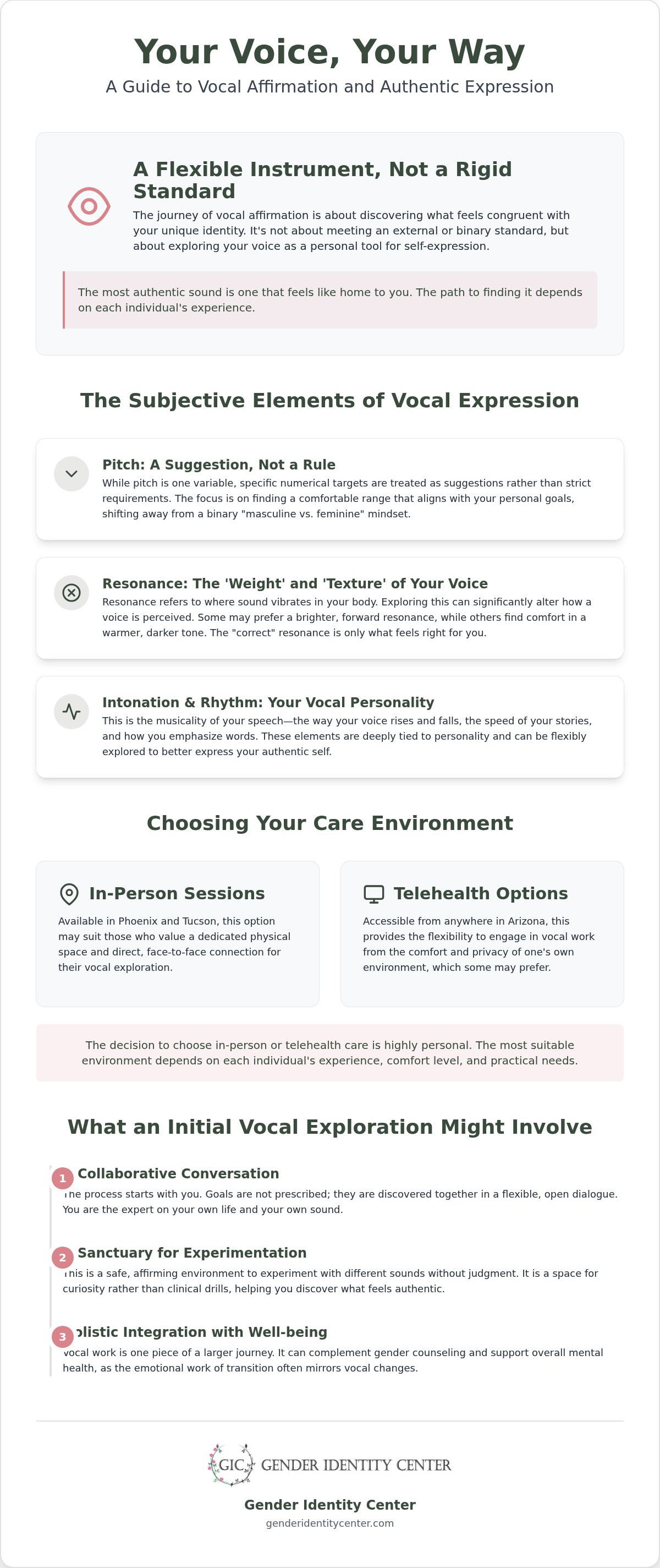
Your Initial Vocal Exploration: What Each Individual Might Expect
Starting something new often feels like a mix of hope and hesitation. When you begin feminizing voice therapy arizona, the first step is a collaborative evaluation that feels more like a low-pressure conversation than a clinical intake. We prioritize creating a secure environment where you can speak openly about your history and your hopes for the future. Vulnerability is a natural part of this process; it's the foundation of finding a sound that feels truly congruent with your identity. This depends on each individual's experience and what they feel comfortable sharing in those first moments.
During these early meetings, sessions often involve gentle experimentation with sound. You might explore different ways of breathing or subtle shifts in how you shape your vowels. There is no expectation to "perform" or get it right on the first try. We view this as a sanctuary for experimentation where you can play with the building blocks of your voice in a non-judgmental space. This depends on each individual's experience and how they prefer to navigate their own vocal discovery.
Collaborative Goal Setting
We believe that you are the expert on your own life. Because of this, success in voice work is not defined by a medical checklist or a specific frequency range. Instead, we work together to define what success looks like for you. Perhaps you want to feel more confident during professional presentations, or maybe you simply want to feel more at ease when speaking with friends. These goals are flexible and can be modified at any time. This depends on each individual's experience; your needs today might be different from your needs six months from now.
The Role of Practice and Patience
Vocal changes happen through gradual, gentle exploration rather than forced effort. We might suggest "vocal homework," which is simply an invitation to integrate new sounds into your daily life at your own pace. It's helpful to remember that progress is rarely a straight line. Some days your voice might feel exactly where you want it, while other days it might feel a bit more elusive. This depends on each individual's experience and the external factors, like stress or physical health, that impact how we sound. If you're ready to start this exploration, you can schedule your initial evaluation with us today to begin your journey.
Integrating Voice and Mental Health at the Gender Identity Center
Vocal transition is rarely just about the mechanics of sound; it's a deeply emotional process that touches every part of your identity. At the Gender Identity Center, we offer an integrated approach that recognizes how your voice and your mental well-being are intertwined. By weaving speech therapy into a broader transgender counseling plan, we provide a space where you can address both the physical and psychological aspects of your journey. This depends on each individual's experience and how they choose to prioritize their personal development. Some might find that their vocal exploration brings up new emotions that are best explored with a supportive therapist by their side.
Working with clinicians who specialize in the transgender experience ensures that you're seen as a whole person rather than a set of symptoms. Our team understands the nuances of feminizing voice therapy arizona and the unique challenges you might face in the local community. We believe that having a steady, guiding hand can make the process feel less like a series of obstacles and more like a meaningful exploration of self. This depends on each individual's experience and the level of support they feel they need at any given stage of their transition.
Integrated Care in Phoenix and Tucson
Having offices in both Phoenix and Tucson allows us to serve the community through a unified clinical team that understands your history. There's a significant benefit to accessing multiple affirming services within the same practice, as it creates a consistent sense of safety and reliability. Beyond vocal work, we also provide WPATH referral letters for those who may be considering medical transition steps. This integrated model helps bridge the gap between your current reality and your future self. Whether you visit us in person or through telehealth, the level of care remains focused on your agency. This depends on each individual's experience and their specific transition goals.
Your Invitation to Explore
We invite you to reflect on what an authentic voice might feel like for you. It's a journey that doesn't have a fixed destination or a required timeline. You're the expert on your sound and your story. If you're curious about how feminizing voice therapy arizona might fit into your life, we provide a warm invitation to reach out for a scheduling consultation. This is a low-pressure way to see if our approach aligns with your needs. We're here to walk alongside you at your own pace, providing the tools and support you need to feel more like yourself. Remember that your identity is valid and worthy of respect, regardless of how you choose to sound. This depends on each individual's experience, and we're honored to be a part of your path.
Embracing Your Unique Vocal Journey
Your voice is a powerful expression of your identity, and the process of finding a sound that feels like home is a deeply personal endeavor. We've explored how vocal affirmation is about more than just hitting specific numbers; it's about finding a resonance and rhythm that resonate with your internal sense of self. This depends on each individual's experience and what they prioritize in their daily interactions. Whether you prefer the sanctuary of our safe spaces in Phoenix and Tucson or the convenience of statewide telehealth, the choice of environment is yours.
Our WPATH-compliant clinicians are specialized in both mental health and speech therapy, ensuring that your transition is supported holistically. By choosing feminizing voice therapy arizona, you're inviting a partnership that respects your agency and your timeline. This depends on each individual's experience, and there's no wrong way to begin your exploration. You deserve to be heard in a way that feels authentic to you. We're here to provide the steady hand and compassionate guidance needed as you move toward a future where your voice finally matches your heart.
Start your vocal journey with a safe, affirming consultation today.
Frequently Asked Questions
Is feminizing voice therapy in Arizona covered by insurance?
Coverage for feminizing voice therapy arizona varies between different providers and specific plans. Some insurance companies recognize vocal affirmation as a medical necessity; others may have different criteria for coverage. This depends on each individual's experience with their insurance carrier. We suggest contacting your member services department to ask about speech therapy benefits under gender-affirming care. Getting a clear answer helps you plan your journey with confidence and peace of mind.
How long does it typically take to see results from voice therapy?
There isn't a fixed timeline for seeing results because this depends on each individual's experience and their unique goals. Some people might notice subtle shifts in their comfort or resonance after just a few sessions. Others may find that developing a voice that feels truly authentic takes several months of steady practice. Progress is often non-linear and reflects the time you spend gently integrating new sounds into your daily life. We value patience over speed.
Do I need to be on HRT to start voice therapy in Phoenix or Tucson?
You don't need to be on hormone replacement therapy to begin feminizing voice therapy arizona. Estrogen doesn't typically change the physical structure of the vocal folds, so therapy is a primary path for many seeking a more congruent sound. You are welcome to start this exploration at any point in your transition that feels right. This depends on each individual's experience and their personal timeline for self-discovery. Your needs are the priority here.
Can voice therapy help with non-binary or gender-fluid vocal goals?
Therapy is a highly adaptable process that can definitely support non-binary or gender-fluid vocal goals. You aren't required to aim for a binary sound; instead, you can explore an androgynous or flexible range that reflects your identity. This depends on each individual's experience and how they wish to express themselves in different settings. We view the voice as a versatile instrument that should serve your internal sense of self above all else.
What is the difference between a voice coach and a speech-language pathologist?
A speech-language pathologist is a licensed clinical professional with specialized training in vocal anatomy and health. While a voice coach might focus primarily on the aesthetics of sound, an SLP ensures that your vocal changes are sustainable and don't cause strain. This depends on each individual's experience and what they seek in a provider. At our center, we balance clinical expertise with an affirming, empathetic approach that treats you as a whole person.
Is it possible to damage my vocal cords during this process?
It's possible to experience vocal strain if you try to force a certain sound without professional guidance. However, the purpose of therapy is to teach you techniques that protect your vocal cords from irritation or damage. We prioritize gentle experimentation and listening to your body's signals to ensure your voice remains healthy. This depends on each individual's experience and their physical comfort. Sustainable progress happens when you move with ease rather than force.
How often should I attend sessions to feel a difference?
The frequency of your sessions is a flexible choice that we make together based on your schedule and goals. Many people find that meeting once a week or every two weeks provides a steady rhythm for building new habits. This depends on each individual's experience and how much time they have to practice between sessions. Consistent, small steps often lead to the most lasting changes, but we will always move at your pace.
Can I do voice therapy if I have already had vocal fold surgery?
You can absolutely participate in voice therapy if you have already had vocal fold surgery. In fact, therapy is often a vital part of the healing process to help you use your voice safely in its new range. This depends on each individual's experience and the specific type of procedure they underwent. We work collaboratively to ensure your post-surgical exploration is supportive and helps you feel more congruent with your sound.