
AHCCCS Gender Therapy Coverage in Phoenix: 2026 Guide

If you’re searching for “gender therapy covered by AHCCCS phoenix,” the answer depends on your plan, the service you’re seeking, and whether a clinician participates in your network. It’s understandable to want clear information before arranging care. You deserve support without having to justify who you are, and you can review coverage one question at a time.
This guide explains how to review your plan’s behavioral-health benefits, what to ask member services, and why covered services and in-network providers are separate questions. It also covers how to clarify referral or authorization requirements, which can vary by plan and situation, as you look for affirming support in Phoenix or Tucson.
At the Gender Identity Center, individual therapy and gender-focused counseling offer space to explore what matters to you at your own pace. Your experience and care needs are personal. Understanding your plan can be one step toward finding support that feels respectful and right for you.
Key Takeaways
- Separate mental-health therapy benefits from coverage for other types of care.
- Check how your plan describes behavioral-health services, since terminology and individual circumstances may vary.
- Use your current plan handbook and member-services contact to clarify benefits, provider participation, authorization, and any cost-sharing.
- Follow a practical verification process: identify your plan, review its benefits, check provider participation, and clarify next steps.
- Consider affirming individual therapy shaped around your goals and experience, rather than a prescribed path.
Does AHCCCS Cover Gender Therapy in Phoenix? Start With the Coverage Question
Insurance language can make it difficult to tell whether affirming therapy is covered. A plan may describe behavioral health, counseling, or provider networks without using the words “gender therapy.” If you’re asking whether gender therapy is covered by AHCCCS in Phoenix, the answer depends on your specific plan, the service, and the provider you want to see. Getting a plan-specific answer can help you understand your options before making care decisions.
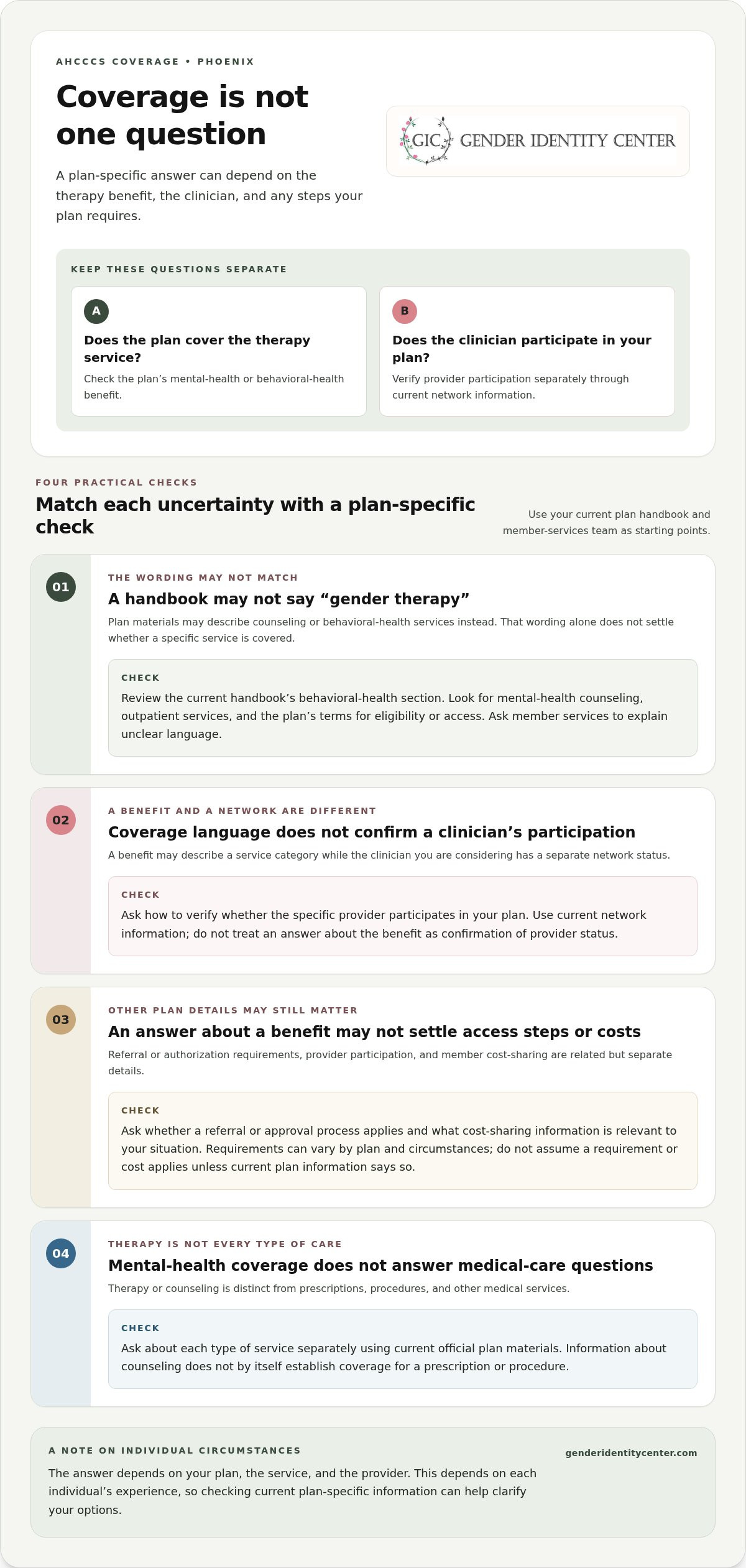
Start by separating two questions: whether your plan covers a mental-health service, and whether a particular clinician participates in your plan’s network. Therapy coverage is also distinct from coverage for medical care. The broad term gender-affirming care can include psychological, medical, physical, and social forms of support, but those categories aren’t interchangeable for insurance purposes.
Your current plan documents and member-services team are the best starting points for understanding your benefits. They can help you identify how your plan describes mental-health services and which questions apply to your situation. Use current plan-specific information, since benefit language and network arrangements may differ.
What does gender therapy mean in this insurance question?
Here, gender therapy means mental-health support focused on your goals and experiences. You might want space to explore identity, relationships, stress, or other concerns, or you may have different priorities. Therapy doesn’t require a particular identity, transition path, or outcome. It’s distinct from an HRT prescription or surgery, which are medical services rather than mental-health therapy.
That distinction can help you describe the service you’re asking about. When reviewing plan materials or speaking with member services, focus on the therapy or counseling benefit and the type of provider involved. An answer about mental-health counseling won’t automatically establish coverage for other kinds of care, and information about medical services won’t answer the therapy question by itself.
Why is there not one answer for every AHCCCS member?
Members may have different plan documents and provider-network arrangements, so one person’s experience may not predict another’s. Coverage, authorization requirements, and provider participation are related but separate questions. A benefit may describe a service category, while the clinician’s network status or the plan’s approval process still needs clarification. Check current information for your own plan.
For example, your handbook might describe outpatient behavioral-health services without using the phrase “gender therapy.” That wording alone may not settle how the plan handles a specific service. Member services can explain the plan’s terms, while provider participation is a separate detail to verify through current network information. The process can vary, so it’s fine to take these questions one at a time.
As you look for affirming support in Phoenix or Tucson, keep your care goals separate from the insurance question. Individual therapy and gender-focused counseling can offer space to reflect on what support would feel useful to you. The next sections explain how to review plan benefits and clarify coverage without assuming every member’s path will be the same.
How AHCCCS Plan Benefits May Affect Gender Therapy in Phoenix
Plan documents don’t always use the same words you might use to describe your care. A handbook may refer to counseling or behavioral-health services without specifically naming gender-focused therapy. That difference in wording doesn’t, by itself, tell you whether a service is covered. Read the benefit language in context and compare it with current information from your plan.
For the question of gender therapy covered by AHCCCS phoenix, begin with your current plan handbook and its behavioral-health benefits section. Look for descriptions of mental-health counseling, outpatient services, and any terms the plan uses to explain eligibility or access. If the language doesn’t clearly address the therapy you’re considering, ask member services to explain it. Coverage details can change, so use current official AHCCCS and plan materials rather than relying on general summaries or another member’s experience.
Which plan details can change the answer?
Benefit coverage is only one part of the picture. Your plan’s provider network, any applicable approval process, and member cost-sharing may also affect access. These are separate details, and one answer doesn’t resolve the others. For example, a benefit description may address a type of behavioral-health service, while the clinician you’re considering has a different network status. Check the relevant handbook sections and ask member services about your circumstances.
Before contacting the plan, write down the service you’re asking about and the exact wording from the handbook. Then clarify what the plan means, whether an approval process applies, and how to determine whether a provider participates. Don’t assume a referral, authorization, cost, or service limit applies unless current plan information says so. The relevant questions can vary with your plan and the care you’re seeking.
Does therapy coverage answer questions about other care?
No. An answer about one benefit shouldn’t be treated as a decision about every kind of care. Mental-health therapy is distinct from prescriptions, procedures, and other medical services. If your plan provides information about counseling, that doesn’t establish coverage for a prescription or procedure. Each service may be handled differently, so ask about them separately using current official materials.
This distinction can also make conversations with your plan clearer. You can first ask about the specific therapy benefit, then raise separate questions about other services if they’re relevant to your needs. Your goals may shift over time, and this depends on each individual’s experience. You can seek counseling for support or exploration without having a particular transition path or outcome in mind.
If you’d like to learn about gender-focused support while reviewing your plan information, explore the Gender Identity Center’s therapy services and therapists. The practice offers individual therapy and gender-focused counseling. Whether a plan covers care and whether a clinician participates in its network are plan-specific questions.
What to Check Before Using AHCCCS for Gender Therapy
Before arranging care, turn the broad coverage question into a few specific ones. The phrase “gender therapy covered by AHCCCS Phoenix” can’t be answered reliably with a general statement about AHCCCS alone. Your current plan handbook and member-services contact are better starting points for understanding how your benefits may apply. Benefit information still isn’t a guarantee that an individual claim will be paid.
Use your current plan handbook and look for its behavioral-health information. Keep these questions separate as you review the details:
| What to check | What to clarify |
|---|---|
| Benefit coverage | Which behavioral-health benefit or service description may apply to the therapy you’re considering? |
| Network participation | Does the clinician participate in your specific plan’s network? |
| Authorization | Does your plan require a referral, authorization, or another step for your situation? |
| Member cost-sharing | Does the plan describe any cost-sharing that may apply to this service? |
These questions are connected, but one answer doesn’t settle the others. A benefit description won’t confirm that a particular clinician is in-network. A network listing won’t explain whether an authorization step or member cost-sharing applies. Current plan materials and member services can help clarify each item without assuming the same answer applies to every AHCCCS member.
Questions to ask about your plan
When you contact member services, use the wording from your handbook and ask focused questions: Which behavioral-health benefits apply to this therapy service? Must the clinician participate in my specific plan network? Does a referral, authorization, or another step apply to my situation? If cost-sharing is relevant, how does the plan describe it? Details may vary by plan and individual circumstances.
For your reference, record the date, the representative’s name or written source, and the exact answer. Note any terms you were asked to look up or next steps described. This makes it easier to revisit the answer or explain which point still needs clarification. It doesn’t guarantee a claim outcome, but it gives you a record of the information you received.
How to understand an incomplete or unclear answer
If an explanation feels incomplete, ask again using the exact benefit or service wording from your handbook. You can also ask which current written plan material addresses the question. If a verbal explanation remains unclear, compare it with the handbook or other current plan documents, then seek clarification from member services. Don’t treat a general response as a promise about eligibility, an exception, or payment for a future claim.
Taking the questions one at a time may make the process feel more manageable. Your circumstances and experience are individual, and written plan information can help you understand what to explore next.
Steps to Verify AHCCCS Gender Therapy Coverage in Phoenix
Once you know which details need clarification, a short sequence can make a broad coverage question more manageable. The process can differ depending on your plan, the therapy you’re considering, and the provider’s network status. Keep current plan information nearby and take one question at a time.
A practical plan-checking sequence
- Identify your plan. Check your AHCCCS member card or current plan documents for the plan name and member-services contact. If you have more than one document, use the most current information available to you.
- Review behavioral-health benefits. Look for the section about mental-health services or counseling. Note the wording used for the benefit, and contact member services if it doesn’t clearly address the therapy you’re considering.
- Ask about the specific service. Describe the therapy in plain language and, if useful, refer to the benefit wording in your handbook. Ask which plan benefit may apply and whether there are stated steps to complete before care begins.
- Check provider participation. If you have a clinician in mind, ask how to determine whether they participate in your specific plan’s network. A service benefit and a provider’s network status are separate details.
- Clarify what happens next. Ask whether your situation involves a referral, authorization, or another plan step, and where to find that guidance in writing. Save the response alongside your plan documents.
For example, your handbook might use a general term such as “counseling,” while you’re trying to understand coverage for gender-focused therapy. Rather than assuming those phrases mean the same thing for your plan, use the exact wording when asking member services for clarification. The question of gender therapy covered by AHCCCS phoenix is best approached through current, plan-specific information, not a general answer that may describe someone else’s circumstances.
Keep the process manageable and personal
You don’t have to resolve every question about care at once. You might start by identifying your plan, then return to network or approval questions when you’re ready. Your timing and priorities are yours to set. Checking coverage can help you understand possible next steps, but it doesn’t guarantee payment or access to a particular provider.
Keep a simple record of the plan information you reviewed, the date you checked it, and any answers you received. If you revisit the question later, your notes can help you see what has been clarified and what may need a fresh answer. Plan documents and networks can change, so consult current information when making decisions.
As you explore what kind of affirming support might feel useful, review the Gender Identity Center’s therapists and therapy services. The practice offers individual therapy and gender-focused counseling for people in Phoenix and Tucson, with telehealth also available. Therapy can offer space to explore your goals at a pace that fits your experience.
Finding Affirming Gender Therapy in Phoenix While You Explore Coverage
Coverage questions can take time, and you can explore support at your own pace. The Gender Identity Center offers individual therapy and gender-focused counseling for transgender and gender-diverse people in Phoenix and Tucson, as well as through telehealth. Therapy offers space to talk through what matters to you, whether you’re exploring identity, working through stress, or looking for support with relationships or transition-related experiences.
What can gender-focused individual therapy support?
There’s no single reason to seek therapy and no required path to follow. You might want room to reflect on identity, consider how you’re feeling, or talk about how relationships and life experiences affect your wellbeing. Your goals can change over time, or you may come with one specific concern. Therapy is collaborative and shaped around your priorities, not a prescribed transition path. It isn’t a test of identity or a requirement to validate who you are.
If you’re considering whether gender therapy covered by AHCCCS phoenix may apply to you, keep two conversations distinct: what support would feel useful, and what your plan says about benefits and provider participation. The Gender Identity Center provides therapy and counseling, not HRT prescriptions or surgical procedures. Keeping these service categories separate can make your questions about care and coverage more specific.
Choose a next step that feels right for you
Exploring options doesn’t require you to make every decision now. Read about the practice’s therapists and therapy services and consider what kind of support might fit your goals. As you think about care in Phoenix or Tucson, your priorities may include having space to discuss identity, wellbeing, relationships, or other parts of your experience. This depends on each individual’s experience, and you’re the best guide to what feels relevant.
Insurance details remain specific to your plan. Learning about a therapy option doesn’t establish whether a particular plan covers it or whether a provider participates in its network. You can check current plan information separately, then decide how you’d like to proceed. If you’re ready to discuss therapy, explore scheduling with the Gender Identity Center. This is an invitation to consider a next step, not a promise about coverage or a particular outcome.
There can be value in moving gradually: first identifying the kind of support you’re looking for, then deciding whether to explore therapy or ask further questions about your plan. You don’t need to have every word figured out before beginning a conversation. Your pace, goals, and experience matter.
Take the Next Step at Your Own Pace
Understanding whether gender therapy covered by AHCCCS phoenix applies to your situation can be one part of deciding what support you want. You don’t have to settle every coverage question or define every goal before considering therapy. A next step might be reviewing your plan information, reflecting on what you’d like support with, or exploring your options. The pace and direction depend on your circumstances and experience.
Seeking therapy is your choice. You deserve a space where your identity is respected and your goals guide the conversation. If you’re ready to explore affirming therapy in Phoenix or Tucson, view scheduling options with the Gender Identity Center. You can decide what to share and what support you’re looking for as you move forward.
There’s no single path you need to follow. Take the time you need, and let your next step reflect what matters to you.
Frequently Asked Questions
Is gender therapy covered by AHCCCS in Phoenix?
It depends on your plan and the therapy service you’re considering. Check your current plan’s behavioral-health information and describe the service clearly when seeking a plan-specific answer. A general statement about AHCCCS can’t confirm how an individual claim will be handled. If your handbook uses different terminology, member services can help explain how the wording relates to your question.
Does AHCCCS cover therapy for transgender or nonbinary people?
Coverage depends on the member’s plan and circumstances, so ask about the specific therapy benefit rather than assume one answer applies to all transgender or nonbinary members. You can describe the counseling you’re considering without treating your identity as something that needs to be justified. If you’re unsure how to phrase the question, ask which behavioral-health benefit applies to the service you have in mind.
Can I use AHCCCS for gender therapy through telehealth in Phoenix?
Telehealth coverage and provider participation depend on your specific plan and situation. The Gender Identity Center offers telehealth, but that alone doesn’t establish whether your AHCCCS plan covers an appointment with a particular clinician. Ask your plan about the service format, and separately clarify the clinician’s network participation. This helps distinguish whether telehealth is addressed by your benefits from whether a specific provider is in-network.
Do I need a referral or prior authorization for gender therapy with AHCCCS?
That depends on your plan’s current requirements and the service you’re seeking. Ask member services whether a referral, prior authorization, or another step applies to your specific therapy and circumstances. If a step is required, ask where the plan explains it and what information you’ll need. Another member’s experience may differ because their plan or care situation may be different.
Will AHCCCS pay for every gender-affirming service if it covers therapy?
No single answer about therapy establishes coverage for every other service. Mental-health counseling, prescriptions, and procedures are different service categories, and plan information about one doesn’t automatically answer questions about another. If you’re considering more than therapy, ask about each service separately using its specific name. The Gender Identity Center provides therapy and counseling, not HRT prescriptions or surgical procedures.
What should I do if my AHCCCS plan information is unclear?
Use the exact wording from your handbook when asking member services to clarify a benefit. For instance, if the document refers to “outpatient counseling” but doesn’t mention gender-focused therapy, ask how the plan interprets that benefit for the service you’re considering. You can request the relevant current written material and keep notes about the answer, including the date and source, so you can refer back to it.
Can I begin exploring gender therapy before I know my coverage details?
You can explore what therapy might involve while continuing to review your plan. You might reflect on what you’d like support with, read about a therapist’s approach, or consider whether telehealth or an office visit feels more comfortable. Exploring options doesn’t guarantee coverage or require you to begin therapy. Your timing is yours to choose, and you can move forward as your questions become clearer.