
Finding a Therapist for Bottom Surgery Preparation in Arizona

What if therapy for bottom surgery preparation is less about proving you’re ready and more about having room to understand what you need? If you’re looking for a therapist for bottom surgery preparation arizona, it’s understandable to wonder whether sessions will feel supportive or judgmental, and what “preparation” actually involves. Your experience, questions, and goals are your own; therapy shouldn’t decide your identity or determine whether you’re ready for surgery.
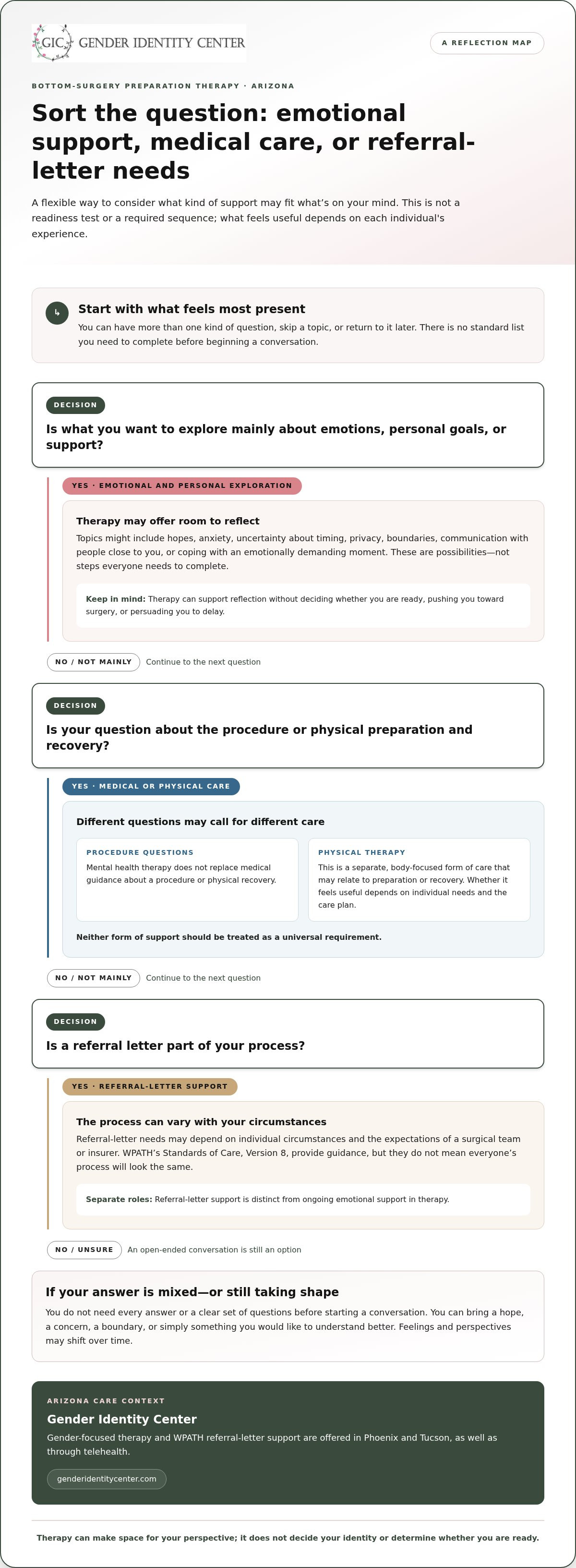
Affirming therapy can offer space to explore emotions, clarify personal goals, and think through the support you may want around surgery. It does not replace medical guidance about a procedure or physical recovery. Referral-letter needs can also vary with your circumstances and the expectations of a surgical team or insurer. WPATH’s Standards of Care, Version 8, provide guidance, but they do not mean everyone’s process will look the same.
This article explains what emotional preparation may include, how it differs from physical preparation, and how therapy and referral-letter support may fit into care in Arizona. Gender Identity Center offers gender-focused therapy and WPATH referral letters in Phoenix and Tucson, as well as through telehealth. You can explore these options at a pace that feels right for you.
Key Takeaways
- Therapy can offer emotional support as you consider bottom surgery, while surgical and physical preparation are separate parts of care.
- Explore topics such as anxiety, communication, coping, or boundaries if they feel relevant. There is no single expected checklist or sequence.
- Therapy can support reflection without deciding whether you’re ready. Referral-letter processes may vary with individual circumstances and requirements.
- You don’t need every answer before beginning a conversation. It may help to note questions, priorities, or language you’d like your therapist to use.
- If you’re looking for a therapist for bottom surgery preparation in Arizona, Gender Identity Center offers gender-focused therapy and WPATH referral-letter support in Phoenix, Tucson, and through telehealth.
What Does a Therapist for Bottom Surgery Preparation in Arizona Help With?
A therapist for bottom surgery preparation arizona can offer a place to explore emotional and personal questions as you consider surgery. This is mental health support, not a surgical procedure or a substitute for medical care. Bottom-surgery preparation therapy supports emotional well-being and reflection; medical and physical care address the procedure and the body. Keeping these roles distinct can help you decide what you want from therapy and which questions are about your medical care.
There isn’t one set of goals for these conversations. You might want to talk through what surgery means to you, or you may feel settled and want to consider how the experience fits into your life. Some people find gender-focused therapy useful for exploring these questions; others may want support with one specific concern. A therapist for bottom surgery preparation arizona can make room for your priorities without requiring a particular path or outcome. This depends on each individual's experience.
Supportive exploration is different from pressure. Therapy can involve listening, asking questions, and helping you consider your own perspective, rather than pushing you toward surgery, persuading you to delay, or asking you to change your decision. If a referral letter is part of your process, that is separate from ongoing emotional support, and the process may depend on your circumstances.
What questions might someone bring to therapy before bottom surgery?
You can begin with whatever feels most present, even if it is still taking shape. You might talk about your hopes for life after surgery, uncertainty about timing, or how you’d like to communicate your needs to people close to you. Other topics might include privacy, boundaries, or asking for support if your routines change. These are options to consider, not a standard list you need to complete.
There’s no requirement to arrive with clear questions. Feelings can be mixed, and they may shift as you reflect or learn more. You might feel confident about one part of your decision and unsure about another. Therapy can offer a steady space to notice those responses without treating them as proof that you should proceed or stop. If a question continues to matter to you, you can return to it in a later conversation.
How is mental health therapy different from physical therapy?
Mental health therapy focuses on emotional well-being, self-understanding, and reflection. Physical therapy is a separate, body-focused form of care that may relate to preparation for or recovery from a procedure. Which forms of support someone considers, and whether either feels useful, depends on their needs and care plan. Neither should be treated as a universal requirement. Gender-affirming care can include psychological, medical, physical, and social support, with the mix varying by person.
Keeping the distinction clear can help you identify what you want to discuss. A therapist for bottom surgery preparation arizona can help you explore emotions and personal goals. Surgery-specific and physical-care questions fall outside the role of mental health therapy. Each form of support has its own possible role, and your experience may include some forms without others.
How Can Gender-Affirming Therapy Support You Before Surgery?
Therapy before surgery doesn’t have to follow a fixed agenda. It can be a space to consider what’s on your mind, whether that means talking through anxiety, sorting out uncertainty, or naming what you hope for. You might feel settled, curious, uneasy, or some combination. A therapist for bottom surgery preparation arizona may help you explore the topics that feel relevant without assuming you’re distressed or need to feel a certain way.
Therapy goals are shaped by the individual, their priorities, and what feels useful at each point in the process. One conversation might focus on communicating with loved ones; another may be about personal boundaries or ways to cope with an emotionally demanding moment. These are possibilities, not steps everyone needs to complete. This depends on each individual's experience.
Making space for emotions, questions, and changing perspectives
You can bring hopes and concerns without having to label them as right or wrong. Reflection may help you notice which parts of surgery feel meaningful, which questions you’d like to explore, and what matters most in your decision-making. Your thoughts may stay consistent or shift over time. Therapy can make room for that movement without promising a particular emotional or surgical outcome.
A therapist may help you slow down a complicated question or put words to a feeling that’s been hard to describe. You could explore what support would feel respectful, how you want others to speak with you, or what you’d prefer to keep private. You don’t have to arrive with distress to have something worth discussing. For instance, you might want to talk through how to explain a boundary, or simply sort out which questions you want to hold onto for now.
Building support and coping strategies at your own pace
If it feels relevant, therapy may help you think through how to approach a conversation, respond to uncertainty, or steady yourself during an emotionally demanding moment. This could mean identifying what you want to say, considering boundaries, or deciding what kind of support you’d welcome. Family therapy may be an option when you want family members involved; it isn’t an assumed part of preparation.
Individual therapy can adapt as your questions and priorities evolve. You might begin with one concern and later find another feels more useful to explore. The WPATH Standards of Care Version 8 offer guidance for gender-affirming care, while therapy conversations can remain responsive to your context. If you’re considering a therapist for bottom surgery preparation arizona, look for a conversation that leaves room for your changing priorities and does not assume that everyone approaches surgery in the same way.
For related support, individual gender therapy can provide space to discuss identity, feelings, and personal goals. You can consider whether that kind of conversation fits what you’re looking for and what you’d want to bring to it. There’s no single pace or set of topics you’re expected to follow.
Does Therapy Mean Someone Else Decides If You’re Ready?
It’s understandable to wonder whether therapy will feel like a test of whether you’re ready for surgery. The purpose of supportive therapy is to make space for your reflection, not to impose a personal decision. You remain the expert on your identity, values, and lived experience. What feels useful in sessions, and how you understand your choices, depends on your circumstances.
Therapy conversations and formal referral-letter processes are related, but they aren’t the same thing. You may want emotional support whether or not a letter is part of your care pathway. If documentation is needed, its purpose and process can depend on the expectations of the relevant surgical team or insurer, as well as your individual situation. A conversation about feelings does not automatically determine a referral outcome.
What does a supportive, nonjudgmental therapy relationship look like?
A supportive relationship may include careful listening, respectful language, and attention to the goals you bring into the room. You can share what you’re comfortable sharing, and you can clarify the name, pronouns, or language you’d like used. Your therapist can help explore questions without treating your identity as something to prove.
You can also speak up about how sessions are going. For example, you might ask to slow down, shift the focus, or spend more time on a specific concern. If a question feels uncomfortable or the conversation doesn’t match what you need, naming that can become part of the work. Therapy is a collaborative relationship, and your preferences matter within it.
How do therapy and referral letters relate?
The World Professional Association for Transgender Health’s Standards of Care, Version 8, uses an individualized assessment approach rather than a single, universal pathway. It offers clinical guidance, but practical documentation expectations may still vary among insurers and surgical teams. The experience of someone seeking a therapist for bottom surgery preparation in Arizona can therefore differ from another person’s, even when they’re considering similar care.
Gender Identity Center offers WPATH-compliant referral letters for gender-affirming medical care. This support does not promise approval, a particular timeline, or the same process for everyone. The therapist and client can discuss the person’s context and the purpose of the requested documentation, while keeping the distinction clear between a formal letter process and therapy for emotional support.
If you’d like to discuss documentation, gender-focused therapy can include conversations about personal goals and referral-letter support. You can explore what you want from therapy, raise questions about pace or comfort, and take the conversation one step at a time. You don’t need to have every concern resolved before beginning.
How to Prepare for a Therapy Conversation in Phoenix, Tucson, or Online
You don’t need to arrive with a complete plan or a perfectly organized list of questions. If you’re looking for a therapist for bottom surgery preparation in Arizona, a first conversation can simply be a chance to share what brings you in and what kind of support you might want. You can decide what feels comfortable to discuss, and your priorities can become clearer over time.
A small amount of preparation may help you feel more grounded, but it’s optional. You could jot down a few words about what’s on your mind, save a question on your phone, or simply begin with, “I’m not sure where to start.” Not knowing yet is a reasonable place to start.
Questions you may choose to bring to a session
Use only the prompts that feel relevant to you. You might ask what emotional support could look like, how therapy goals are shaped, or how referral-letter support fits into your questions. If privacy is on your mind, you could ask how the therapist approaches privacy in sessions. Your questions can change, and you don’t have to cover them all at once.
- What would I like to feel understood about?
- What kind of support would feel useful right now?
- Are there words, names, or pronouns I’d like used?
- Is there a question about documentation I want to discuss?
Before a session, try this brief prompt: “One thing I hope to explore is ____. One thing I’m unsure about is ____.” You can bring your notes, keep them private, or leave them at home. They’re there to support you, not to set an agenda you have to follow. You might also note what would make a conversation feel useful, such as having time to speak freely or focusing on one question rather than several.
Finding a format that feels accessible in Arizona
Gender Identity Center serves clients through offices in Phoenix and Tucson, as well as telehealth. The format that feels accessible may depend on your location, preferences, schedule, and comfort with meeting online or in person. There’s no single best choice for everyone. Exploring Arizona gender therapists can help you learn about gender-focused therapy and consider what kind of conversation you want to begin.
If you choose telehealth, you might think about where you’d feel comfortable speaking and whether you’d prefer to write down thoughts beforehand. If meeting in person feels more supportive, an office in Phoenix or Tucson may suit you better. These are considerations, not requirements. What feels manageable and affirming depends on each individual’s experience.
When you feel ready to take a next step, you can schedule a therapy conversation with Gender Identity Center. You can begin with your questions as they are today, even if some answers are still unfolding.
Explore Bottom-Surgery Preparation Therapy With Gender Identity Center
Choosing what support looks like is personal. At Gender Identity Center, gender-focused individual therapy and gender counseling offer space to reflect on your questions, feelings, and goals as you consider bottom surgery. You help shape the conversation and its pace. You might want to explore a specific concern, talk through changing priorities, or begin with what feels present today.
Therapy isn’t a requirement to feel a certain way or make a particular choice. Your needs may shift as you learn more or as life changes, and sessions can respond to what matters to you. A therapist can support reflection without deciding whether you should pursue, delay, or change your plans.
What support can look like at Gender Identity Center
Individual therapy can provide a consistent place to consider emotional well-being, personal goals, and the kinds of support you’d like around your care. Gender counseling can also make room for questions connected to identity and self-understanding. What you choose to discuss, and what feels useful, depends on your experience.
Gender Identity Center also offers WPATH-compliant referral letters for gender-affirming medical care. A letter is a separate form of support from ongoing therapy, and the process can vary with individual circumstances and expectations. There’s no promise of a particular outcome or timeline. You can discuss what the documentation process means for you without treating the conversation as a judgment of your identity.
Support is available through Arizona offices in Phoenix and Tucson, as well as telehealth. A local visit or an online conversation may feel more accessible depending on your location, preferences, and comfort. The format doesn’t define the value of your experience; what matters is finding a way of engaging that feels workable for you.
Choose a next step that feels right for you
You might begin by asking yourself what you hope to get from a first conversation. Perhaps you want a place to talk openly, help organizing questions, or information about referral-letter support. You might not know yet. That’s okay. You can start with uncertainty and decide together what feels relevant to explore, without committing to a particular outcome or pace.
If you’re considering a therapist for bottom surgery preparation in Arizona, Gender Identity Center offers space to explore support on your terms. You can bring one question, several, or simply a sense that you’d like to talk. There’s no need to have every answer ready before beginning.
When you feel ready, schedule a conversation with Gender Identity Center. A first discussion can help you explore what support might mean for you, at a pace that respects your choices.
Take Your Next Step at Your Own Pace
Deciding whether to begin therapy doesn’t require you to have every question answered. You might be ready to talk, still weighing what support could mean, or simply curious about having a space to reflect. Any of those starting points can be valid. The choice to pursue surgery, pause, or continue exploring belongs to you.
If you’re considering a therapist for bottom surgery preparation arizona, let your own priorities guide what you look for in a first conversation. You might want to focus on one concern, ask about how therapy works, or take time to notice whether the conversation feels respectful. There’s no single pace or response that applies to everyone; this depends on each individual’s experience.
When you feel ready, Gender Identity Center welcomes you to take a next step that fits where you are now. You can schedule a conversation about affirming therapy and begin with whatever feels most important to share. Your path can unfold one thoughtful conversation at a time.
Frequently Asked Questions
Can I start therapy before choosing a surgeon?
Yes, you can begin therapy before choosing a surgeon. An early conversation can help you sort out what information you’re still seeking, what support could feel helpful, or which questions you want to keep for later. For example, you could talk about how you’d like to make decisions without needing to choose a provider during that session. The timing and focus depend on your circumstances and what feels useful to you.
Do I need to be certain about bottom surgery before starting therapy?
No, you don’t need to have every answer before starting therapy. You might feel sure about some parts of your thinking and still have questions about others. It can help to say plainly, “I’m still exploring,” or “I know what I want to discuss today, but not what I’ll decide.” A therapist for bottom surgery preparation Arizona residents seek can support reflection without assuming uncertainty means you should reach a particular conclusion.
Can therapy help if I feel anxious about talking with loved ones?
Yes, therapy may give you space to consider whether, when, and how you want to talk with loved ones. You could rehearse a sentence you might use, think through what you’d prefer to keep private, or identify what kind of response would feel supportive. You’re not obligated to disclose personal information or involve family in therapy. Whether these conversations belong in your sessions depends on your relationships, comfort, and goals.
Can I use telehealth for gender-focused therapy in Arizona?
Yes, Gender Identity Center offers telehealth, as well as care through its Phoenix and Tucson offices. A remote session may suit you if meeting online feels more comfortable or helps with access from your location. You might consider whether you have a private place to talk and whether video or in-person conversation feels easier. The best fit depends on your needs and circumstances, not on a universal preference.
What if my feelings about surgery change over time?
Feelings and priorities can change, and that doesn’t automatically mean your earlier thoughts were mistaken. You might notice that a concern has eased, a new question has become important, or your perspective is still mixed. In therapy, you can describe what feels different and explore what remains meaningful to you. There’s no single emotional pattern everyone follows, and you can take time to understand your own responses.
Can therapy support a partner or family member too?
Yes, Gender Identity Center offers family therapy, which may be relevant if you want a loved one involved in support. For example, you might want help making space for a respectful conversation or understanding each other’s perspectives. You can also choose to keep therapy individual. Whether family participation feels helpful depends on your relationships and preferences, and your comfort and agency can remain central to deciding what involvement looks like.
Does therapy guarantee a referral letter for bottom surgery?
No, therapy can’t guarantee that a referral letter will be provided or promise a particular outcome. Gender Identity Center offers WPATH-compliant referral letters for gender-affirming medical care. The World Professional Association for Transgender Health’s Standards of Care provide guidance, while circumstances and documentation processes may vary from person to person. If a letter is part of your plans, you can discuss its purpose and your questions as part of an individual conversation.