
Am I Faking Being Nonbinary? A Tucson Therapist Can Help You Explore

What if doubting whether you’re nonbinary doesn’t mean you’re faking it, but simply reflects questions you’re still working through? If you’ve searched “am i faking being nonbinary therapist tucson,” you may be looking for reassurance while worrying that someone will judge or dismiss you. You don’t have to prove your identity or reach a fixed conclusion before you’re allowed to explore what feels true for you.
Uncertainty can feel unsettling, especially when labels and other people’s expectations seem to call for a clear answer. Doubt alone doesn’t decide your identity; what it means depends on your experience. This article looks at why self-doubt may arise, what it can and can’t tell you, and how affirming therapy in Tucson might support reflection without steering you toward a particular conclusion.
Individual therapy and gender counseling can offer a collaborative space to talk through your feelings, questions, and needs at your own pace. You remain the expert on your life, and exploration doesn’t have to follow a set path. Whether you’re in Tucson or Phoenix, you can ask a prospective therapist how they make room for uncertainty and what support is available.
Key Takeaways
- Uncertainty alone can’t confirm or disprove your identity; what it means depends on your experience.
- Social expectations, fear of rejection, or pressure to explain yourself may be useful areas to reflect on, but they aren’t universal explanations.
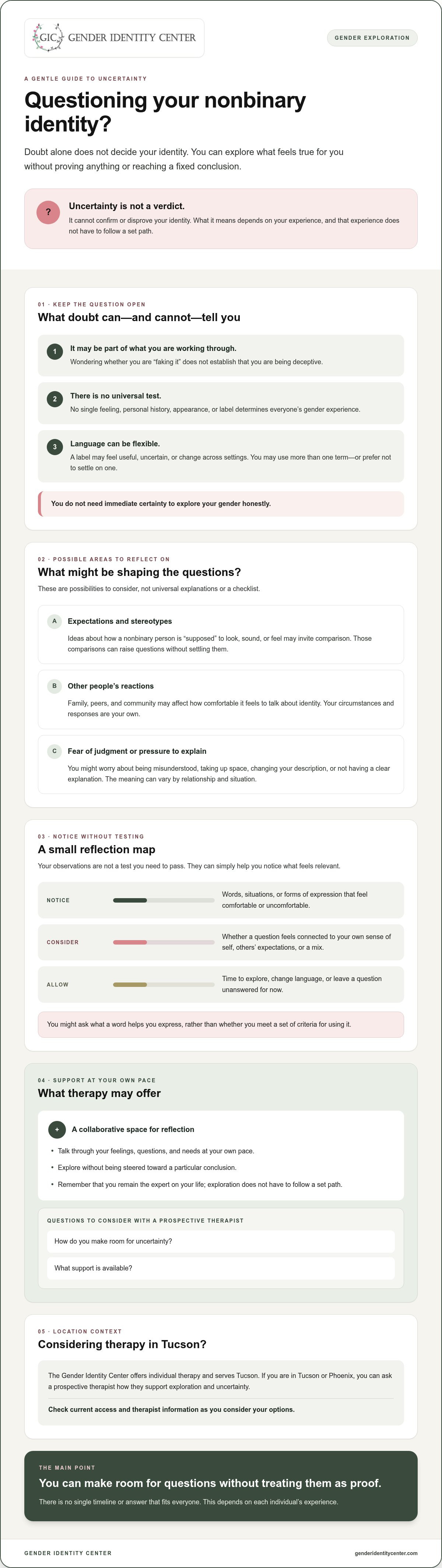
- Notice which words, situations, or forms of expression feel comfortable or uncomfortable, without treating your observations as a test.
- If you’re asking “am i faking being nonbinary therapist tucson,” individual therapy may offer space to explore your questions without requiring a particular conclusion.
- The Gender Identity Center offers individual therapy and serves Tucson; check current access and therapist information as you consider your options.
Questioning Whether You Are Nonbinary Does Not Mean You Are Faking
Wondering whether your identity is real can feel frightening, especially if you worry that other people might dismiss your questions or expect you to explain them perfectly. But uncertainty by itself doesn’t prove that you are nonbinary, and it doesn’t prove that you aren’t. It may simply be part of what you’re trying to understand right now.
There isn’t one feeling, personal history, appearance, or label that determines everyone’s gender experience. You might relate to some descriptions of nonbinary identity and not others. You might feel comfortable with a label in one setting but unsure about it in another. For a broad introduction to what it means to be nonbinary, you can explore how the term is used as an umbrella for varied experiences.
You don’t need immediate certainty to explore your gender honestly. If you’re searching “am i faking being nonbinary therapist tucson,” you may be hoping someone can settle the question. A therapist can help you examine it with care, but the purpose of that conversation need not be to assign you an identity.
What might “faking it” mean to you?
It may help to pause over the phrase itself. Are you afraid someone will judge you, misunderstand you, or decide you’re mistaken? Perhaps you’re worried about taking up space, changing how you describe yourself, or not having a clear explanation. These concerns can have different meanings in different relationships and circumstances. “Faking it” isn’t a clinical term, and having the fear doesn’t establish that you’re being deceptive.
Is uncertainty part of exploring gender?
People may experience clarity, uncertainty, or shifts in the language they use in different ways. Some may find a label that feels useful; others may question it, use more than one term, or prefer not to settle on a label. None of those paths is a universal timeline or a test you need to pass.
If it feels useful, consider what you mean when you ask yourself whether you’re faking it. Is the question about how you feel privately, how others respond, or whether you’re allowed to change your mind? You don’t have to answer all at once or reach a fixed conclusion. The meaning of your questions depends on your individual experience, and you can give yourself time to notice what feels relevant as your understanding develops.
Why You Might Doubt Your Nonbinary Identity
Questions about gender can be shaped by more than one part of life, and no single explanation will fit everyone. Social expectations, other people’s reactions, or pressure to describe yourself clearly may be worth reflecting on, but they aren’t a checklist for deciding what your identity means. The reasons someone questions their gender depend on each individual’s experience.
How expectations and other people’s reactions can shape questions
Narrow ideas about what a nonbinary person is “supposed” to look, sound, or feel like may lead you to compare yourself with a stereotype. For example, you might wonder whether a particular label fits because your appearance or interests don’t match what you’ve seen represented. Those comparisons can raise questions, but they don’t have to settle them.
Family, peers, and community can also influence how comfortable it feels to talk about identity. You may feel at ease in one setting and more guarded in another, or you may not have faced a difficult response at all. Your circumstances are your own. If it feels relevant, consider whether a question comes from your private sense of self, someone else’s expectations, or a mix of both. Harvard Health’s Understanding Gender Fluidity offers context on gender diversity and why support can matter.
When a label feels useful, uncertain, or changeable
Some people find labels helpful because they give language to an experience or make it easier to communicate with others. Others prefer broader terms, use different language in different contexts, or aren’t ready to choose a label. You might ask yourself what a word helps you express, rather than whether you can meet a set of criteria for using it.
It can also help to separate uncertainty about a label from uncertainty about what support or language feels useful. You may know what pronouns or forms of address feel comfortable while still wondering which identity term fits, or you may be exploring both. A change in language doesn’t automatically make an earlier description false; it may reflect new context or a different understanding. What feels meaningful depends on your experience.
If you searched “am i faking being nonbinary therapist tucson,” you might be looking for space to explore these influences without being pushed toward an answer. Individual therapy may offer a collaborative setting to discuss your questions at a pace that works for you. If you’d like to learn about the Gender Identity Center’s therapists, you can review therapist profiles as one step in considering your options.
Common Fears About Being Nonbinary, and What They Can and Cannot Tell You
Some worries can sound like questions with a yes-or-no answer: “If I have doubts, does that mean I’m not nonbinary?” or “Will a therapist decide for me?” These concerns deserve thoughtful attention, but they don’t need to become tests you must pass. A thought or feeling may be worth exploring without serving as a verdict about your identity.
| Fear or misconception | A more open way to consider it |
|---|---|
| “I have to feel certain all the time for my identity to be meaningful.” | People’s thoughts and feelings may vary across time and context. Constant certainty isn’t a universal measure of identity. |
| “If I doubt, that proves I’m not nonbinary.” | Doubt alone can’t settle the question either way. It may be one part of what you’re experiencing, with meaning that depends on your circumstances. |
| “I need therapy to prove or defend who I am.” | You can seek support to talk through questions, feelings, or goals without presenting a case for a particular identity. |
| “A therapist will tell me what I am.” | You can ask how a prospective therapist approaches identity exploration and whether there’s room for your own language and questions. |
Does having doubts mean you are not nonbinary?
Not by itself. Doubt doesn’t confirm or disprove a nonbinary identity, and it doesn’t automatically point to a hidden answer. Your thoughts may shift with relationships, settings, or what you’re considering at a given time. You can notice those shifts without treating them as a symptom or requiring them to mean one specific thing.
Will a therapist tell you what your identity is?
It’s understandable to wonder whether talking with a therapist could turn into being judged or directed toward a conclusion. Therapy can be a place to bring your questions, but you can ask in advance how a therapist makes room for uncertainty and respects a client’s own words. For example: “Would we be able to explore this without needing to settle on a label?” Their response may help you decide whether the conversation feels right for you.
A search for “am i faking being nonbinary therapist tucson” may reflect a wish for certainty, but you don’t have to prove your identity to seek individual therapy or gender counseling. You can bring what you know, what you’re unsure about, or simply the questions you have today. What feels useful from therapy depends on your experience, and you can decide what you want to explore.
Ways to Explore Your Gender Questions at Your Own Pace
You don’t have to turn your questions into a test with a right answer. If reflection feels helpful, you might gently notice what brings a sense of comfort, neutrality, or discomfort. You can write things down, think them over privately, or leave them alone for now. These are optional ways to listen to yourself, not steps you need to complete to understand your gender.
Questions you can consider without needing immediate answers
You might ask yourself what brought this question to mind now, or what you hope to understand by exploring it. Notice whether particular words, pronouns, situations, or forms of expression feel affirming, neutral, or uncomfortable. If you like, keep a private note of specific moments and what stood out, such as feeling more at ease with one form of address in a particular setting. This is for your own reflection, not a scorecard or a way to prove an identity. There’s no required conclusion.
Pause or skip any prompt that feels uncomfortable. You can revisit it later, or decide it isn’t useful to you. If you want to talk with someone, consider whether there’s a trusted person and setting where you feel safe enough to share. You don’t have to disclose anything before you’re ready. Professional support is another option, not a requirement for self-understanding.
How to look for a therapist who respects your pace
If you’re considering therapy, ask a prospective therapist about their experience supporting nonbinary and gender-questioning clients, and how they make room for uncertainty. You might also ask how privacy is handled, how you can shape therapy goals, and what you can do if you feel unsure or want to pause a topic. Practical questions matter too: ask about in-person options in Tucson or Phoenix, telehealth availability in Arizona, and how to find out about scheduling. Their answers can help you decide whether the fit feels right for you.
If your search is “am i faking being nonbinary therapist tucson,” it may help to remember that a therapist’s role need not be to decide your identity. Individual therapy and gender counseling can offer space to explore questions collaboratively, with the pace and focus shaped around your needs. What feels supportive depends on your individual experience.
You can review the Gender Identity Center’s therapist information as one way to consider provider fit. If you’d like to explore next steps, check the therapy scheduling information and confirm current availability and details that matter to you.
Finding Nonbinary-Affirming Therapy in Tucson Without Giving Up Your Agency
Looking for support doesn’t mean you need to arrive with a settled identity or a clear plan. Individual therapy may offer room to talk through feelings, questions, and possible goals, including what you hope to understand and what you’d rather leave open for now. The conversation can begin with what feels important to you.
If you’ve searched “am i faking being nonbinary therapist tucson,” you may be concerned that a therapist will expect you to prove your identity or reach a particular conclusion. You can ask about a therapist’s approach before deciding whether to begin. For instance, ask whether you can focus on exploring questions without committing to a label or goal. A first conversation can help you understand whether there’s room for your questions and your own language.
What you can ask before starting therapy
You might ask how sessions make room for uncertainty, how you and the therapist would decide what to focus on, and what happens if you’re not ready to discuss something. You can also ask about privacy, current Tucson or telehealth availability, and practical next steps. The Gender Identity Center offers individual therapy and serves Tucson, though current access and appointment details should be confirmed directly.
You don’t need to share everything at the outset. It may be enough to say, “I’m questioning and not sure what I want to call it,” or simply, “I have some questions about gender.” You can decide what feels comfortable to disclose, and you can ask for clarification if something about the process isn’t clear.
Taking a first step without deciding everything
Contacting a practice can be a way to ask questions, not a commitment to a label or a particular therapy goal. You remain the expert on your experience. Whether therapy feels useful, and what you choose to explore there, depends on your needs and circumstances.
If you’re considering Tucson transgender counseling, you can learn more about therapist information as you think about provider fit. When you feel ready, review the scheduling options and confirm current availability. There’s no need to decide everything before taking a small step toward learning what support might involve.
Take the Next Step at Your Own Pace
Questioning whether you’re nonbinary doesn’t require an immediate answer. Doubt alone can’t confirm or disprove your identity, and the influences behind your questions may be personal and change with context. You can notice what language and experiences feel meaningful without turning reflection into a test.
If you searched “am i faking being nonbinary therapist tucson,” individual therapy may be one option for exploring your feelings, questions, and possible goals. The Gender Identity Center offers individual therapy and gender counseling and serves Tucson, with telehealth in Arizona. Current in-person or telehealth access and scheduling details should be confirmed with the practice.
Therapy doesn’t have to decide who you are. You can bring questions, set a pace that feels workable, and choose what you’re comfortable sharing. If you’d like to learn more, explore scheduling options and see what next step, if any, feels right for you. Your understanding can unfold in its own time.
Frequently Asked Questions
Am I faking being nonbinary if I sometimes doubt myself?
Not necessarily. Doubt by itself doesn’t establish whether you’re nonbinary or not. Thoughts about identity may vary with time, relationships, or context, and there isn’t one required pattern. If you’re searching “am i faking being nonbinary therapist tucson,” you may be looking for a way to explore without being judged. A therapist can support reflection, but you remain the person best placed to describe your experience.
Can a therapist tell me whether I am really nonbinary?
A therapist can help you explore your questions, but therapy doesn’t need to involve someone else deciding your identity. You might talk about what different words mean to you, what feels uncertain, or how other people’s responses affect you. You can ask a prospective therapist how they approach identity exploration and whether they make room for your own language. Your conclusions depend on your experience and aren’t a test result.
Do I need to be certain before seeing a gender therapist in Tucson?
No, you can consider therapy while you’re still questioning. You might begin with a broad concern, such as feeling unsure about labels or wanting space to talk without pressure. The Gender Identity Center offers individual therapy and gender counseling, and serves Tucson. If you’re considering care in Tucson or elsewhere in Arizona, confirm current availability and ask what the first steps involve. You can share only what feels comfortable.
What happens in therapy when I am questioning my gender?
Therapy may involve talking through your feelings, questions, relationships, or possible goals, depending on what you want to focus on. You could tell the therapist that you’re unsure about labels, or ask to explore how certain words or situations feel. There isn’t one required conversation or outcome. In Tucson or through Arizona telehealth, you can ask the practice what sessions may involve and how you can shape the discussion.
Can my feelings about being nonbinary change over time?
People’s feelings and the words they use can shift, stay consistent, or feel different in different settings. A change in language doesn’t automatically make an earlier description false. You might find a label useful now and reconsider it later, or prefer not to use a label. There’s no single timeline that applies to everyone. What a change means depends on your individual experience and the context around it.
How do I find a nonbinary-affirming therapist in Tucson?
Consider asking about a therapist’s experience supporting nonbinary and gender-questioning clients, how they approach uncertainty, and how you can shape therapy goals. The Gender Identity Center offers individual therapy and gender counseling and serves Tucson and Phoenix. Telehealth is also offered in Arizona, but current in-person and telehealth access may vary, so confirm availability and scheduling directly. You can also ask what practical steps are involved before beginning.
Is gender therapy only for people who want to transition?
No single goal is required to explore gender therapy. Someone might want to discuss identity, language, relationships, or uncertainty without deciding to pursue a particular transition-related step. The focus depends on the person’s needs and goals. The Gender Identity Center offers gender counseling and individual therapy, but doesn’t provide hormone prescriptions or surgical procedures. If you’re in Tucson or Phoenix, ask the practice about current service availability and what support may fit your questions.