
What If I Regret Transitioning? Exploring Counseling in Arizona

What if questioning your transition doesn’t have to lead to an immediate decision? If you’re searching “what if i regret transitioning counseling arizona,” you may be carrying doubts, changing feelings, or fear that someone will treat your questions as proof of a particular answer. Those feelings deserve room to be heard, not a verdict.
It makes sense to want a counselor who listens without steering you toward transition or detransition. The meaning of regret, pausing, or changing direction depends on each person’s experience. Counseling can offer space to reflect on what you’re feeling, what matters to you, and what support might help, without promising a specific conclusion.
This article explores what transition-related uncertainty can mean, what individual counseling may and may not offer, and how to look for affirming support in Arizona. Gender Identity Center offers individual therapy and gender-focused counseling, with offices in Phoenix and Tucson. Telehealth may also be an option, depending on current availability. Wherever you are in your process, you can take questions one step at a time.
Key Takeaways
- Asking whether you might regret transitioning doesn’t require an immediate decision or label. The meaning of the question depends on your experience.
- Questioning, pausing, regret, and detransition can describe different experiences. One aspect of your life doesn’t automatically define another.
- Look for a counselor who listens, respects uncertainty, welcomes questions, and explains what counseling can and can’t offer.
- If you’re searching “what if i regret transitioning counseling arizona,” you can prepare to talk even if you don’t yet have a clear explanation.
- Gender Identity Center offers individual therapy and gender counseling in Phoenix and Tucson. Ask about current availability and telehealth options.
What if I regret transitioning? Start with what the question means to you
Asking “What if I regret transitioning?” doesn’t mean you need to make an immediate decision or choose a label. If you’re looking for what if i regret transitioning counseling arizona, you may be trying to understand a feeling, not asking someone else to decide what it says about you.
Transition regret is a phrase people may use for different feelings or experiences related to transition; what it means is defined by the person experiencing it. One person may be unsure about a particular change, while another may have mixed feelings about timing, expectations, or how others have responded. The word “regret” alone can’t explain someone’s identity or determine what they should do next.
Can uncertainty mean different things to different people?
Yes. Questioning, mixed feelings, and changing needs can overlap or arise at different times, but they aren’t fixed stages that everyone moves through in the same way. You might feel settled about one part of your life and uncertain about another. Social circumstances, relationships, health, and personal priorities may also shape how transition feels, though the relevance of each factor varies from person to person.
Related terms can describe different experiences, too. What detransition is may be useful to explore, but detransition and regret aren’t interchangeable for everyone. Someone’s social choices, medical experiences, and personal understanding of identity may connect, or they may not. No single part automatically proves or disproves a particular identity.
Does asking about regret mean you must choose a direction now?
No. This article can offer context, but it can’t decide what you should do. You don’t have to settle on an identity label, explain every feeling, or choose to pause, continue, or change course before you’re ready to reflect. Those possibilities don’t carry the same meaning for everyone.
You might start by noticing what prompted the question. Is it about a specific experience, a change in your circumstances, or a feeling that’s difficult to name? You don’t need to reach a conclusion to consider those questions. Individual counseling may offer a place to talk them through, while the meaning and any next steps remain yours to explore. The aim is to make room for your perspective, not turn uncertainty into a verdict.
How transition-related feelings can change without defining your identity
Words like questioning, pause, detransition, and regret can help describe an experience, but they don’t have one universal meaning. You might question how you feel, pause one part of your transition, or reconsider a choice without relating to the other terms. Someone else may use the same word differently. Your language can change as your understanding changes, and you don’t have to choose a label if none feels right.
What might “regret,” “pause,” or “detransition” mean?
For one person, regret might refer to a specific decision or its effects. Another may use the word to describe broader uncertainty, or may not use it at all. A pause might mean taking time to reflect or changing one aspect of a transition, rather than making a lasting decision. Detransition can also refer to different experiences and doesn’t automatically tell you how someone understands their identity. These words are descriptions, not steps everyone follows in a set order.
It can help to name what you’re describing. Are you thinking about how you present socially, a medical experience, a relationship, or your personal understanding of yourself? These areas can connect, but one doesn’t determine the meaning of another.
How can personal context shape what someone is feeling?
Feelings about transition may sit alongside other parts of life. You might consider your wellbeing, relationships, sense of safety, social pressures, or changing priorities. These factors may matter in different ways, or may not feel relevant to you. Outside pressure can shape someone’s circumstances, but it shouldn’t be assumed to explain any person’s feelings.
For example, you might feel comfortable with one aspect of your life and uncertain about another. That contrast doesn’t need to be resolved into a single explanation. General information can offer language and possible questions, but it can’t determine what your feelings mean or provide a personalized clinical assessment. If you’re asking, “what if i regret transitioning counseling arizona,” a counselor may give you space to consider your own context without treating any one feeling as a final answer.
You can explore what kind of support feels comfortable, including whether you’d prefer to speak with someone who works with gender-related questions. The therapist information may be one place to learn about available counseling support. Your pace and the words you use can remain your own.
How to evaluate transition regret counseling in Arizona
If you’re looking for “what if i regret transitioning counseling arizona,” focus on how a counselor responds to your questions, not only on the words they use to describe their approach. You can ask about their experience supporting people who are questioning transition-related decisions. Listen for whether their answers leave room for your perspective, including uncertainty or changing goals.
Observable communication can offer clues about fit. Notice whether the counselor listens before interpreting your feelings, explains what counseling can and can’t provide, and welcomes questions about the process. These are signs to consider, not a guarantee that a particular counselor will feel right for you.
| What to notice | A useful sign in the conversation |
|---|---|
| Listening | They make space for your account before offering interpretations or suggestions. |
| Explaining limits | They describe what counseling can address and clarify when a question may call for another type of support. |
| Respecting uncertainty | They don’t treat doubts as proof of one identity or expected outcome. |
| Welcoming questions | They respond to questions about their approach, privacy, and practical details without dismissing your concerns. |
What questions can you ask a potential counselor?
You might ask, “How do you support clients who are questioning or unsure about next steps?” or “How do you respond if someone’s feelings or goals change?” You can also ask what privacy means in their setting, whether sessions are in person or by telehealth, and what practical details to understand before starting. You don’t need to ask everything at once.
What might help a session feel respectful and non-directive?
A respectful conversation may leave room for you to say what feels comfortable, uncomfortable, or unclear without needing to defend it. Notice whether the counselor checks their understanding rather than assuming what you mean. If something feels off, you might name it and see how they respond. Fit can become clearer over time, and you can ask about other options if you want to consider them.
A first conversation can help you assess comfort and approach, though it can’t guarantee compatibility. Gender Identity Center offers individual therapy and gender counseling; its therapist directory may help you learn about the practice’s therapists. Ask about current availability and whether the format could suit your needs.
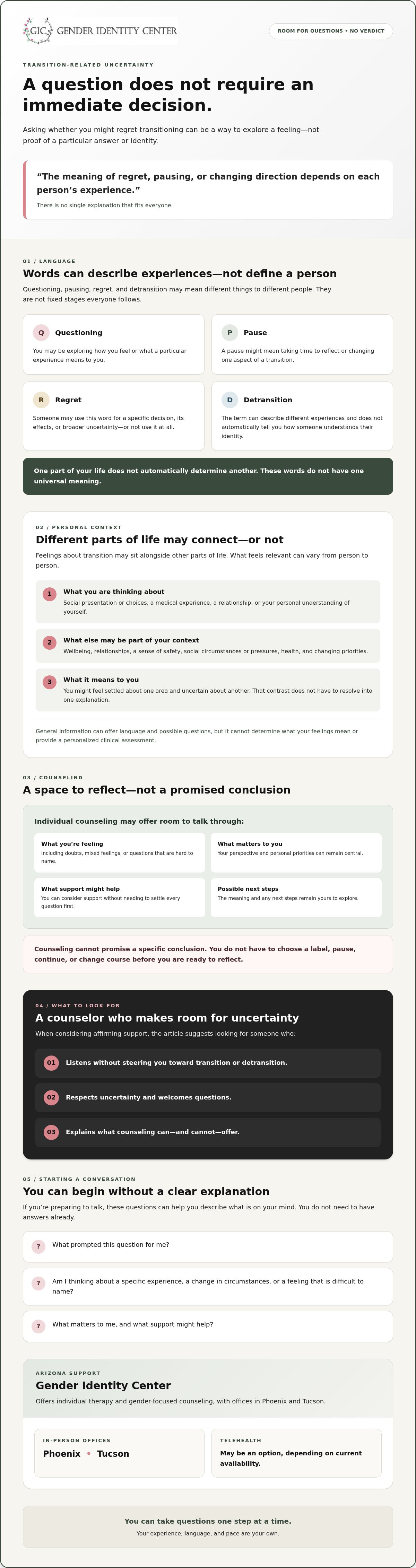
Ways to prepare for a counseling conversation about transition regret
You don’t need a polished explanation, a settled label, or a complete account of your experience before reaching out. Preparation is optional. If writing something down helps, a few brief notes can give you a starting point. If you’d rather speak without preparing, that’s valid too.
As you consider “what if i regret transitioning counseling arizona,” think about what you want from a conversation. Are you looking for someone to listen, information about counseling, or support while you sort through questions? Your answer may be uncertain or change over time.
What could you write down before a first conversation?
Use only prompts that feel useful. You might note what brought the concern forward, what you hope to understand, and what you’re not ready to discuss. A few words are enough. You can share your notes, keep them private, or set them aside.
- Name the concern: What feels confusing, difficult, or important right now?
- Note your questions: What would you like to ask about counseling, your options, or the counselor’s approach?
- Identify support preferences: Would listening, reflection, information, or help exploring choices feel most useful?
- Discuss next steps: What would you like to understand about the process before deciding whether to continue?
How can you describe what support would feel helpful?
You can tell a counselor what kind of conversation you want, even if you’re still figuring it out. For example, you might say, “I’d like space to talk without being pushed toward a decision,” or “I’m not ready to discuss every detail yet.” You can also share preferences about communication, topics, or the pace of conversation. Your preferences may become clearer as you talk.
It’s okay to ask what a counselor can help with and where their role has limits. Counseling may support reflection and mental health, but it doesn’t replace medical care. If you have questions about medical options, you can ask which type of provider may be appropriate to consult. You don’t have to settle every question in one conversation.
If you’d like to explore whether individual therapy could be a place to discuss your questions, review the scheduling information for individual therapy. Check current details and decide whether reaching out feels right for you.
Find gender-affirming counseling in Phoenix, Tucson, or by telehealth
Looking for what if i regret transitioning counseling arizona can mean wanting a place to discuss uncertainty without being directed toward a particular decision. Gender Identity Center offers individual therapy and gender counseling for transgender and gender-diverse people. The practice has offices in Phoenix and Tucson. Telehealth may be another way to connect, depending on current availability.
What can individual gender counseling offer?
Individual therapy can provide space to discuss feelings, questions, relationships, and personal priorities at a pace that feels manageable. You might want to explore what has changed, put words to uncertainty, or talk without needing a clear explanation. The focus and usefulness of counseling depend on your experience and goals, so a particular result can’t be promised.
It may help to distinguish counseling from medical treatment. Therapy can support reflection and mental health, but Gender Identity Center does not prescribe hormone replacement therapy or provide gender-affirming surgery. If you have questions about those forms of care, you can ask a relevant medical provider. Counseling and medical care have different roles, though you may choose to consider both.
How can Arizona residents explore a first step?
Before making plans, check whether in-person appointments are currently available in Phoenix or Tucson, and whether telehealth is an option for your circumstances. Service format and appointment availability can change, so confirm directly what is presently offered. You might also ask how individual therapy is structured and whether the counselor’s approach leaves room for questions or changing goals.
If you’re unsure whether counseling is right for you, you don’t have to settle that question all at once. Reviewing practical details can help you see whether an option feels accessible. You’re welcome to explore scheduling options and decide what, if anything, feels like a comfortable next step.
Take the next step at your own pace
Uncertainty about transition doesn’t have to become an immediate decision or a fixed label. Words like regret, pause, or changing direction can mean different things to different people, and your experience is yours to understand. Counseling may offer space to reflect, ask questions, and consider what support feels useful, without requiring a particular conclusion.
If you’re searching for what if i regret transitioning counseling arizona, individual therapy may be one option for exploring your thoughts with support. Gender Identity Center offers individual therapy and gender-focused counseling, with offices in Phoenix and Tucson. Telehealth may also be an option. Current appointment and service-format availability can vary, so check directly for up-to-date information.
Counseling can support reflection and mental health, but it doesn’t provide hormone prescriptions or surgery. To learn more about arranging a conversation, explore scheduling options with the Gender Identity Center. You don’t need to have every answer before you begin. You can move forward at a pace that feels manageable to you.
Frequently Asked Questions
Can I talk to a therapist about regretting or questioning transition?
Yes. A therapist can provide space to discuss questions or feelings about transition without requiring you to reach a particular conclusion. Gender Identity Center offers individual therapy and gender counseling for transgender and gender-diverse people. If you’re searching for “what if i regret transitioning counseling arizona,” ask a potential counselor how they respond to uncertainty and changing goals. Your experience doesn’t need to fit a particular label before you talk.
Does wondering if I will regret transitioning mean I should stop?
Wondering about regret doesn’t, by itself, determine what you should do. It may be a reason to reflect on what you’re feeling and what questions you want answered, but it doesn’t prove a particular identity or point toward one right choice. If you’re considering changes to medical care, discuss those decisions with a relevant medical provider. A therapist may help you explore your thoughts without directing you toward continuing or stopping.
What happens if my feelings about transition change over time?
Changing feelings can mean different things to different people. You might feel differently about one part of transition while your thoughts about another part stay the same, or your priorities may shift with life circumstances. No single change automatically defines your identity or determines what comes next. If you want, you can talk with a counselor about what has changed, what feels important now, and what support might suit your circumstances.
How do I find a non-directive gender therapist in Arizona?
Ask how a counselor supports people who are questioning, how they respond when goals change, and whether they make room for uncertainty without assuming an outcome. Notice whether they listen, explain the limits of counseling, and welcome your questions. Gender Identity Center offers gender counseling and individual therapy, with offices in Phoenix and Tucson. Ask about current appointment availability and service format, including whether telehealth is an option for you.
Can I get gender counseling online in Arizona?
Telehealth may be an option for gender counseling through Gender Identity Center, but confirm current availability directly. The practice also has offices in Phoenix and Tucson, so ask which formats are currently offered and whether they fit your needs. Before scheduling, consider asking how sessions work online and what privacy arrangements you may want to plan for. Counseling supports reflection and mental health, not medical treatment.
What should I ask a counselor if I am unsure about transitioning?
You could ask, “How do you support clients who are uncertain about next steps?” and “What happens if my feelings or goals change?” You may also want to ask about privacy, session format, and what counseling can or can’t offer. If you have preferences, such as wanting time to speak before discussing options, you can share them. You don’t need a complete explanation or prepared decision to begin a conversation.
Does the Gender Identity Center prescribe hormones or provide surgery?
No. Gender Identity Center does not prescribe hormone replacement therapy or provide gender-affirming surgery. Its services include individual therapy, gender counseling, and WPATH referral letters. Counseling may offer a place to discuss feelings, questions, and personal priorities, while medical treatment is separate. If you’re looking for hormone prescriptions or surgery, contact an appropriate medical provider. You can ask the practice about its current counseling services and referral-letter process.