
Choosing Gender Therapists in Phoenix and Tucson: A Guide to Finding Your Affirming Match

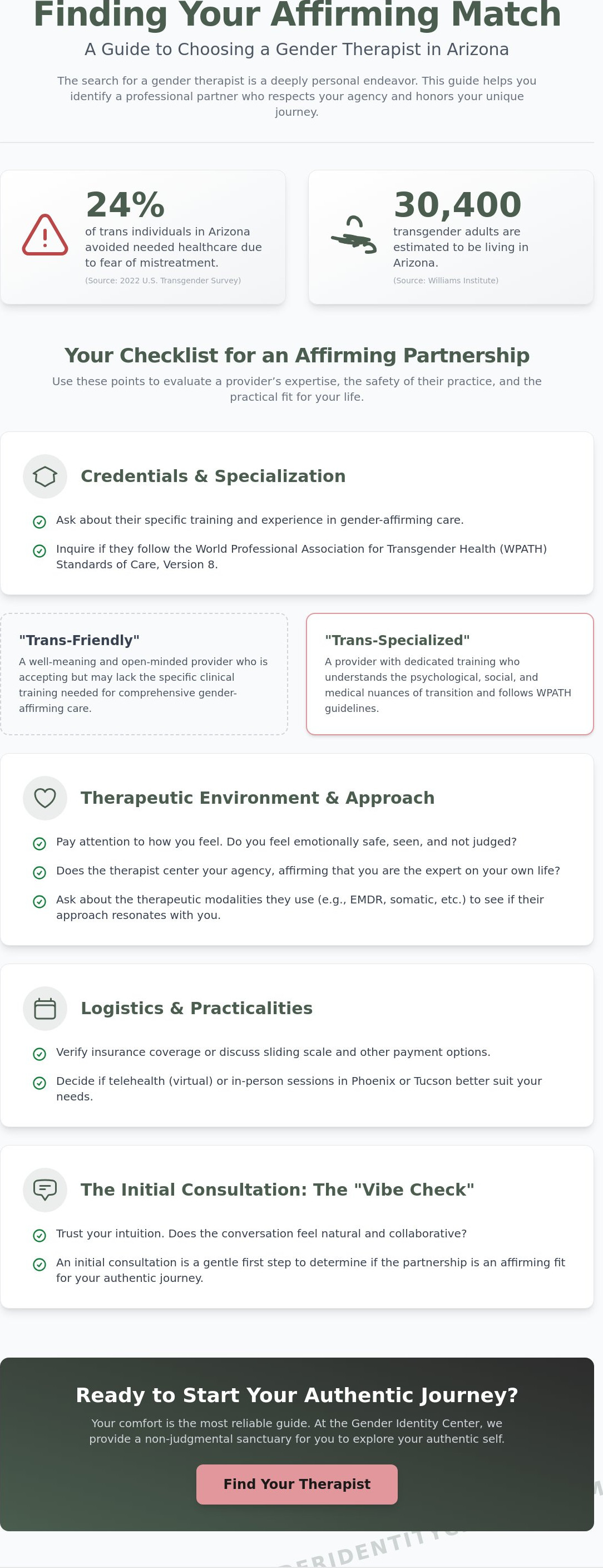
What if the most vital credential your provider holds is simply the ability to hear your truth without judgment? You might find that the search for gender therapists in Phoenix or Tucson feels heavy with the weight of past systemic barriers. It's a common experience. According to the 2022 U.S. Transgender Survey, 24% of respondents in Arizona avoided necessary healthcare due to fear of mistreatment. You deserve a sanctuary where your identity isn't a puzzle to be solved but a reality to be honored.
We understand that the definition of a perfect fit is entirely subjective and depends on each individual's experience. You may be looking for a clinical guide or a peer-led advocate, and both paths are valid depending on your current needs. Our goal is to help you discover how to find your affirming match through a lens of radical acceptance. This article provides a comprehensive checklist to help you identify a partner who respects your agency. We will explore how to manage insurance hurdles in the Southwest and how to secure medical referrals if that's part of your unique journey.
Key Takeaways
- Understand why the search for gender therapists is a deeply personal endeavor, as the ideal match often depends on each individual’s unique experience and inner resonance.
- Gain access to a comprehensive checklist designed to help you evaluate a provider’s specific experience and the emotional safety of their therapeutic environment.
- Discover how various specialized modalities, including EMDR, may offer different pathways for healing based on your own subjective needs and goals.
- Learn to navigate the practical logistics of care in Phoenix and Tucson, from verifying insurance coverage to choosing between telehealth and in-person sessions.
- Explore how an initial consultation can serve as a gentle first step in determining if a collaborative partnership feels like an affirming fit for your authentic journey.
Understanding the Role of Gender Therapists in Arizona
The search for alignment between your inner self and your outward life is a deeply personal endeavor. When you begin looking for gender therapists in cities like Phoenix or Tucson, you aren't just seeking a clinical provider; you're looking for a partner. This relationship functions as a collaborative, affirming sanctuary where you can explore the nuances of your identity without the pressure of external expectations. Because every person's history is unique, the effectiveness of a therapeutic bond often relies on personal chemistry. A provider who feels like a perfect match for one person might not resonate with another, as this depends on each individual's experience and what they prioritize in their healing journey.
Choosing the right support involves recognizing the distinction between general counseling and specialized gender-affirming care. While many practitioners are kind and well-meaning, specialized gender therapists possess specific training in the psychological, social, and medical complexities of the transition process. They act as a steady hand, helping you navigate the evolving landscape of your own becoming. This partnership centers your agency, ensuring you remain the ultimate expert on your own life while receiving the professional validation you deserve.
What Does a Gender Therapist Actually Do?
At its core, a therapist provides a non-judgmental space where you can unpack the layers of your identity at your own pace. They help you manage the emotional weight of social transition, such as coming out to family or navigating workplace changes, while also offering support for those considering medical interventions. Many people find that having a dedicated space to discuss dysphoria or euphoria leads to a greater sense of empowerment and clarity. Gender therapy is an individualized process that depends on each person’s unique goals.
- Identity Exploration: Uncovering your authentic self through open, guided reflection.
- Transition Support: Assistance with the logistical and emotional hurdles of social or medical shifts.
- Resilience Building: Developing tools to maintain mental well-being in a world that isn't always affirming.
The Importance of Affirming Care in the Southwest
Arizona presents a specific social landscape for gender-expansive individuals. According to 2022 data from the Williams Institute, there are approximately 30,400 transgender adults living in Arizona, many of whom reside in the Phoenix and Tucson metropolitan areas. Navigating life here requires a therapist who understands the local climate and the importance of finding safe, community-oriented spaces. You can learn more about finding a professional match by visiting our page on gender therapists.
It's vital to understand that "trans-friendly" is not the same as "trans-specialized." A friendly therapist is open-minded, but a specialized one follows the World Professional Association for Transgender Health (WPATH) Standards of Care, Version 8, released in 2022. These ethical guidelines ensure that your care is grounded in the latest clinical research and human rights standards. Whether you're in the initial stages of questioning or you've been on your journey for years, having a mentor who understands these frameworks provides a sense of stability and safety as you move toward your most authentic future.
The Ultimate Checklist for Choosing Gender Therapists
Finding the right support in Arizona is a deeply personal process that looks different for everyone. Because every journey is unique, the qualities you look for in gender therapists will likely depend on your specific goals at this moment. There isn't a single correct way to experience therapy; instead, the focus remains on what helps you feel seen and safe. This depends on each individual's experience and how they choose to navigate their own identity. You might prioritize a therapist's clinical background, while someone else might focus entirely on the "vibe" of the office. Both approaches are valid because your comfort is the most reliable guide in this search.
Assessing emotional safety involves noticing how your body reacts during an initial conversation. Do you feel a sense of openness, or do you feel the need to filter your thoughts? A professional who offers a non-judgmental sanctuary allows you to explore your authentic self without the pressure of meeting external expectations. It's helpful to remember that you're hiring a partner for your growth, and you have the agency to decide if their communication style aligns with your personal needs. To learn more about selecting a clinical expert who prioritizes your well-being, check out Siegel Psychology Services.
Initial Screening Questions for Arizona Providers
Start by asking about their history with the local LGBTQ+ community in Phoenix or Tucson. It's helpful to know how they approach the concept of gender dysphoria versus gender euphoria, as some people prefer a focus on joy rather than distress. You might also ask about their policy on providing letters for HRT or surgery. While WPATH guidelines (updated in 2022 to Version 8) provide a clinical framework, the way a provider handles these requests depends on their personal practice and your specific health goals.
Signs of a Truly Affirming Therapeutic Relationship
Notice how it feels when your therapist uses your correct name and pronouns consistently. This simple act of validation builds a foundation for deeper work. According to 2022 research from the Trevor Project, 71% of LGBTQ+ youth who had access to affirming spaces reported significantly better mental health. In an affirming relationship, you'll feel empowered to lead the conversation about your own identity. The focus of your sessions should be determined by your current priorities, whether that's exploring transition or discussing unrelated life stressors.
Red Flags to Watch For During Your Search
Watch for any suggestion that your identity is something that needs to be "fixed" or "cured." This is a major boundary violation and a sign that the environment isn't safe. Gatekeeping behavior, where you feel you must "prove" your gender to receive support, can be incredibly draining. A lack of familiarity with the gender identity center model might also suggest they aren't connected to the wider community of care. If you're looking for a place to start, you can explore our list of gender therapists to find a match that feels right for you.
Specialized Modalities: Finding the Right Approach for You
Every person’s path toward self-actualization looks different. There isn't a single "correct" way to engage with gender-affirming care. Instead, we see a variety of therapeutic techniques that might support your specific journey. The efficacy of these methods often depends on each individual's experience and personal history. What feels grounding for one person might not resonate with another, and that's a perfectly valid part of the process. Professional gender therapists often integrate specialized modalities to help you navigate the nuances of your identity while honoring your unique pace.
We often find that combining traditional talk therapy with more specialized services creates a more holistic support system. Talk therapy provides a space to explore your thoughts and feelings, while specialized approaches target specific needs like trauma processing or physical expression. This multi-layered approach isn't a requirement, but it's an option that many find helpful. Whether you choose a singular focus or a blend of techniques depends on what you feel you need at this moment in your life. We believe that you're the expert on your own needs, and our role is to offer the tools that might fit your specific context.
In addition to local support, staying informed through professional clinical resources can be empowering. For instance, Siegel Psychology Services provides expert insights into evidence-based therapy and psychological evaluations that can complement your personal growth journey.
EMDR and Trauma-Informed Care
Many people in our community face unique stressors. In Arizona, a 2022 Trevor Project survey indicated that 52% of transgender and nonbinary youth seriously considered suicide, highlighting the weight of minority stress. EMDR helps process past experiences of exclusion or misunderstanding by reframing traumatic memories. You can learn more about starting this process by exploring Individual Gender Therapy in Phoenix.
Speech Therapy and Voice Transition
For some, the way they sound is a significant part of their gender expression. Speech therapy can empower your social transition as you move through public Phoenix spaces like Roosevelt Row. This work bridges the gap between your internal self and your physical voice. Voice work is always an optional part of the journey. This choice remains entirely yours.
Ultimately, the "best" therapeutic modality is a subjective choice. It's influenced by your past, your current environment, and your future goals. Some individuals might find that somatic experiencing helps them connect with their bodies, while others prefer the structured nature of Cognitive Behavioral Therapy. Gender therapists in the Phoenix and Tucson areas recognize that your history with medical or social systems can impact how you view therapy. Because of this, we prioritize a flexible approach that respects your boundaries. Your comfort and safety are the most important factors in determining which path we take together. We're here to walk alongside you, offering a steady hand as you decide which tools feel right for your evolving self.
For women seeking a therapeutic environment that focuses specifically on their unique life experiences, you can visit Female Focused Therapy to explore specialized counseling.
Navigating Logistics: Insurance and Access in Phoenix & Tucson
Finding the right logistical fit is just as vital as the therapeutic bond itself. Your search for gender therapists often begins with the practicalities of daily life, such as how far you're able to travel or what your monthly budget allows. For many residents, the first step is identifying a gender clinic near me that aligns with their specific insurance plan. This process is deeply personal. What works for a student at the University of Arizona might not be the right fit for a professional in downtown Phoenix. Your comfort level with different systems depends on each individual's experience and past interactions with healthcare.
- Insurance verification: Contacting your provider to ask about gender-affirming coverage helps clarify costs.
- Superbills: If a therapist is out-of-network, you can request a document to submit for potential reimbursement.
- Group sessions: These often provide a more affordable way to access professional guidance while building community.
Virtual vs. In-Person Therapy in Arizona
The choice between meeting on a screen or in an office is a flexible one. Choosing a gender therapist online has become a popular option for those in rural parts of Pima or Maricopa county. It eliminates the stress of commuting through 115 degree heat during a Phoenix summer. Online care offers a sense of privacy that some find essential. Conversely, a physical safe space in a Tucson office provides a tangible sense of sanctuary. This choice depends on each individual's experience with technology and their need for a physical "away" space from their home environment.
Affordability and Community Resources
Financial barriers shouldn't dictate your access to growth. Many Arizona-specific insurance providers, including Blue Cross Blue Shield of Arizona and Cigna, have updated their 2024 policies to be more inclusive of gender-affirming services. If traditional insurance isn't an option, exploring sliding scale fees is a valid path. Some community-funded programs in the Valley offer support for those who qualify based on income. Family therapy is also a resource that can help stabilize your home life. It creates a collaborative environment where everyone can learn together. Ultimately, the best way to move forward is the one that feels sustainable for your unique life circumstances.
Starting Your Authentic Journey at the Gender Identity Center
We recognize that the search for gender therapists in Arizona is a deeply personal task. Our team supports the Phoenix and Tucson communities by offering a sanctuary where your identity is celebrated without question. We follow the WPATH Standards of Care Version 8, which were updated in September 2022, to ensure our clinical practices align with the most current global health recommendations. These standards help us provide necessary medical referrals for those who choose to pursue hormone replacement therapy or gender-affirming surgeries. However, we believe the necessity and timing of these steps depends on each individual's experience. You are the primary expert on your own life. We act as a professional guide rather than a gatekeeper.
Your comfort and agency are the cornerstones of everything we do. We don't believe in a one-size-fits-all approach to mental health. Instead, we offer a flexible environment where you can explore your sense of self at a pace that feels safe for you. This commitment to your autonomy ensures that every session is a collaborative effort. We prioritize creating a space where you feel seen, heard, and respected from the very first moment you walk through our doors or join a virtual session.
Meet Our Affirming Therapists
Our team consists of diverse professionals with expertise in clinical social work, marriage and family therapy, and specialized speech-language pathology. This variety allows us to match you with therapists who align with your specific background and goals. We understand that the effectiveness of therapy often relies on a subjective connection between two people. Because identity is multifaceted, our clinical and speech therapy offerings work together to support both your internal emotional health and your external expression. This collaborative nature helps address the unique challenges that may arise during your transition or exploration.
Take the Next Step Toward Your Authentic Self
Reaching out for support is a courageous act of self-care. When you contact us for the first time, you can expect a warm and non-judgmental response focused on your immediate needs. We offer flexible scheduling options for both Phoenix and Tucson residents to ensure that support is accessible regardless of your location. During an initial consultation, you have the opportunity to share your story and see if our practice feels like the right match for you. We want you to feel empowered in your choice of provider. Your journey is valid and meaningful, and we are here to support your evolution whenever you feel ready to begin.
Moving Toward Your Most Authentic Future
The process of finding gender therapists who resonate with your unique story is a deeply personal endeavor. This choice depends on each individual's experience and what feels most supportive to your spirit right now. You might find that specialized modalities like EMDR or gender-affirming speech therapy offer the specific relief you're seeking as you navigate your identity. Our team provides WPATH-compliant referral letters based on the Standards of Care Version 8 released in September 2022, ensuring your transitions are supported by recognized clinical benchmarks. Whether you prefer meeting in our safe spaces located in Phoenix and Tucson or through a Telehealth session, the path you take is entirely yours to define. We've seen that healing isn't a linear process; it's a series of evolving steps toward becoming your most genuine self. Your comfort and safety remain the priority as you explore these various professional approaches. Every person’s timeline is valid, and there's no single right way to begin this work. We're here to walk alongside you whenever you feel ready to take that next step.
Begin your journey toward authenticity, schedule a consultation with our affirming team today.
Frequently Asked Questions
How do I find a gender therapist who takes my insurance in Arizona?
You can find a provider by searching directories like Psychology Today or the GLMA Provider Directory, which allow you to filter results by insurance and identity focus. Many Arizona residents utilize plans from Blue Cross Blue Shield of Arizona or AHCCCS, which cover gender-affirming care under the 2021 settlement in Doe v. Arizona Board of Regents. Whether a specific therapist fits your financial needs depends on your individual plan details and their current network status.
Can a gender therapist in Phoenix help me get a WPATH letter for HRT?
Is gender therapy different from regular talk therapy?
Gender therapy specifically centers your identity and the nuances of the transition journey, whereas general therapy might focus on broader mental health concerns. While both use talk therapy techniques, gender-affirming care prioritizes your lived experience with dysphoria or gender euphoria. The depth of this focus depends on each individual's experience and what they hope to explore during their sessions. You may also choose to explore Individual Psychotherapy to address broader concerns in a specialized space where your authentic self can grow and evolve.
How much does gender-affirming therapy typically cost in Tucson?
Costs for therapy in Tucson vary based on the practitioner's years of experience and whether they offer sliding scale fees. According to 2023 data from the National Alliance on Mental Illness, out-of-pocket costs for mental health services can fluctuate significantly depending on the provider's specific credentials. Your final investment depends on your individual insurance coverage and the billing practices of the clinic you choose to join. We encourage you to ask about payment plans during your initial consultation.
What should I talk about in my first session with a gender therapist?
You might start by sharing your current goals for your identity journey or any challenges you’re facing with social transition. It’s also a good time to ask about their experience with the LGBTQ+ community to ensure you feel safe. What you choose to disclose depends on each individual's experience and comfort level during that initial meeting. We encourage you to move at a pace that feels right for your heart, as you're the expert on your own life.
Can I see a gender therapist online if I live outside of Phoenix or Tucson?
Yes, Arizona licensing laws allow gender therapists to provide telehealth services to any resident living within the state’s borders. This means you can access specialized care from Flagstaff, Yuma, or rural areas without traveling to a major city. Whether online therapy feels as effective as in-person sessions depends on each individual's experience with digital communication. For those seeking specialized youth support in other regions, such as Alberta, Canada, platforms like thriveteens.ca offer accessible mental health services tailored to teenagers and young adults. It’s a flexible option that brings the sanctuary of therapy directly to your home, providing stability during your discovery.
Do I need a diagnosis of gender dysphoria to see a gender therapist?
You don't need a formal diagnosis to begin exploring your identity in a therapeutic setting. However, many insurance companies require a diagnosis of gender dysphoria, often coded as F64.0 in the ICD-10, to authorize coverage for sessions or future medical steps. The necessity of a label depends on each individual's experience with their insurance provider and their personal goals for seeking support. We focus on your growth and empowerment, rather than just a clinical category.
How long does it take to find the "right" therapist for my gender journey?
Finding a therapist who feels like a true partner in your journey can take anywhere from a few days to several months. Some people connect with the first person they meet, while others interview three or four providers before feeling a sense of safety. This timeline depends on each individual's experience and the specific qualities they look for in a mentor. We recommend being patient with yourself as you navigate this important choice on your path to authenticity.