
Navigating WPATH Referral Letters in Arizona: A Guide to Affirming Support (2026)

What if the process of obtaining a medical referral felt less like a hurdle to clear and more like a conversation that honors your truth? You likely already know that the healthcare system can feel rigid, especially when you are looking for WPATH referral letters Arizona to begin the next chapter of your life. It's common to feel a sense of hesitation or even a bit of anxiety when you think about meeting with a provider for the first time. We understand that your identity isn't something to be "proven," and the weight of clinical requirements can often feel at odds with your personal sense of self.
Our goal is to offer a supportive space where you can find the documentation you need for insurance or surgeons in Phoenix and Tucson without the fear of being misunderstood. This guide explores how you can obtain a valid WPATH letter while feeling validated in your unique journey, acknowledging that the path to affirmation depends on each individual's experience. You'll discover how to navigate local insurance nuances and connect with trans-competent providers who prioritize your agency. We'll walk through the specific steps updated for January 2026, following the WPATH Standards of Care Version 8, to ensure you have a clear, compassionate roadmap for your evolving future.
Key Takeaways
- Understand how the latest WPATH standards guide medical professionals in Phoenix and Tucson, while recognizing that the application of these guidelines often depends on each individual's unique experience.
- Explore the collaborative 50-minute assessment process designed to help you secure WPATH referral letters Arizona residents may need for their specific gender-affirming goals.
- Gain clarity on navigating the varying clinical and insurance requirements in Arizona, noting that the necessity of one or two letters often hinges on the specific procedure and personal context.
- Learn how a supportive approach can transform the referral process from a perceived barrier into a collaborative step on your personal journey toward authenticity.
- Discover flexible options for beginning your assessment, whether through in-person sessions in Phoenix and Tucson or via secure telehealth from anywhere in the state.
What are WPATH Referral Letters and Why Are They Needed in Arizona?
You're exploring what it means to live as your most authentic self, and we're here to walk beside you as you navigate the medical landscape. The World Professional Association for Transgender Health, or WPATH, is an international organization that provides clinical guidance for gender-affirming care. In cities like Phoenix and Tucson, healthcare providers rely on these guidelines to ensure that your transition is supported by the highest standards of safety and empathy. When people talk about WPATH referral letters Arizona, they're referring to a collaborative document written by a mental health professional that outlines your readiness and informed consent for specific medical steps.
This document isn't a hurdle to clear; it's a way to ensure you've had the space to explore your goals with a supportive partner. The role of the letter is inherently subjective, as it focuses on your personal narrative and your unique understanding of your gender identity. Whether a letter is needed depends on each individual's experience and the specific requirements of their medical team. In Arizona, many insurance providers require these letters to demonstrate that a procedure is a necessary part of your gender-affirming journey. This documentation helps bridge the gap between your personal needs and the administrative requirements of the healthcare system.
The Purpose of Documentation in Your Transition Journey
We view the referral letter as a key that helps unlock access to the care you deserve. For many individuals, these documents are the primary way to secure insurance coverage for gender-affirming surgeries. While some clinics in Arizona operate on an informed consent model for hormone replacement therapy (HRT), most surgical centers still require formal documentation. How you approach this depends on each individual's experience and their specific medical goals. You might find that you need one letter for certain procedures, while others might require two from different clinicians. If you're looking for a professional to help you through this process, you can connect with our affirming therapists who specialize in this collaborative work.
- Letters for HRT often focus on your history of gender dysphoria and your understanding of the effects of hormones.
- Surgical letters typically require a more detailed look at your support systems and your post-operative care plan.
- Insurance companies in Arizona often use these letters to verify that the care meets their specific policy criteria.
WPATH SOC 8: The Current Standard in 2026
The year 2026 marks a period where the WPATH Standards of Care (SOC 8) have become the established baseline for clinicians across the Southwest. These guidelines represent a significant shift toward patient autonomy and the recognition of diverse gender expressions. Arizona clinicians interpret these standards to prioritize your agency, ensuring that you're the one leading the way in your own transition. SOC 8 serves as a flexible and evolving framework designed to support individualized care that honors your specific gender goals. By moving away from rigid, one-size-fits-all requirements, WPATH referral letters Arizona have become more about your personal truth and less about clinical gatekeeping. We're here to help you translate your lived experience into the documentation needed to move forward with confidence.
The Assessment Process: What to Expect During Your Session in Phoenix or Tucson
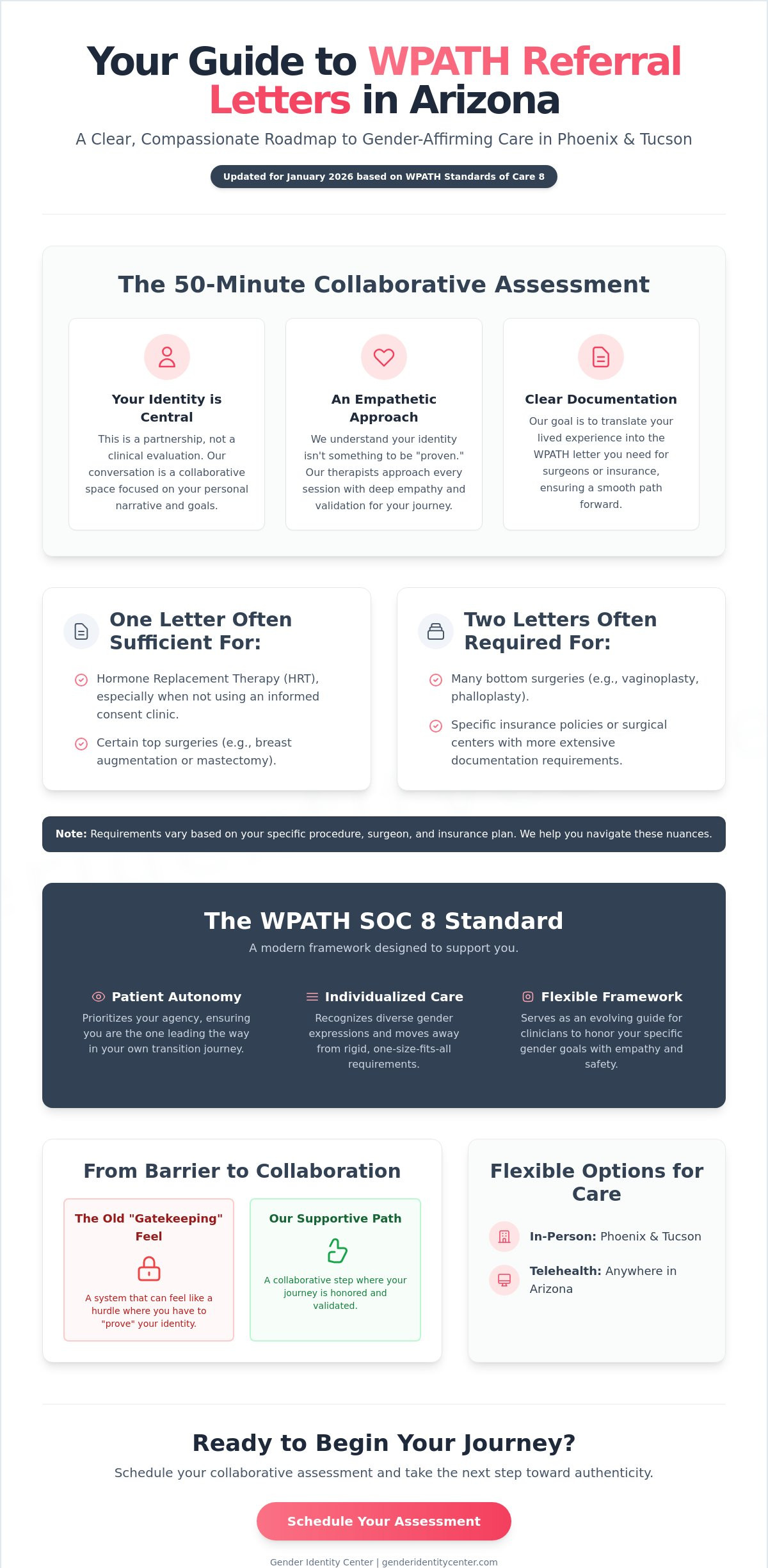
When you walk into our offices in Phoenix or Tucson, your 50-minute assessment for WPATH referral letters Arizona is designed to feel like a partnership rather than a clinical evaluation. We view this time as a collaborative space where your identity remains the central focus of the conversation. Our therapists approach every session with deep empathy, recognizing that you're the true expert on your own life. We understand that the traditional medical concept of "readiness" is not a universal metric. This depends on each individual's experience, and we prioritize your personal sense of timing and comfort above all else.
Our clinicians utilize the official WPATH Standards of Care Version 8 as a flexible guide to help you access the care you need. We move at your pace, ensuring that the rhythm of the session feels calm and unhurried. This approach helps to lower the defenses often built up after years of navigating systemic barriers. We're here to act as a bridge, helping you move toward your most authentic future self while maintaining a non-judgmental sanctuary for your thoughts and feelings.
Step 1: Sharing Your Authentic Narrative
The first part of our time together involves discussing your gender history and your future goals in a safe, affirming environment. We frame this conversation as an exploration of your unique path. It's not a test you can pass or fail; instead, it's a way for us to hear your story in your own words. We listen closely to your subjective needs so we can craft a personalized letter that truly reflects who you are. This process is deeply personal, and we acknowledge that perspectives on gender vary based on the person. By centering your agency, we ensure that your narrative is the foundation of the documentation we provide.
Step 2: Reviewing Medical and Support Goals
We'll also spend time identifying the specific medical interventions you are pursuing within the Arizona healthcare landscape. Whether you are looking for hormone therapy or specific surgical procedures, we discuss these goals in a supportive way that honors your autonomy. We might talk about your post-operative support plans or your recovery needs, but we do so to ensure you feel empowered and prepared. Every transition journey is different and valid. There's no single "right" way to be gender-expansive, and our role is to support the specific path you've chosen for yourself. If you feel ready to begin this part of your journey, you can explore our options for scheduling a session with one of our compassionate providers.
Navigating Insurance and Clinical Requirements for Gender-Affirming Care in AZ
The process of securing coverage for gender-affirming procedures often feels like a series of evolving steps rather than a single destination. In Arizona, the path you take depends on your individual experience and the specific details of your health plan. While some residents in Phoenix or Tucson find their providers have clear paths, others encounter a landscape that shifts based on how an insurer interprets current standards. Obtaining WPATH referral letters Arizona is a central part of this journey; it acts as a bridge between your personal goals and the clinical documentation your insurance requires.
Insurance providers often distinguish between different types of care when deciding how many letters are necessary. For example, many surgical teams and insurers in the Southwest still request two separate letters from mental health professionals for bottom surgery. Conversely, top surgery or hormone therapy might only require one. This isn't a universal rule. It often fluctuates based on your specific policy's language or the surgeon's personal clinical requirements. Our role is to provide professional, WPATH-compliant documentation that honors your story while meeting these specific technical needs. We advocate for you by ensuring your letters are written with the quiet resilience and clinical authority needed to navigate these systems.
For individuals living outside the major metro areas, accessing specialized care can feel challenging. We offer telehealth options for those in Flagstaff, Yuma, or rural parts of the state to ensure that geography isn't a barrier to your authenticity. This flexibility allows you to connect with a mentor who understands your needs from the safety of your own space.
Arizona Insurance Nuances
Your experience with local plans like Blue Cross Blue Shield of Arizona or UnitedHealthcare will vary significantly based on the employer or individual policy you hold. Some plans might adopt the WPATH Standards of Care Version 8 immediately, while others may stick to Version 7 criteria for a longer period. Communicating with your provider about "medical necessity" is a collaborative process. You might ask for a "Summary of Benefits and Coverage" to see how they define affirming care. For more detailed guidance, you can explore Insurance Coverage for Gender-Affirming Care in Arizona to better understand these local complexities.
Coordinating with Arizona Surgeons and Providers
The relationship between your mental health support and your medical team is a partnership built on your agency. We frequently coordinate with surgeons in the Phoenix metro area and Tucson, as well as out-of-state specialists who may have different intake forms. This clinical consultation ensures that your letters reflect the specific language your surgeon needs to move forward. You can begin this process by finding a gender therapist who understands the specific nuances of the Arizona medical landscape and can help you navigate the road ahead.
Addressing Common Concerns: Is the Letter Process a Form of Gatekeeping?
The thought of needing a "letter of permission" often brings up a deep sense of unease. For many people, the process of obtaining WPATH referral letters Arizona can feel like another hoop to jump through in a system that hasn't always been kind. We recognize that the feeling of being "gatekept" is a valid and subjective experience; how a person perceives this step often depends on their unique history with healthcare. At the Gender Identity Center, our philosophy centers on the belief that we're here to open doors, not close them. We view these documents as keys that unlock access to the care you deserve rather than barriers meant to keep you out.
We've designed our process to be as affirming and efficient as possible. We know that waiting for care can be painful, so we prioritize a timeline that respects your urgency. Our clinicians work to demystify the requirements, ensuring you feel like an active participant in the process rather than a subject being studied. Whether this feels like a formality or a significant milestone depends on each individual's experience, and we're here to support you regardless of your perspective.
Reducing Assessment Anxiety
Preparing for your session doesn't mean studying for a test or rehearsing a script. You're the expert on your own life, and our role is simply to listen and document your needs. To stay grounded, it helps to remember that there are no "wrong" answers when you're discussing your own identity. We aren't looking for a specific narrative or a "standard" trans experience because every journey is unique. The validity of your identity depends entirely on your own lived experience and how you choose to define yourself. You can prepare by reflecting on your goals, but know that your presence is enough. We're here to capture your truth, not to challenge it.
A Collaborative Advocacy Model
We've intentionally moved away from an "evaluative" model of care, which often feels cold and clinical. Instead, we use a collaborative advocacy model. This means our clinicians view themselves as your partners. We're working together to satisfy insurance requirements and medical standards while keeping your agency at the center of the conversation. This partnership is especially vital when you're looking into medical steps like Hormone Therapy in Phoenix. We want to ensure you have all the information you need to make informed decisions for your future. Our goal in 2026 remains the same: to act as a bridge between where you are now and the authentic future you're building.
If you're ready to take the next step in your journey with a team that truly hears you, we're here to help. Schedule your consultation today to begin the referral process in a safe, affirming space.
Scheduling Your WPATH Referral Letter Assessment at the Gender Identity Center
Taking the next step toward your medical and personal goals is a significant milestone in your journey. We recognize that obtaining WPATH referral letters Arizona can feel like a clinical hurdle, but we prefer to frame this assessment as a celebratory moment in your authentic life. Our clinicians are committed to providing timely, professional letters that respect your agency and lived experience. We don't see ourselves as gatekeepers; instead, we aim to be partners who help you access the care you deserve.
We offer flexible options to meet you where you are. You might choose an in-person session at our offices in Phoenix or Tucson, or you may find that secure telehealth better suits your current lifestyle. This choice depends on each individual's experience and comfort level. We've designed our process to be as smooth as possible, ensuring you feel seen and validated throughout the assessment. Whether you're seeking gender-affirming surgery or other medical interventions, we're here to provide the clinical documentation required by the WPATH Standards of Care guidelines updated in 2026.
Booking Your Session in Phoenix or Tucson
You can use our online tool to begin the process of scheduling your assessment. We've streamlined this system to reduce stress and provide clear availability for our Arizona community. Before your appointment, gathering a few key details can help the session flow more easily. You might want to have your surgeon's contact information, specific insurance requirements, and any relevant medical history ready for discussion. Having these pieces in place allows us to focus more deeply on your goals and aspirations during our time together.
- Select a date and time that aligns with your current energy and needs.
- Confirm whether you prefer a virtual space or one of our physical locations in Phoenix or Tucson.
- Prepare any specific questions you have about the WPATH referral letters Arizona process.
Continuing Your Journey with Therapeutic Support
The transition toward your most authentic self is an evolving process. While a referral letter is a practical tool, ongoing support can be a vital part of your long-term wellness. Many individuals find that individual or group therapy helps them navigate the emotional shifts that often accompany medical steps. We offer a non-judgmental sanctuary where you can explore your identity at your own pace. This support is not a requirement for your letter, but it remains available as you move through different stages of your life.
Our role as a resource doesn't end once the letter is signed. We're here to support you through the various stages of your becoming. Your path is unique, and the way you choose to engage with therapy is entirely up to you. We believe in the power of living authentically; we're honored to be a steady, guiding hand on your pathway toward empowerment and self-discovery.
Embracing Your Personal Path to Wellness
Your journey is entirely your own; it's a process that unfolds at its own pace. Understanding clinical requirements involves navigating the WPATH Standards of Care Version 8, which were updated in 2022 to better reflect the diverse needs of our community. While these documents are often required by insurance providers, the way you perceive this step depends on each individual's experience and personal history with the healthcare system. We've seen how a supportive assessment can serve as a bridge to the medical interventions you may be seeking.
Since our founding, we've prioritized specialized advocacy to ensure you're heard and respected. With physical offices in Phoenix and Tucson, we also provide telehealth services across all 15 Arizona counties to remain accessible. Securing WPATH referral letters Arizona doesn't have to feel like a hurdle; instead, it can be a collaborative moment of validation. Our clinicians are here to walk beside you, offering a steady hand as you move toward your most authentic self. You deserve a space where your identity is celebrated without reservation.
Schedule your WPATH Referral Letter Assessment in Arizona today
We're honored to support your growth and look forward to meeting you exactly where you are.
Frequently Asked Questions
What exactly is a WPATH referral letter and do I really need one in Arizona?
A WPATH referral letter is a clinical document that supports your access to gender-affirming care by detailing how you meet the Standards of Care Version 8 criteria. Whether you need one for WPATH referral letters Arizona depends on the specific requirements of your surgical team or insurance provider. We see that requirements vary across the 15 counties in Arizona, as each medical office sets its own internal protocols for patient intake and documentation.
How many sessions does it take to get a referral letter at the Gender Identity Center?
The number of sessions required isn't a fixed number because the process depends on each individual's experience and unique journey. While some people might complete their assessment in 1 session, others choose to engage in 3 or more sessions to feel fully supported. Our focus remains on your pace, ensuring you feel heard and validated while we navigate the 2026 clinical guidelines together in a way that feels safe.
Can I get a WPATH letter via telehealth if I do not live in Phoenix or Tucson?
You can absolutely receive a letter through telehealth if you live anywhere in Arizona, from Flagstaff to Yuma. Data from the 2024 Arizona Telemedicine Program indicates that virtual visits are a primary way for gender-expansive individuals to access specialized care. This flexible format allows us to meet in your own safe space, ensuring that your location doesn't prevent you from obtaining the WPATH referral letters Arizona you might need for your transition.
Does insurance in Arizona typically cover the cost of a referral letter assessment?
Insurance coverage for these assessments varies significantly based on your specific policy and whether your provider is in-network. Many plans under the Affordable Care Act include provisions for gender-affirming services, but 100 percent of the decision rests with your insurance company's current summary of benefits. We suggest calling the member services number on your card to ask about behavioral health codes for gender dysphoria assessments to clarify your potential out-of-pocket costs.
What happens if my surgeon requires two letters from two different providers?
If your surgeon requires two letters, you'll need to meet with two different licensed mental health professionals to complete separate assessments. This is a common requirement for complex procedures like phalloplasty or vaginoplasty. We can help you coordinate this by providing the first letter and then suggesting a network of 5 or more trusted colleagues in Arizona who can provide the second independent evaluation to ensure your surgical timeline stays on track.
Will I be denied a letter if I am non-binary or do not want a full medical transition?
You won't be denied a letter simply for being non-binary or choosing a partial medical transition. The WPATH Standards of Care Version 8, released in September 2022, explicitly states that gender-affirming care should be tailored to your authentic self. Your journey is valid whether you want every available procedure or only one. We view our role as partners who support your specific goals rather than gatekeepers of a singular transition path.
How long is a WPATH referral letter valid for most Arizona surgeons?
Most surgeons in Arizona consider a referral letter to be valid for exactly 12 months from the date it was signed. If your surgery date is scheduled beyond this 1-year window, you might need a brief follow-up session to provide an updated letter. Checking with your surgeon's office 6 months before your procedure is a helpful way to ensure your documentation remains current and acceptable for their specific medical records department.
What should I do if my insurance company rejects my WPATH letter?
If your insurance company rejects your letter, you have the right to file a formal appeal within their specified timeline, which is often 30 or 60 days. You can request a peer-to-peer review where your therapist speaks directly with the insurance medical director. Providing additional clinical notes or a revised letter that uses specific phrasing from your plan's 2026 medical necessity guidelines often helps resolve these administrative hurdles in a timely manner.