
Exploring Voice Therapy for Transgender Individuals in Arizona (2026)

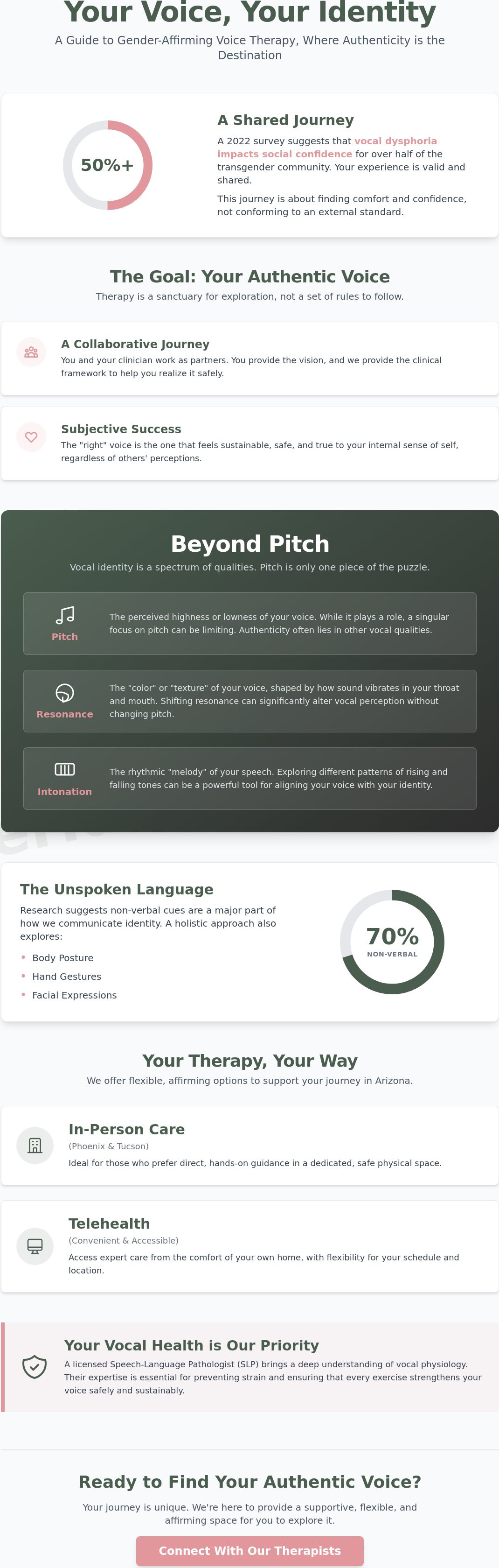
What if the sound of your voice wasn't a source of anxiety, but a flexible instrument that reflects your evolving sense of self? You likely understand that the way we speak is deeply personal, and for many, the journey toward vocal alignment feels like a path with no single right destination. It's common to feel a sense of hesitation when looking for voice therapy for transgender Arizona programs, especially when 2022 survey data suggests that vocal dysphoria impacts social confidence for over 50 percent of the community. This feeling is valid, as the comfort of these sessions depends on each individual's experience and their specific needs.
We're here to help you discover a supportive, flexible approach in Phoenix and Tucson that centers your unique identity and personal comfort. Our focus is on creating a sanctuary where you can experiment with resonance and pitch in ways that feel authentic to you. We believe you're the expert on your own life. This article explores how gender-affirming techniques available in 2026 can help you build confidence in social settings while ensuring you always feel heard and respected as you navigate your own journey.
Key Takeaways
- Understand that vocal success is highly subjective, as the most authentic outcome depends on each individual's experience and their unique sense of self.
- Discover how resonance and subtle vocal nuances may impact your transition, offering a flexible path that extends beyond a simple focus on pitch.
- Evaluate whether in-person care in Phoenix and Tucson or the convenience of telehealth best supports your personal journey with voice therapy for transgender Arizona.
- Gain insight into the collaborative evaluation process, where your personal comfort and vulnerability are centered as you explore new ways of being heard.
Understanding Gender-Affirming Voice Therapy in Arizona
We believe your voice is one of your most powerful tools for self-expression. In the context of 2026, voice therapy for transgender arizona has evolved into a deeply collaborative journey where you and your clinician work as partners. This process isn't about meeting a predetermined standard of how a person should sound. Instead, it's about aligning your vocal resonance, pitch, and inflection with the person you know yourself to be. We view this work as a sanctuary where you can explore the mechanics of your breath and sound without judgment or pressure.
The definition of a successful outcome in this space is entirely personal. For some, success means achieving a specific pitch range. For others, it involves finding a vocal quality that feels sustainable and safe during a long workday. Because this depends on each individual's experience, our approach remains flexible and open to interpretation. We're here to provide the clinical framework while you provide the vision for your most authentic self.
The Role of an Affirming Speech-Language Pathologist
Clinical expertise is vital when you're making changes to your communication style. A licensed Speech-Language Pathologist (SLP) brings a deep understanding of vocal fold physiology that a standard voice coach may not possess. In the state of Arizona, SLPs must hold a Master’s degree and maintain licensure through the Arizona Department of Health Services, ensuring they meet rigorous safety and ethical standards. This clinical background is essential for preventing vocal strain or long-term nodules as you experiment with new sounds.
The field of Transgender voice therapy encompasses more than just pitch; it involves breath support, resonance, and non-verbal communication. Our clinicians create a nurturing environment where these elements are explored through a lens of health and wellness. You can connect with our therapists to begin this exploration in a space designed specifically for the gender-expansive community. We prioritize your safety, ensuring that every exercise strengthens your voice rather than taxing it.
Subjectivity in Vocal Expression
There's no single right way to have a voice. We intentionally move away from rigid binary expectations of what sounds masculine or feminine. Your vocal identity is a spectrum, and where you choose to land on that spectrum is a matter of personal comfort. This depends on each individual's experience and their specific social or professional goals. Some people seek a neutral, androgynous tone, while others want to lean into traditional gender markers.
Voice work serves as a tool for empowerment and self-discovery. It's a way to reclaim agency over how you move through the world. By framing therapy as an invitation to explore rather than a set of rules to follow, we help you find a sound that resonates with your internal truth.
- Resonance: Finding where the sound vibrates in your body.
- Intonation: The rhythmic melody of your speech patterns.
- Authenticity: Prioritizing how the voice feels to you over how it's perceived by others.
Beyond Pitch: The Components of Vocal Transition
Many people starting their journey believe that raising or lowering their pitch is the primary goal of vocal work. While pitch plays a role, it isn't the sole defining characteristic of how a voice is perceived. In 2026, many practitioners of voice therapy for transgender Arizona individuals emphasize a more nuanced approach that prioritizes your personal comfort over rigid gender norms. This depends on each individual's experience, as what feels authentic to one person might feel performative to another.
Vocal transition involves a delicate blend of physical adjustments and social cues. Beyond the frequency of your voice, you might explore how you hold your body or the way you use your hands while speaking. These non-verbal elements often account for a significant portion of how we communicate our identity to the world. Research from 2024 suggests that up to 70 percent of communication is non-verbal, which highlights why a holistic approach is so valuable for those seeking to align their outward expression with their internal sense of self.
Resonance and Vocal Weight
Resonance refers to how sound vibrates within the spaces of your throat and mouth. You can think of it as the color or texture of your voice. By shifting the position of your tongue or larynx, you can change the shape of your vocal tract, which is typically about 17 centimeters long in adults. This adjustment influences whether a voice sounds bright or dark.
- Forward Resonance: Often associated with a brighter, more feminine quality by focusing sound toward the front of the mouth.
- Chest Resonance: Often provides a darker, more masculine depth by allowing sound to vibrate more in the pharyngeal space.
- Vocal Weight: The thickness or thinness of the sound produced by the vocal folds, which adds another layer of character to your speech.
These shifts are entirely flexible. You don't have to choose one setting and stay there forever. Instead, you can learn to adjust these components based on your environment or how you feel on a particular day. If you're ready to explore these possibilities, you might consider scheduling a consultation to see what feels right for you.
Intonation and Rhythm
Intonation is the melody of your speech. It's the way your voice rises and falls at the end of a sentence or to emphasize a specific word. Arizona speech patterns can be quite diverse, often blending Western influences with a more relaxed, rhythmic pace. Some people in the Phoenix area might notice they use a rising intonation at the end of questions, while others prefer a more steady, grounded rhythm that reflects a different regional energy.
Exploring these patterns allows you to build a voice that doesn't just sound right, but feels like it belongs to you. This depends on each individual's experience and the specific social contexts they inhabit as they move through their personal pathway of discovery. If you are also interested in refining your pronunciation of American English sounds, click here to explore resources from the American Accent Program.
Choosing Your Path: Telehealth vs. In-Person Care in Arizona
Arizona offers a wide variety of ways to engage with your vocal journey. Whether you're walking through the doors of a clinic in downtown Phoenix or logging into a secure portal from a home in Flagstaff, your experience is uniquely yours. We recognize that the choice between sitting in a physical room or connecting through a screen depends on each individual's experience and what feels most supportive at this moment in time.
The Gender Identity Center provides both modalities to ensure that accessibility is never a barrier to your growth. For some, the tactile nature of a clinic is essential. For others, the privacy of a living room is where they feel most empowered to experiment with their resonance. There's no single correct way to pursue voice therapy for transgender Arizona residents; there's only the way that aligns with your personal comfort and needs.
The Benefits of In-Person Sessions in Phoenix or Tucson
Choosing to meet in a physical clinical setting can offer a sense of groundedness that some find helpful. These sessions provide a dedicated safe space where the outside world falls away, allowing you to focus entirely on your vocal goals. Having a clinician present in the room may allow for more direct feedback on posture or physical tension that can be harder to sense through a camera. This hands-on guidance can be a vital part of the process for those who value tactile feedback.
Building a personal connection in person might feel more organic for you, depending on your communication style. Our team of therapists works to create an environment where you feel seen and heard without judgment. This face-to-face interaction often helps lower defenses, making the vulnerable work of voice therapy for transgender Arizona feel more manageable. For many, the ritual of traveling to a clinical sanctuary helps mark the session as a significant step in their authentic journey.
Telehealth: Affirming Care from Your Own Home
The rise of virtual care has transformed how many people access support, especially those living outside the major metropolitan hubs. In 2024, reports from Arizona health networks indicated that over 35 percent of rural residents utilized telehealth for specialized services, a trend that continues to grow in 2026. Virtual sessions can significantly reduce the anxiety that often comes with traveling to a clinic, especially if you're navigating public spaces while in the middle of a transition. It's a way to keep your energy focused on your voice rather than the logistics of a commute.
Practicing in a familiar environment allows you to integrate your new vocal skills directly into your daily life. You can explore your range in the same room where you'll be using it most. Many people find that telehealth fits more seamlessly into their evolving schedules, offering a level of privacy that is difficult to replicate elsewhere. Whether this path is right for you often depends on your comfort with technology and your need for a controlled, private environment. We're here to support whichever medium helps you feel most empowered to speak your truth.
Navigating the Voice Therapy Journey: What to Expect
Beginning your path with voice therapy for transgender Arizona residents often feels like a blend of quiet anticipation and natural nerves. This process usually starts with a thorough evaluation of your current vocal health. We look at your history, any past vocal strain, and how your voice functions in daily life. Since the release of the WPATH Standards of Care Version 8 in 2022, the focus on holistic, person-centered care has become the gold standard. This means we prioritize your comfort and safety as you begin to explore the possibilities of your sound.
Producing novel sounds can make you feel vulnerable. It's a space where you might feel exposed, but it's also where your most authentic growth happens. Progress often feels slow or non-linear. Some weeks you'll feel a deep connection to your resonance; other weeks might feel like a plateau. This depends on each individual's experience and how their body responds to the exercises. Many people find it helpful to integrate this work with gender identity therapy in Phoenix. Addressing the emotional side of transition alongside the physical provides a more rounded sense of validation.
The Initial Assessment and Goal Setting
During your first meeting, you'll discuss your history and your hopes for your voice. We establish a baseline together, yet we understand that goals often change as you move through your transition. You're the expert on your own desired outcomes. Whether you seek a voice that sounds more feminine, masculine, or gender-neutral, the focus remains on what feels right for you. This collaborative approach ensures that the therapy evolves as your identity does. We don't use a one-size-fits-all model; instead, we listen to your specific needs.
Practice and Perseverance
Consistent, gentle practice outside of your sessions is vital for muscle memory. Your clinician gives you the tools to move through roadblocks when they appear. The timeline for change varies greatly. A 2021 study in the Journal of Voice suggested that while some individuals see changes in 12 sessions, others may take 20 or more to feel confident. This depends on each individual's experience and the time they can dedicate to the work. We use a variety of techniques to help you persevere, such as:
- Breath support exercises to build a strong foundation.
- Resonance shifting to find a tone that matches your identity.
- Pitch exploration that feels sustainable and healthy.
- Intonation patterns that reflect your personality.
We are here to walk this path with you, providing a steady hand as you discover the voice that has always been there. If you're ready to explore these possibilities, you can connect with our team of affirming therapists to start your journey.
Finding Your Authentic Voice with the Gender Identity Center
At the Gender Identity Center, we view the process of vocal alignment as a bridge between your current reality and your most authentic future self. We understand that the way you project your voice into the world is a deeply personal choice. Finding voice therapy for transgender Arizona residents involves more than just vocal exercises; it's about the intersection of mental wellness and physical expression. Our team works to bridge the gap between speech therapy and emotional support, recognizing that the two are often inseparable during a transition.
Our 2026 care model remains firmly rooted in the latest WPATH standards. This ensures that the support you receive is both affirming and evidence-based. We prioritize a holistic approach because we know that identity isn't a checklist. It's an evolving experience. Whether you're seeking to change your pitch, resonance, or inflection, or perhaps looking to complement your progress with the American Accent Program, the path you take depends on each individual's experience and what feels right for your unique anatomy and goals. We're here to offer a steady hand as you explore these possibilities.
A Holistic Approach to Transition
Voice work doesn't exist in a vacuum. For many, it's a piece of a much larger puzzle that includes medical or social milestones. This service often complements other essential steps, such as obtaining WPATH referral letters in Arizona. By working with clinicians who are allies or members of the LGBTQIA community, you connect with a professional network that understands the nuances of gender-affirming care. We focus on creating a community where lived experience is valued as much as clinical expertise. This shared understanding helps lower barriers and fosters a sense of safety that is vital for vocal exploration.
Your Next Steps Toward Vocal Affirmation
Deciding to begin voice therapy for transgender Arizona services is a significant milestone, but there's no universal timeline you must follow. Some people feel ready at the start of their transition, while others wait years. Both paths are valid. Your journey is yours alone, and the "right" time is simply whenever you feel the internal pull to begin. We offer accessible support through our locations in both Phoenix and Tucson, ensuring that Arizonans have local options for their care.
- We offer flexible consultation styles to match your comfort level.
- Our clinicians specialize in gender-expansive communication.
- We provide a non-judgmental space to practice and evolve.
If you're curious about how vocal work might fit into your life, we invite you to visit our scheduling page. You can explore a consultation to discuss your needs without any pressure to commit to a specific outcome. We're here to listen, support, and walk beside you as you navigate your own path toward empowerment and self-discovery.
Embracing Your Unique Vocal Path
Finding a voice that feels like home is a deeply personal process, and there isn't a single path that fits everyone. For many, voice therapy for transgender arizona involves working alongside our team of Licensed Speech-Language Pathologists who utilize the WPATH Standards of Care Version 8 to provide affirming support. Whether you visit our safe spaces in Phoenix and Tucson or utilize telehealth, the specific techniques used often depend on each individual's experience and their personal comfort levels. Our team focuses on the three core components of vocal transition, which include resonance, pitch, and non-verbal communication, to help you explore what feels most authentic to you.
We believe that your identity is yours to define, and our role is to act as a steady, guiding hand throughout your transition. Since every person's vocal folds and resonance patterns are unique, the timeline for growth varies based on personal context rather than a set clinical schedule. You're the expert on your own life, and we're here to offer a non-judgmental sanctuary for that discovery. Begin your vocal journey by scheduling a consultation with our Arizona team today. Your voice is a powerful tool for self-expression, and we're honored to support you as you become your most authentic self.
Frequently Asked Questions
Is voice therapy in Arizona covered by insurance?
Coverage for voice therapy for transgender Arizona residents varies significantly based on your specific provider and policy. While the 2024 updates to Section 1557 of the Affordable Care Act aim to reduce discrimination in healthcare, each individual's experience with claim approval is unique. Some plans categorize this as a medical necessity while others view it as elective. We recommend checking your specific Summary of Benefits to see how your journey is supported by your current insurance.
How long does it typically take to see results in voice therapy?
You may begin to notice shifts in your vocal resonance within 8 to 12 weeks of consistent practice. This timeline isn't a fixed rule because every person's vocal cords and goals are different. Your progress depends on your personal commitment to daily exercises and your comfort level with experimenting. We find that most individuals reach a point of authentic expression after 6 months of dedicated guidance and self-discovery.
Do I need to have had surgery to start gender-affirming voice therapy?
You don't need to have any gender-affirming surgeries to begin your vocal journey. Many people choose voice therapy as their first step toward alignment because it's a non-invasive way to explore their identity. This path depends on your individual needs and what feels right for your body at this moment. We believe your voice is a tool for empowerment that you can access at any stage of your transition.
Can voice therapy help with both feminization and masculinization?
Voice therapy is designed to support both feminization and masculinization, as well as gender-neutral or non-binary expressions. For those seeking masculinization, we focus on resonance and chest placement, while feminization often involves pitch and inflection work. The specific techniques we use will depend on your individual vision for your most authentic self. It's a collaborative process where you lead the way in defining how you want to be heard.
What if I feel too intimidated or embarrassed to practice my voice?
Feeling a sense of hesitation or vulnerability when practicing your voice is a deeply common experience for many in our community. We provide a non-judgmental sanctuary where you can experiment with new sounds without fear of being misunderstood. This emotional hurdle depends on your personal history and current environment. We're here to offer a steady, guiding hand as you navigate these feelings and move toward a place of vocal confidence.
Are virtual voice therapy sessions as effective as in-person ones?
Virtual sessions are widely considered as effective as in-person visits for voice therapy for transgender Arizona individuals. A 2021 study published in the Journal of Voice found that 95 percent of participants achieved similar clinical outcomes regardless of the delivery method. This flexibility depends on your personal preference and access to technology. We prioritize your comfort and safety, whether we meet through a screen or in a physical office.
How does voice therapy interact with hormone replacement therapy (HRT)?
The way voice therapy interacts with hormone replacement therapy depends on your specific hormonal path. Testosterone typically thickens the vocal cords, naturally lowering the pitch for many, while estrogen does not usually change the physical structure of the voice. Because of these biological differences, the focus of our work together will shift based on your medical journey. We see voice therapy as a complementary bridge that helps you navigate these physical changes with intention.