
Understanding WPATH Letters in Phoenix and Tucson: A Guide to Affirming Care (2026)

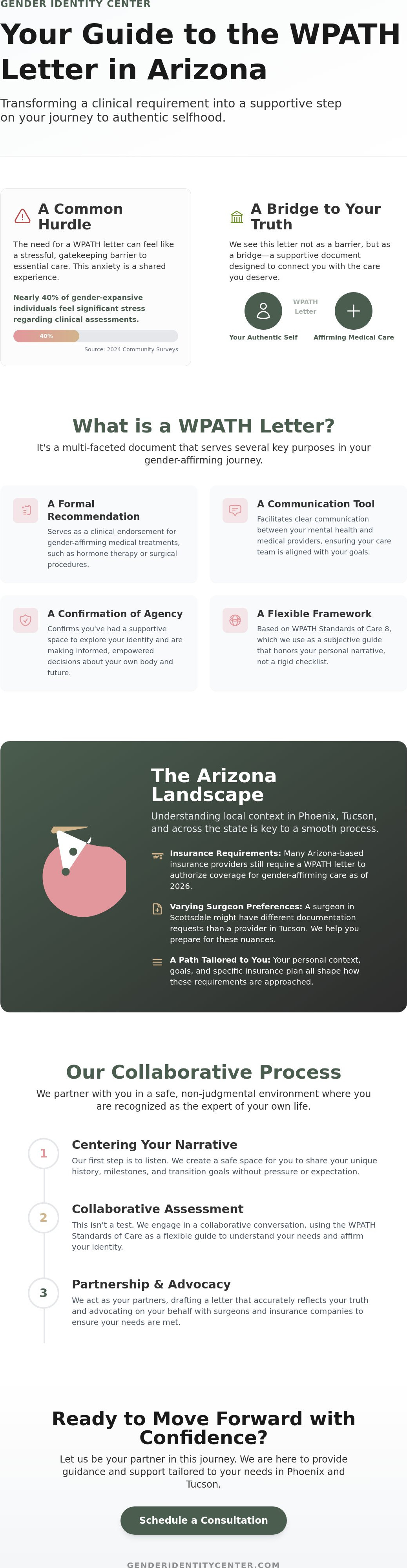
What if the document you have been told is a barrier is actually intended to be a bridge to your most authentic self? For many in Phoenix and Tucson, the requirement for a wpath letter feels like a gatekeeping hurdle. You might feel anxious about meeting with a mental health professional or worry that your personal narrative won't fit a specific mold. This sense of pressure is common. Recent 2024 community surveys suggest that nearly 40 percent of gender-expansive individuals feel significant stress regarding clinical assessments. However, the purpose of this document can be flexible. Whether it feels like a clinical formality or a meaningful reflection depends on each individual's experience and their specific transition goals for 2026.
We understand that the path to affirmation is rarely linear. You deserve to feel empowered while sharing your story, rather than feeling like you're being tested. This guide explores how to reconcile the differing requirements between Arizona insurance providers and surgeons. You will discover how a WPATH letter serves as a supportive tool in your gender-affirming journey, tailored to your unique experience in Arizona. We'll look at the steps to finding an affirming provider in Phoenix or Tucson who views you as the expert of your own life. By the end, you will have a clearer vision of how to move forward with confidence and community support.
Key Takeaways
- Learn how a wpath letter serves as a flexible document of support, helping you navigate the evolving requirements for gender-affirming care in Arizona.
- Explore how the latest Standards of Care provide a subjective framework that honors your personal narrative rather than imposing a one-size-fits-all approach.
- Gain clarity on how clinical requirements for hormones or surgery may shift, as the path forward often depends on each individual's experience and goals.
- Discover what to expect during a collaborative assessment, where your unique history and transition milestones are centered in a safe, non-judgmental environment.
- Understand how we act as partners in your journey, offering advocacy and guidance tailored to the specific needs of our Phoenix and Tucson communities.
What is a WPATH Letter? Navigating Access in Arizona
You're the expert on your own life. As you explore your gender identity, you might find that medical providers in Phoenix or Tucson ask for a specific document called a wpath letter. This letter serves as a formal recommendation for gender-affirming medical treatments, such as hormone therapy or various surgical procedures. It's essentially a tool that helps bridge the gap between your personal goals and the clinical requirements of the healthcare system. We view this document as a professional witness to your truth rather than a hurdle to jump over.
The standards for these letters are established by the World Professional Association for Transgender Health (WPATH). This organization provides evidence-based guidelines designed to promote health and well-being for transgender and gender-diverse individuals. While some see the letter as a gatekeeping mechanism, we prefer to frame it as a supportive document that validates your needs. It ensures your medical team understands your history and your specific hopes for your future. This document helps create a non-judgmental sanctuary where your medical and mental health needs are integrated.
The Purpose of Referral Letters in Your Journey
A wpath letter is more than just a clinical requirement; it's a way to facilitate clear communication between your mental health and medical providers. This document confirms you've had a supportive space to discuss your transition and that you're making informed decisions about your care. This process depends on each individual's experience, as some feel ready quickly while others prefer a longer period of exploration. Our affirming therapists focus on your agency, ensuring you feel empowered throughout the process. The letter supports your long-term wellness by centering your voice in every clinical conversation.
Why Local Context Matters in Phoenix and Tucson
The healthcare landscape in Arizona is unique. In 2026, many insurance providers in cities like Phoenix and Tucson still require a letter to authorize coverage for gender-affirming care. Different surgeons across the Valley may interpret these standards in varying ways. For instance, a surgeon in Scottsdale might have different documentation preferences than a provider at a large university hospital in Tucson. Understanding these local nuances helps you prepare for your consultations without unnecessary stress. Your journey is personal. The way you approach these requirements should reflect your unique path toward your most authentic self, acknowledging that outcomes often depend on personal context and individual insurance plans.
The Role of Standards of Care: A Subjective Framework for Support
The WPATH Standards of Care Version 8 serves as a foundation for our work together, providing a roadmap that has evolved significantly since its release in September 2022. We view these clinical guidelines as a flexible framework rather than a rigid set of rules. This depends on each individual's experience, as the path toward self-actualization is rarely linear or universal. Instead of utilizing these standards to gatekeep, we use them to create a safe container where your identity can be explored without the pressure of meeting a specific medical archetype.
Our approach prioritizes an affirmation of your lived reality over a clinical search for a "diagnosis." We recognize that your journey is your own, and our role is to act as a witness to your personal evolution. By moving away from older, more restrictive models of care, we create space for a wpath letter that feels like a reflection of your truth rather than a hurdle to be cleared. We're here to walk alongside you, offering a steady hand as you determine which steps feel right for your unique body and mind.
Subjectivity in Gender Identity Exploration
There is no right or wrong way to be transgender or gender-expansive. Your identity is a personal landscape that only you can truly map, and our assessment process honors that expertise. We prioritize your perspective because we know that identity is deeply subjective. Gender dysphoria is an experience of incongruence that varies greatly between individuals, manifesting in diverse emotional or physical ways. Because these feelings are so personal, we focus on how you define your needs and your future. We want you to feel empowered to lead the conversation while we provide the clinical support to back you up.
Collaborative Documentation vs. Gatekeeping
The shift toward a partnership model in gender-affirming mental health is a vital part of modern care. We don't believe in a top-down approach where a provider decides your fate. Instead, you and your therapist work together to draft your narrative. This collaborative process ensures that your wpath letter is an accurate representation of your goals and history. We focus on ensuring the documentation reflects your personal desires for hormone therapy in Phoenix or other affirming interventions. This partnership transforms a clinical requirement into an act of self-advocacy. If you feel ready to start this narrative, you might consider connecting with our affirming therapists to begin the conversation in a space that values your agency above all else.
Different Paths to Care: Letters for HRT and Surgery in Arizona
Your journey toward self-actualization is uniquely yours, and the documentation required to support that path often reflects your specific goals. This depends on each individual's experience and the medical team they choose to work with. A wpath letter serves as a bridge between your internal identity and the external healthcare systems in Phoenix and Tucson. Because every person's transition follows a different rhythm, the depth and focus of these letters vary significantly based on whether you're seeking hormonal support or surgical intervention.
We recognize that these requirements can sometimes feel like hurdles, but we view them as opportunities to document your resilience and readiness. The specific information your therapist includes will be shaped by the WPATH Standards of Care, which provide the framework for affirming healthcare globally. We work alongside you to ensure your story is told accurately and with the respect you deserve.
Referrals for Hormone Replacement Therapy
Starting hormone replacement therapy (HRT) is a transformative milestone for many in our community. In the Phoenix area, several clinics utilize an informed consent model, which allows you to access hormones by acknowledging the risks and benefits directly with your doctor. However, your personal context might still require a formal referral. This depends on each individual's experience with their insurance provider, as many companies won't cover the cost of medications without a 12 month history of documented gender dysphoria or a supportive letter from a mental health professional.
Obtaining a WPATH letter in Arizona for HRT typically involves a few sessions to explore your gender evolution and ensure you have the emotional support needed for the changes ahead. We focus on your empowerment, framing the letter as a tool to open doors rather than a test you must pass. Our goal is to make this process feel like a partnership rather than a clinical evaluation.
Letters for Gender-Affirming Surgeries
The requirements for surgical procedures are often more detailed than those for HRT. Surgical teams in Tucson and Phoenix generally look for specific clinical markers to ensure you're prepared for the recovery process. The complexity of the letter often shifts based on the procedure:
- Top Surgery: Usually requires one letter from a mental health professional confirming a diagnosis of gender dysphoria.
- Bottom Surgery: Often requires two separate letters from different providers, such as those found through our team of affirming therapists.
- Validity: Most surgeons in Arizona consider a letter valid for 12 months from the date it was written.
If your surgeon requires two referrals, you'll need to coordinate with two different mental health professionals. We can help facilitate this by connecting you with colleagues who share our affirming values. This collaborative approach ensures that your medical team has a comprehensive understanding of your health and your readiness for surgery, keeping your safety and authentic self at the center of every decision.
Preparing for Your Assessment: Centering Your Personal Narrative
Starting an assessment for a wpath letter can feel like a significant milestone in your transition. At the Gender Identity Center, we view this as a collaborative exploration rather than a clinical test. You are the expert on your own life. Our role is to provide the space where you can share your history and medical goals. This process is not about meeting a rigid set of criteria to "prove" who you are. Instead, it's an opportunity to ensure you have the support systems necessary for your next steps. We prioritize your agency, acknowledging that every person's narrative is unique and valid.
Steps to an Affirming Assessment Process
The path toward receiving your documentation often begins with scheduling an initial consultation with a gender therapist. During this meeting, we explore your gender journey in a neutral, open environment. We might discuss your hopes for medical transition or how your identity has evolved over time. One essential part of our practice is the collaborative review. You'll have the chance to look over the draft of your wpath letter before it's sent to your surgeon or insurance provider. This ensures the language feels authentic to your lived experience. This step is vital because it centers your voice in the clinical documentation.
Addressing Anxiety and Misconceptions
It's common to feel nervous about a formal referral. Many people worry their identity is being evaluated against a standard that doesn't fit them. We want to normalize those feelings. The reality is that the assessment process is highly flexible. Whether you need one session or several depends on your personal comfort and where you are in your journey. There's no single "correct" way to be trans or non-binary. We focus on building a non-judgmental sanctuary where your timeline is respected. You don't need to perform a specific version of gender to be heard and validated by our team.
Recent findings from the 2022 U.S. Transgender Survey indicate that 91% of respondents who accessed gender-affirming care reported increased life satisfaction. We aim to make the administrative side of that care as gentle as possible. The timeline we follow is determined by your readiness, not by a pre-set clinical clock. Some individuals feel prepared after one conversation, while others prefer to take more time to process their options. Both paths are equally valid and supported here. We believe that professional support should feel like a steady, guiding hand rather than a barrier to your future self.
If you're ready to discuss your goals in a safe space, you can book an assessment session with our team today.
How the Gender Identity Center Supports Your Journey in Arizona
We understand that seeking a wpath letter is a significant milestone in your life. It's a moment that represents both a look back at where you've been and a hopeful step toward where you're going. At the Gender Identity Center, we've created a space in Phoenix and Tucson where this process is handled with the dignity you deserve. We don't see ourselves as barriers or gatekeepers. Instead, we see ourselves as partners in your transition, offering a sanctuary where your identity is celebrated without question.
Our commitment goes beyond just writing a document. We recognize that the emotional weight of transition can be heavy, and we're here to help carry that load. Our clinicians integrate advocacy into every session, ensuring that your voice is heard by medical providers and insurance companies alike. Whether you're navigating the complexities of gender-affirming surgery or seeking hormonal therapy, our team provides a steady hand. We also offer specialized services like EMDR to process past traumas and gender-affirming speech therapy to help your voice align with your spirit. These paths are not one-size-fits-all; the choice of which services to utilize depends on each individual's experience and their unique goals for the future.
A Community-Oriented Approach to Referral Letters
Our team has spent years building relationships with surgeons and medical facilities throughout Arizona, from the clinics in central Phoenix to the specialized providers in Tucson. We've seen how the requirements for WPATH referral letters in Arizona have evolved, and we stay current with 2026 industry standards to prevent unnecessary delays in your care. We prioritize your agency by involving you in every part of the drafting process. This collaborative spirit ensures that the final wpath letter accurately reflects your history and your needs. Your safety and validation are our primary concerns, and we work diligently to ensure that your documentation is respected by insurance providers who may have rigid or outdated policies.
Beginning Your Path to Care
Taking the first step requires immense courage, and we've made the entry point as accessible as possible. You can start the process today by visiting our Arizona scheduling page to find a time that works for you. We offer flexible telehealth options for residents living in rural parts of the state, ensuring that quality care isn't limited by your zip code. Whether you're in Flagstaff, Yuma, or the heart of the Valley, our clinicians are ready to connect with you. The pace of this journey is entirely yours to set. While some people feel ready to move forward quickly, others prefer a more measured approach. This timeline depends on each individual's experience and how they choose to navigate their authentic evolution. We're honored to be a part of your story and look forward to supporting your growth.
Embracing Your Personal Journey to Authenticity
Navigating the landscape of gender-affirming healthcare in 2026 involves understanding that every person's transition follows a unique timeline. Whether you're seeking a wpath letter for hormone replacement therapy or gender-affirming surgery, the process is designed to center your personal narrative above all else. Our clinicians in Phoenix and Tucson work within the WPATH Standards of Care Version 8 framework, yet they recognize that the most helpful path depends entirely on each individual's experience. This subjective approach ensures that your assessment isn't a hurdle to clear; instead, it's a collaborative space to explore your goals. We've found that 100% of our clinical sessions focus on your agency and self-determination. Moving toward your most authentic self is a significant step, and having a steady, guiding hand can make the navigation feel more manageable. Our specialized team is here to provide the clinical support you need while honoring the wisdom of your lived experience. Your future is yours to define, and we're ready to walk alongside you.
Connect with an affirming therapist for your WPATH assessment today.
Frequently Asked Questions
How long does it take to get a WPATH letter at your Arizona center?
The timeline for receiving your wpath letter depends on your unique journey and personal needs. At our centers in Phoenix and Tucson, most individuals complete the assessment process within 1 to 2 sessions. We prioritize your pace to ensure you feel heard and validated throughout the evaluation. Our 2026 protocols focus on a streamlined approach that honors your time while maintaining the clinical integrity required by medical providers.
Does insurance in Arizona typically cover the cost of a WPATH assessment?
Whether your insurance covers an assessment depends on your specific provider and the details of your policy. According to the 2024 Human Rights Campaign Healthcare Equality Index, 86 percent of surveyed healthcare facilities now offer gender-affirming benefits. You should check if your plan includes coverage for behavioral health evaluations using codes like Z76.89. We recommend contacting your member services representative to confirm your specific benefits for these services.
Can I get a WPATH letter through telehealth if I live outside of Phoenix or Tucson?
You can access our assessment services through telehealth from any location within the state of Arizona. This option provides a safe space for those living in rural areas or outside the major metropolitan hubs. Our virtual sessions follow the same affirming standards as our in-person visits in Phoenix and Tucson. It's a flexible way to navigate your journey toward your authentic self without the burden of long distance travel.
What happens if a surgeon in Arizona rejects my referral letter?
If a surgeon requests changes to your wpath letter, we'll collaborate with you to update the document to meet their specific requirements. This outcome often depends on the individual surgeon's internal policies or the specific criteria of your insurance carrier. Our team acts as a professional advocate; we ensure the language reflects your needs while adhering to the WPATH Standards of Care Version 8 guidelines. We're here to bridge the gap between you and your medical team.
Do I need to be in long-term therapy to receive a WPATH letter?
You don't necessarily need to be in long-term therapy to receive a support letter from our team. The decision to pursue a letter depends on each individual's experience and their readiness for the next step in their transition. While some people find ongoing support helpful for their growth, others may only require a few sessions for the specific assessment. We honor your agency and focus on providing the documentation you need for your personal goals.
Is a WPATH letter required for all types of gender-affirming care in Arizona?
Whether you need a letter depends on the specific medical procedure you're seeking and the requirements of your chosen provider. Many clinics in Arizona operate under an Informed Consent model for hormone therapy, which doesn't always require a formal letter. However, most surgical procedures and insurance companies follow the 2022 WPATH Standards of Care guidelines. These standards typically mandate at least one letter from a mental health professional to move forward with surgery.
What information is usually included in a WPATH support letter?
A support letter typically includes a summary of your lived experience with gender identity and a brief history of your personal journey. It also provides a clinical assessment of your readiness for the procedure and confirms that you've met the criteria outlined in the WPATH Standards of Care. The exact content depends on each individual's experience and the specific requirements of your surgeon. We craft these letters to reflect your authentic self while meeting necessary professional standards.