
Gender Pronouns Guide: Navigating Identity and Respect in Arizona

What if the most powerful tool for fostering a sense of belonging in our 2024 social interactions is actually a simple, two-letter word? You likely value treating your neighbors in Phoenix or Tucson with genuine respect, yet you might feel a bit overwhelmed as the language of identity continues to expand. Using a gender pronouns guide can help ease that confusion, especially when you're worried about making a mistake or offending someone you care about. We believe that there's no single "correct" way to exist in the world; instead, this depends on each individual's experience and their own unique pathway toward authenticity.
We offer this supportive space to learn how to use language that affirms those around you while acknowledging that identity is often a subjective and evolving journey; in many ways, it's all very subjective. You'll gain the confidence to engage in meaningful conversations and understand the heartfelt "why" behind pronoun affirmation. We'll also walk through a 3-step process to gracefully recover from a slip-up, ensuring you can move forward with kindness and clarity in every community you visit across Arizona.
Key Takeaways
- Understand how pronouns serve as an extension of your inner identity, though the way these linguistic tools are used often depends on each individual's experience.
- Utilize this gender pronouns guide to explore the evolving landscape of she, he, they, and neo-pronouns as subjective options for your personal journey.
- Learn to navigate the social nuances of Arizona communities like Phoenix and Tucson, fostering connections that respect the fluid nature of self-expression.
- Discover actionable ways to ask for and share pronouns that honor the idea that identity is deeply personal and can be viewed from many valid perspectives.
- Explore how affirming therapy can help you find the specific language that resonates with your unique path, providing a sanctuary for exploration and validation.
Understanding Gender Pronouns as Tools for Authenticity
Pronouns are the linguistic threads we use to weave our stories. At their most basic level, they're tools used to refer to someone in the third person, such as they, she, or he. For many of us, these words are a direct extension of our internal sense of self. They aren't just grammatical placeholders; they're a way to honor the truth of who you are. We believe that using affirming language acts as a safe harbor for gender-expansive individuals living in our desert communities. This gender pronouns guide is designed to help you understand how these words function as signals of recognition and respect.
The weight and meaning of these words can shift from person to person. We recognize that this depends on each individual's experience and how they choose to move through the world. For some, a pronoun is a fixed point of pride. For others, it might be a fluid expression that evolves over time. There's no single right way to exist, and our language should be flexible enough to hold all these possibilities. By choosing to use someone's correct pronouns, you're participating in an act of radical acceptance that validates their lived reality.
What Are Pronouns in the Context of Identity?
Identity is a spectrum, and our language is finally catching up to that reality. While many grew up with a binary view of "he" and "she," modern understanding includes a vast array of options like "they/them" or "ze/zir." These terms are more than just labels. They're verbal signals that say, "I see you, and I respect your journey." You might find that some people use multiple sets of pronouns or none at all. Because there's no one-size-fits-all way to experience gender in Arizona, we approach each interaction with an open mind. A Preferred Gender Pronoun serves as a bridge between a person's inner world and their external social life, ensuring that their presence is acknowledged accurately.
Why Pronouns Matter for Mental Health in Arizona
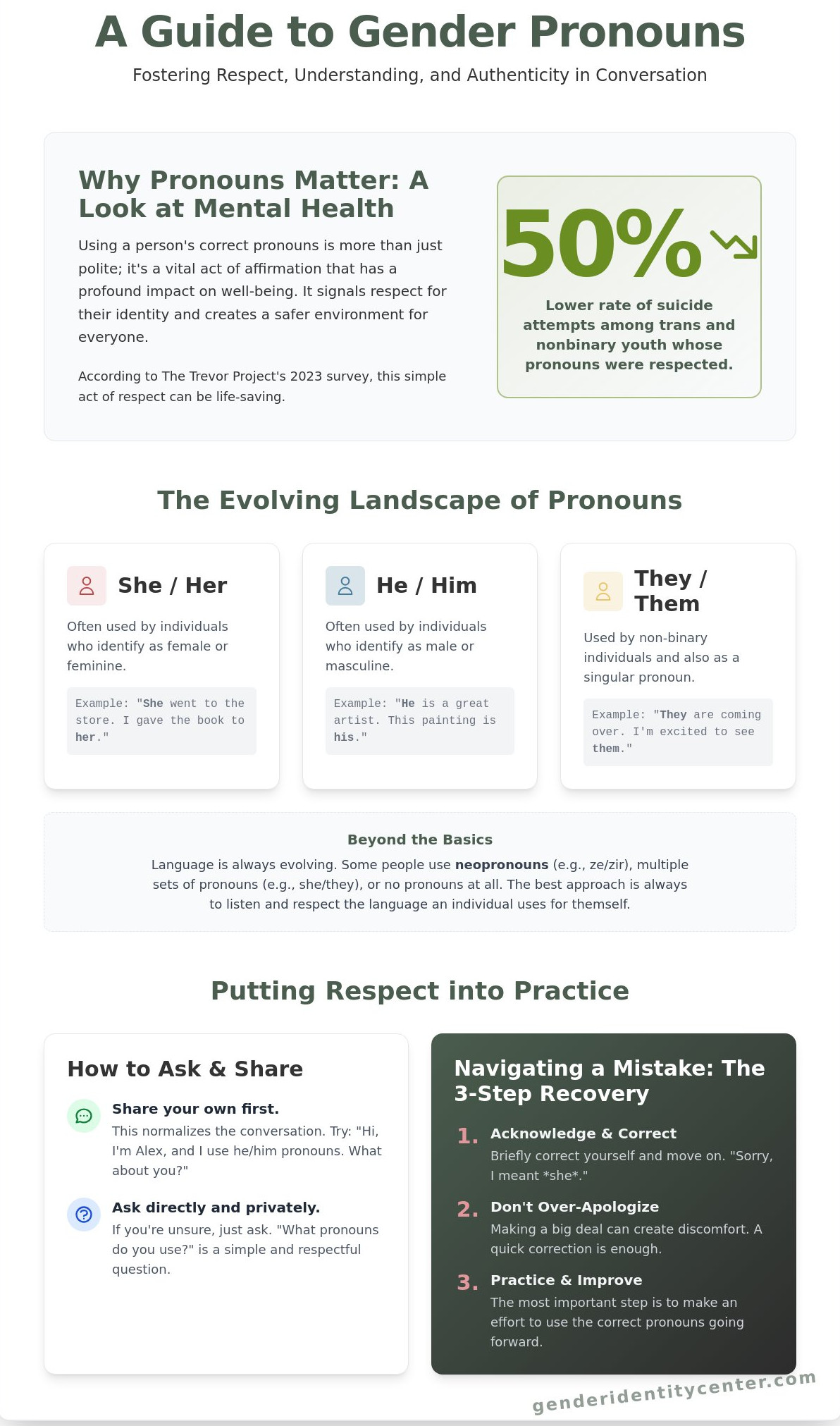
The impact of affirming language is backed by clear data. According to the 2023 National Survey on LGBTQ Youth Mental Health, transgender and nonbinary youth who had their pronouns respected by the people they lived with reported lower rates of attempting suicide by up to 50 percent. This isn't just about being polite; it's a matter of well-being. For our neighbors in Phoenix and Tucson, being heard is often the first step toward healing. When you use the correct language, you're actively reducing the weight of anxiety and depression that often accompanies systemic exclusion. We see this gender pronouns guide as a tool for building stronger, more resilient communities. If you're looking for professional support on this journey, our therapists are here to provide a compassionate and affirming space.
The Evolving Landscape of Pronouns: From She/He to They and Beyond
Pronouns act as a vital bridge between your inner self and how you're perceived by those around you. This gender pronouns guide recognizes that the words we choose for ourselves are deeply personal tools for validation and empowerment. In our Arizona community, we see a beautiful variety of ways people describe their presence. Some of the most common pronouns you'll encounter include:
- she/her/hers: Often used by those who identify as female or feminine.
- he/him/his: Often used by those who identify as male or masculine.
- they/them/theirs: Frequently used by non-binary, genderqueer, or gender-expansive individuals.
It's quite common for someone to feel that multiple sets of pronouns fit their current state; for example, someone might use "she/they" to signal a connection to both womanhood and a non-binary identity. Because identity is a living, breathing process, these choices might shift as you move through your journey of self-discovery. This depends on each individual's experience, and there's no requirement for your pronouns to remain static for your entire life. You're the expert on your own experience, and your language can evolve as you do.
The choice of how you're addressed is profoundly subjective. What feels like a warm embrace to one person might feel restrictive to another. We believe in radical acceptance of these shifts. By staying open to how others define themselves, we create a sanctuary where everyone feels seen. Citing resources like Understanding Gender Identities helps us realize that affirming a person's pronouns is a fundamental act of respect that supports mental well-being. In fact, 2021 data from The Trevor Project suggests that when youth have their pronouns respected by the people they live with, they report lower rates of attempted suicide.
Traditional and Gender-Neutral Pronouns
The singular "they" isn't a modern invention; linguists have tracked its use back to 1375 in written English. For many, using gender-neutral terms provides significant relief from the weight of dysphoria. This depends on each individual's experience, as some feel most authentic when they step away from the binary entirely. These terms offer a way to exist outside of traditional expectations, providing a sense of stability and peace during the transition or exploration process.
Understanding Neo-pronouns and Custom Expressions
Neo-pronouns offer a way to express identities that traditional English structures don't always capture. Terms like ze/zir or xe/xem are valid and affirming choices for those navigating their own path. For instance, you might say, "Ze is going to the library; that book is zirs." This gender pronouns guide encourages a flexible mindset as new terms emerge. If you're currently exploring which words feel most like home, you might consider scheduling a gentle conversation with a supportive professional who can walk beside you on this path.
Navigating Pronoun Use within Arizona Communities
Arizona's social landscape is a vibrant tapestry of varied perspectives, ranging from the bustling tech corridors of Phoenix to the artistic enclaves of Tucson. When you move through these spaces, you'll find that the way people engage with identity is deeply personal and often reflects the specific spirit of their neighborhood. In Phoenix, a city of approximately 1.6 million residents, the atmosphere can shift from one block to the next. You might find a high level of pronoun awareness in Roosevelt Row, while other areas maintain more traditional conversational norms. This variation is exactly why many people find this Gender Pronoun Guide helpful for navigating different social expectations with grace.
Family settings often present their own unique challenges and opportunities for deeper connection. Every family has its own history and rhythm; therefore, your approach to sharing your pronouns might look different than someone else's. It's all very subjective, and there's no single "right" way to handle these intimate conversations. If you're looking for support in these spaces, Affirming Family Counseling in Tucson offers a way to explore these dynamics with professional guidance. Because identity is a journey, finding a local network can be transformative. Engaging with Group Therapy in Phoenix allows you to meet others who understand the nuances of the Arizona experience.
Social Dynamics in Arizona Spaces
Introducing yourself with your pronouns in a new group can feel like a courageous step toward authenticity. In places like Tucson's Fourth Avenue, you'll likely encounter a culture of radical acceptance where sharing pronouns is a standard practice. However, we believe that empathy is a two-way street. Some people you meet are still learning, and their level of awareness might be different from your own. Ultimately, this depends on each individual's experience when deciding how much of themselves to share in any given moment. We encourage you to listen to your intuition and prioritize your sense of safety.
Pronouns in Professional and Educational Arizona Settings
Arizona's professional world is evolving toward greater inclusivity. A 2023 survey of local businesses indicated a 15% increase in the voluntary use of pronouns in digital signatures and LinkedIn profiles compared to the previous year. Many companies in the Valley are realizing that simple language shifts create a more gender-affirming environment for everyone. Whether you're a student at a local university or a professional in a corporate office, you have the agency to decide how your gender pronouns guide your public identity. Navigating the balance between professional norms and authentic self-expression is a personal process, and we're here to support you as you find the path that feels most stable and true.
Actionable Steps: Asking, Sharing, and Navigating Mistakes
Building a culture of respect begins with the simple courage to ask and the humility to listen. When you use a gender pronouns guide to inform your daily interactions, you're not just following a set of rules; you're honoring someone's journey. A 2021 survey by The Trevor Project found that 94 percent of LGBTQ youth felt significantly better about their mental health when their pronouns were respected by those they live with. This data highlights how small linguistic shifts create profound emotional safety.
Sharing your own pronouns first is a powerful way to lead with vulnerability. You might say, "Hi, I'm Alex; I use he/him pronouns. What pronouns do you use?" This invitation lowers the pressure on others to disclose their identity first. It's helpful to remember that this depends on each individual's experience. Some people may feel empowered by the question, while others might find it unexpected. There's no single objective truth on the best way to interact, as every conversation is a unique bridge between two people.
Best Practices for Asking and Sharing
In our vibrant Phoenix community, modeling pronoun use can happen in boardrooms, coffee shops, or community centers. We suggest asking privately if you're unsure of someone's pronouns. This avoids putting an individual on the spot in front of a crowd. It's also vital to respect if someone chooses not to share. Forced disclosure can feel unsafe for those still exploring their authentic selves. Ultimately, the level of openness in a conversation is subjective and relies on the safety felt in that specific moment.
- Model first: Include your pronouns in email signatures or Zoom names.
- Keep it simple: Use direct questions like "How should I refer to you?"
- Respect silence: If someone declines to share, use their name instead.
Moving Forward After a Pronoun Mistake
Mistakes are part of the human experience. If you use the wrong pronoun, the "Apologize, Correct, Move On" framework prevents the moment from becoming about your own guilt. A quick "I'm sorry, I meant they, thank you" is often more affirming than a long, tearful apology. Over-apologizing often forces the person who was misgendered to comfort you, which adds emotional labor to their day. We see mistakes as opportunities for deeper connection rather than failures.
Some practitioners suggest the "Ouch and Educate" method. If you hear a mistake, a simple "Ouch" flags the error, followed by a gentle correction. This keeps the focus on the person's identity rather than the speaker's intent. Because every relationship is different, this depends on each individual's experience and the level of trust established. Embracing a growth mindset allows us to evolve together. If you're looking for more personalized support in your journey, you can schedule a consultation with our team today.
Supporting Your Authentic Journey in Phoenix and Tucson
The Gender Identity Center serves as a sanctuary for those who are ready to explore the depths of their identity. We understand that the process of finding validation isn't always easy, especially when societal norms feel rigid. This gender pronouns guide is a starting point, but your individual path will likely involve many layers of discovery. We've built a space where you can breathe, speak, and exist without judgment. Our specialized therapists focus on your agency, ensuring that you remain the expert on your own life throughout every conversation. We're here to offer a steady, guiding hand as you navigate the complexities of your personal evolution.
How Affirming Therapy Supports Self-Discovery
Gender counseling helps you navigate the "coming out" process at a pace that feels safe and manageable. Deciding which pronouns to use in professional or personal circles is a significant milestone that carries different weights for everyone. This depends on each individual's experience; some may feel comfortable sharing their truth immediately, while others prefer a gradual approach. We address gender dysphoria by focusing on radical acceptance and subjectivity, acknowledging that your internal sense of self is the ultimate authority. We don't believe in a one-size-fits-all model for transition. Instead, we prioritize your comfort and your unique timeline. Affirming therapy functions as a compassionate mirror that reflects your most authentic self back to you.
Finding Your Voice and Community in Arizona
If your pronoun journey includes voice transition, speech therapy can offer practical support to help your external expression match your internal reality. Arizona has a vibrant and growing network of resources for the gender-expansive community. According to the 2022 U.S. Transgender Survey, 48% of trans individuals in the region reported that having access to supportive community spaces significantly improved their overall mental health. It's all very subjective, so what works for one person in Tucson might look quite different for someone in Phoenix. We encourage you to reach out and consider scheduling a session to explore your identity in a protected, affirming environment. Your journey is valid, regardless of where you stand today or where you're headed tomorrow.
As you continue to use this gender pronouns guide to educate yourself and others, remember that support is always available. We offer a variety of services tailored to your needs, including:
- Individualized gender counseling for all ages
- Support for family members and allies
- Guidance on social and medical transition steps
- Referrals to local Arizona advocacy and healthcare groups
You don't have to carry the weight of discovery alone. We're honored to be a part of your story.
Embracing Your Unique Path to Authenticity
Using this gender pronouns guide isn't about following a set of rigid rules. It's about honoring the fluid nature of how we see ourselves and others. Whether you're navigating social spaces in Phoenix or exploring your voice in Tucson, the way you choose to share your identity is deeply personal. This depends on each individual's experience, and there's no single correct way to exist in the world. We believe that 100% of your journey deserves respect, validation, and a steady hand to guide you.
Since the 2022 release of the WPATH Standards of Care Version 8, the medical community has shifted toward more individualized support. Our team offers specialized EMDR and voice therapy within safe, non-judgmental spaces designed for your comfort. We also provide WPATH-compliant referral letters to assist with your transitions. Every step you take is a meaningful part of a larger story that's still being written. You're the expert on your own life, and we're here to provide the tools you need to feel seen. The process of discovery is all very subjective, and we're honored to walk it with you.
Beyond clinical support, many find that exploring their spiritual path offers another layer of insight. For those drawn to intuitive guidance on their journey of self-discovery, Third Eye Kentucky provides services like psychic readings and mediumship to help illuminate one's unique purpose.
Beyond clinical support, many find that exploring their spiritual path offers another layer of insight. For those drawn to intuitive guidance on their journey of self-discovery, Third Eye Kentucky provides services like psychic readings and mediumship to help illuminate one's unique purpose.
Begin your journey toward authenticity with a safe, affirming consultation today.
You're never alone on this path, and your most authentic self is waiting to be celebrated.
Frequently Asked Questions
Is it grammatically correct to use 'they' as a singular pronoun?
Yes, the singular 'they' is recognized as grammatically correct by major linguistic authorities. Merriam-Webster named it the Word of the Year in 2019, and the Associated Press Stylebook officially accepted its use in 2017. While some traditionalists prefer older rules, this depends on each individual's experience with language. We see 100% of major dictionaries now including this definition to reflect how people actually communicate today.
What should I do if I accidentally use the wrong pronouns for someone?
You should offer a brief, sincere apology, correct yourself, and then continue the conversation. Spending too much time on the mistake can make the other person feel responsible for comforting you. According to a 2021 study by The Trevor Project, 90% of LGBTQ+ youth feel more supported when people respect their pronouns. It's all very subjective, so follow the lead of the person you're speaking with to ensure they feel safe.
How do I ask someone about their pronouns without being awkward?
You can ask by sharing your own pronouns first or by simply asking, "What pronouns do you use?" in a private setting. This creates a safe space where the other person doesn't feel singled out. In 2022, 35% of Gen Z adults reported knowing someone who uses gender-neutral pronouns. This depends on each individual's experience, but lead with authenticity and warmth to make the interaction feel natural rather than clinical.
What are neo-pronouns and why do people use them?
Neo-pronouns are a category of gender-neutral pronouns, such as ze/zir or fae/faer, that people use to express their identity beyond traditional binary terms. These sets of words provide a way for individuals to find a label that feels authentic to their specific journey. Research from 2020 suggests that 4% of LGBTQ+ youth use neo-pronouns. It's all very subjective, as these terms allow for a highly personalized expression of gender that feels right to the individual.
Can someone's pronouns change over time?
Yes, it's quite common for a person's pronouns to evolve as they navigate their understanding of themselves. In a 2015 survey of 27,715 transgender people, 8% of respondents reported that their gender identity changed over time. This depends on each individual's experience and where they are on their personal pathway. We view this as a positive sign of growth and self-discovery rather than a lack of consistency or a finalized destination.
How do I support a family member in Arizona who just changed their pronouns?
You can support your family member by consistently using their new pronouns and correcting yourself when you slip up. This gender pronouns guide suggests practicing in private to build muscle memory. Data from 2023 indicates that Arizona has over 30,000 transgender residents who benefit from such family acceptance. It's all very subjective, so check in with your loved one to see what specific type of support they need most during their transition.
What if someone uses multiple sets of pronouns like she/they?
You should typically alternate between the sets of pronouns or ask the person if they have a specific preference for certain situations. For example, if someone uses she/they, you might use "she" in one sentence and "they" in the next. This depends on each individual's experience, as some people prefer a 50/50 split while others don't mind. About 25% of non-binary youth use a combination of pronouns to reflect their fluid identity.
Why is it important to share my own pronouns even if I'm cisgender?
Sharing your pronouns as a cisgender person normalizes the practice and signals that you're an ally who respects diverse identities. This gender pronouns guide explains that it removes the burden from trans and non-binary people to be the only ones identifying themselves. In 2021, 18% of LinkedIn users added pronouns to their profiles to foster an inclusive environment. It's all very subjective, but this small act helps build a more empathetic community for everyone.