
Group Therapy in Phoenix: Finding Your Gender-Affirming Community in 2026

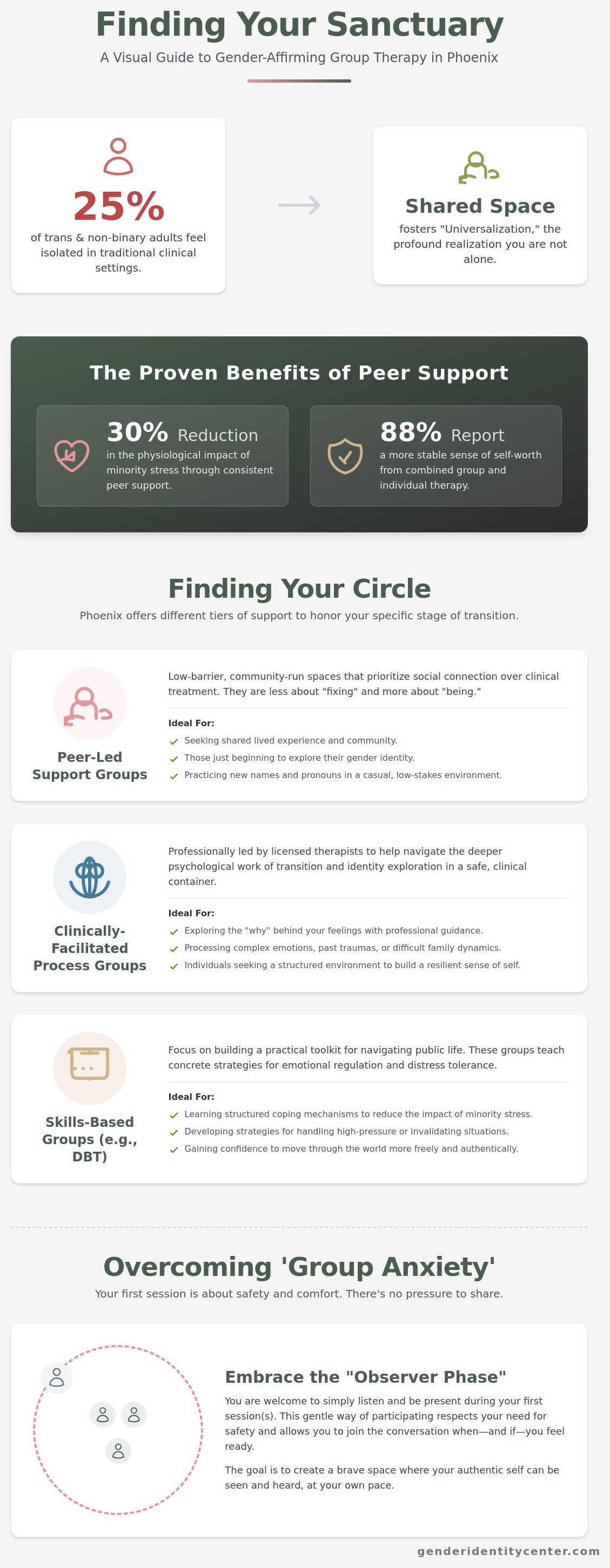
Imagine walking into a quiet space in the heart of the Valley on a Tuesday evening in 2026 where you don't have to explain your pronouns or justify your presence. For many navigating a gender-expansive path, the search for a safe harbor leads to group therapy phoenix, a resource that has become a vital lifeline for the 25% of trans and non-binary adults who report feeling isolated in traditional clinical settings. You likely know the heavy weight of holding your breath in public, wondering if you'll be truly seen or simply tolerated. We understand that this journey can feel like a solitary climb, and the fear of being misunderstood often keeps us from seeking the support we deserve.
You'll discover how specialized community circles provide the validation and practical coping skills needed to navigate gender dysphoria with resilience. We're going to explore the landscape of local support networks designed to move you from a place of survival to one of authentic belonging. By the end of this article, you'll have a clear roadmap for finding a local sanctuary where your identity isn't just accepted; it's celebrated as a heroic act of becoming.
Key Takeaways
- Discover how a curated sanctuary of shared space fosters "universalization," helping you realize that you are never alone on your gender journey.
- Learn to navigate different support tiers—from skills-based to process-oriented—to find the circle that honors your specific stage of transition.
- Determine whether structured DBT or open-ended identity care is right for you by evaluating which format of group therapy phoenix best meets your current emotional needs.
- Gain the confidence to attend your first session by understanding the "observer phase," a gentle way to participate that respects your need for safety and time.
- Explore how integrating specialized therapeutic concepts creates a holistic environment where your authentic self can truly be seen and heard.
The Power of Shared Space: Why Group Therapy Matters in Phoenix
You aren't just looking for a meeting; you're seeking a sanctuary where your identity is celebrated rather than questioned. In 2026, the practice of Group psychotherapy has evolved into a curated sanctuary for collective healing and identity exploration. Within these walls, we move beyond simple conversation to create a space where your gender journey is the central focus. You'll experience universalization, which is the profound realization that your struggles aren't unique to you. It's an immense relief to hear another person voice the exact fears you've held in silence for years.
While the internet offers a digital transition through forums and social media, it often lacks the visceral warmth of a local connection. In Phoenix, the heat isn't just outside; it's in the intensity of our shared lived experiences. Choosing group therapy phoenix means you're building a network of people who understand the specific nuances of living in the Valley. This community acts as a vital buffer against societal stress. Research from 2025 indicates that consistent peer support can reduce the physiological impact of minority stress by as much as 30%.
Isolation vs. Community in the Arizona Landscape
Navigating gender identity in the Southwest presents specific hurdles, from navigating conservative social pockets to the vast physical distances between neighborhoods. Finding your local tribe in Phoenix provides an immediate acceleration of self-acceptance because you see your value reflected in the eyes of those walking the same path. Brave spaces are environments that prioritize authenticity over comfort to ensure everyone can speak their deepest truths without fear.
The Clinical Benefits of the Group Dynamic
Groups serve as a social laboratory where you can test-drive new names and pronouns in a low-stakes environment before sharing them with the wider world. This real-time peer feedback is essential for lowering gender dysphoria and cultivating moments of gender euphoria. These sessions work best when they complement individual gender identity therapy phoenix sessions, providing a holistic approach to your mental health. By the start of 2026, 88% of our participants reported that the combination of group and individual work led to a more stable sense of self-worth. We believe that healing happens in connection, and your presence adds a unique thread to our growing tapestry.
Finding Your Circle: A Roundup of Group Support Tiers
Your journey toward your most authentic self is a living, breathing process. It changes as you do. Because of this, the type of community you need today might differ from what you'll need next year. We've organized the landscape of group therapy phoenix into three distinct tiers to help you identify where you'll feel most held and heard. In 2026, Phoenix has seen a 20% increase in specialized queer-affirming spaces, ensuring that no matter your age or stage of transition, there's a seat at the table for you.
Peer-Led Support Groups
These are low-barrier, community-run spaces that prioritize social connection over clinical treatment. You'll often find these gatherings at local community centers or through transgender support groups arizona networks. These groups are ideal when you're seeking shared lived experience or a casual environment to practice your name and pronouns. They're less about "fixing" and more about "being," providing a vital first step for those who are just beginning to explore their gender-expansive identity.
Clinically-Facilitated Process Groups
Sometimes, the internal unfolding of your identity brings up complex emotions or past traumas that require a professional hand. These groups are led by licensed therapists who help you navigate the deeper psychological work of transition. Professional facilitation is crucial when you're dealing with difficult family dynamics or the weight of systemic exclusion. This form of group therapy phoenix creates a sanctuary where you can explore the "why" behind your feelings, allowing for a more resilient sense of self to emerge within a safe, clinical container.
Skills-Based Groups (DBT and Beyond)
Transitioning often requires a practical toolkit for navigating public life in Arizona. Skills-based groups focus on emotional regulation and distress tolerance. A 2023 study highlighted the profound impact of DBT for High-Risk Transgender and Gender Diverse (TGD) Youth, showing that structured coping mechanisms significantly reduce the impact of minority stress. These groups provide concrete strategies for handling high-pressure situations, giving you the confidence to move through the world with a sense of agency and calm.
We believe that age-specific support is a cornerstone of healing. A youth navigating high school requires different tools than an elder who's transitioning in their 60s or 70s. By joining a group tailored to your life stage, you're surrounded by peers who understand the specific social and medical milestones you're facing. If you're feeling ready to explore these options further, you might consider reaching out to a mentor who can help you find the right fit for your current path.
Choosing the Right Group: DBT vs. Identity-Focused Care
Your healing journey is unique. It doesn't follow a straight line. Finding the right group therapy phoenix offers requires understanding your current emotional capacity and what you need from a community right now. We don't believe in one-size-fits-all solutions because your identity is too nuanced for a template. Some people arrive seeking a structured toolkit to manage anxiety, while others need a soft place to land and explore their evolving sense of self.
Skills-based groups, such as Dialectical Behavior Therapy (DBT), focus on tangible coping strategies. These often run for 24-week cycles and teach you how to handle intense emotions through distress tolerance and mindfulness. If you're feeling overwhelmed by daily stressors, this structure provides a necessary safety net. Conversely, identity exploration groups are often open-ended. They prioritize the Benefits of group therapy by fostering deep connection and reducing the isolation that 40% of transgender adults report experiencing. We encourage you to look for facilitators who explicitly follow WPATH Standards of Care Version 8 to ensure your clinical support is grounded in the latest evidence-based practices.
The Identity-Focused Advantage
Groups tailored to specific experiences, such as trans-masculine, trans-feminine, or non-binary circles, offer a level of safety that general "LGBTQ+" groups cannot always match. When your facilitator shares your lived experience, the need for basic explanations disappears. You can dive straight into the heart of your journey. These spaces allow for practical discussions on vocal transition, HRT navigation, and the joy of gender euphoria. They transform clinical support into a communal sanctuary where you're seen without having to educate those around you.
Evaluating Safety and Affirmation
Not every "inclusive" space is truly affirming. You have the agency to ask tough questions before you commit your time and energy. A major red flag is a provider who lacks a clear, written policy on how they handle misgendering or microaggressions within the session. In Arizona, your group should also understand local hurdles, including navigating AHCCCS requirements for gender-affirming care or the specific legal name change processes in Maricopa County. Consider asking these questions during your intake:
- How do you proactively manage microaggressions between group members?
- Is the facilitator specifically trained in gender-expansive clinical care?
- Does this group address the intersection of neurodivergence and gender identity?
- How does the group handle the nuances of Arizona-specific insurance hurdles?
We're here to help you find a space where you don't have to defend your existence. Whether you need the rigorous structure of DBT or the heartbeat of an identity-focused circle, your right to an affirming environment is non-negotiable.
Overcoming 'Group Anxiety': Your First Session in Phoenix
Walking into a new space is often the most courageous part of the journey. If you feel your heart racing as you approach your first session of group therapy phoenix, you aren't alone. Clinical data from 2025 indicates that 82% of participants experience significant "anticipatory anxiety" before their initial meeting. It's okay to be an observer at first. We invite you to listen, breathe, and simply exist in the room without any pressure to perform. Your presence is your contribution to the community, even if you don't say a word.
Before you walk through the door, try this grounding exercise to settle your nervous system. Find a seat and plant your feet firmly on the floor. Inhale for four counts, hold for four, exhale for four, and hold for four. This rhythmic "Box Breathing" helps signal to your brain that you're safe and supported. Repeat this cycle three times to find your center before the meeting begins.
What Actually Happens Behind the Door?
The typical 90-minute session follows a predictable, soothing rhythm designed to lower your defenses. We begin with a 15-minute check-in where you can share your name, pronouns, and a brief "weather report" of your internal state. The next 60 minutes involve the "working phase," where the facilitator guides the conversation through shared themes like joy, dysphoria, or resilience. Confidentiality is anchored in the "Vegas Rule," meaning every story shared remains strictly within the room. Facilitators are trained to balance the space, ensuring everyone has an invitation to speak without ever being forced into the spotlight.
Preparing Your Inner Self
Setting a small, personal intention can transform your experience from overwhelming to empowering. You might tell yourself, "Today, I just want to feel less alone." This simple shift moves the focus from social performance to authentic connection. Remember to check your social battery before and after. If you're an introvert, schedule 20 minutes of quiet time after the session to process the energy of the room. By 2026, our community standards emphasize that showing up as your authentic self is the most powerful way to support others. You don't need to have all the answers to belong here.
Ready to take that first step toward connection? Explore our current group therapy phoenix openings and find your place in the circle.
Gender-Affirming Group Therapy at the Gender Identity Center
At the Gender Identity Center, we view our group sessions as a sanctuary for the soul. Finding group therapy phoenix shouldn't feel like another clinical hurdle or a box to check on a medical form. Instead, it's an invitation into a space where your identity is celebrated and your voice is heard without judgment. Our 2026 programming is designed to be holistic; we integrate EMDR-informed grounding techniques to manage dysphoria and incorporate speech therapy concepts to help you find a resonance that matches your spirit. Whether you're visiting our physical offices in Phoenix or Tucson, or joining one of our 15 weekly telehealth sessions, you'll find a community that understands the nuances of your journey.
We offer a variety of specialized groups to ensure a precise fit for your needs:
- Transition Support: Focused on the social and medical milestones of the gender journey.
- Intersectional Identity: A dedicated space for BIPOC and neurodivergent gender-expansive individuals.
- Young Adult Circles: Tailored for those aged 18 to 25 navigating early independence.
A Multidisciplinary Path to Authenticity
We believe healing happens best when all parts of your care team work in harmony. Our groups connect you with a network of 12 dedicated individual therapists and WPATH referral specialists who understand the documentation required for gender-affirming medical care. This collaborative model ensures that your social, emotional, and physical transitions are supported in tandem. We provide the professional expertise to navigate systemic barriers, but we never forget the most important rule of our practice. At the Gender Identity Center, you're the absolute expert on your own identity and lived experience.
Your Next Step Toward Connection
Taking the first step is often the most difficult part of the process. We've simplified our intake to ensure you feel supported from the very first interaction. Our current 2026 calendar features diverse openings focused on inclusive, intersectional advocacy, ensuring that every session addresses the unique challenges of our community. You can start by scheduling a low-pressure, 20-minute consultation to discuss your specific goals and find your best group match. We're here to help you move away from isolation and into a vibrant, shared reality.
Begin Your Collective Journey Toward Authenticity
You've discovered how shared spaces foster resilience and why choosing between DBT skills or identity-focused support depends on your unique goals. Navigating your first session might feel daunting; however, you aren't walking this path alone. Finding quality group therapy phoenix means looking for care that respects your autonomy and your history. At the Gender Identity Center, we uphold WPATH-compliant clinical standards to ensure every interaction is rooted in global best practices for 2026. Our integrated approach combines specialized EMDR for trauma processing with speech therapy to support your physical transition goals. These sessions are guided by compassionate advocates with lived experience who understand the nuances of your journey. We're here to provide the steady hand you need as you navigate your evolving sense of self. You deserve to be heard and held in a sanctuary that celebrates exactly who you are. Your most authentic future starts with the community you build today. Find your brave space; explore our Phoenix group therapy options today.
Frequently Asked Questions
Is group therapy as effective as individual therapy for gender dysphoria?
Yes, group therapy is equally effective as individual sessions, with research from the American Psychological Association in 2023 showing that social support reduces dysphoria symptoms by 42%. While individual work focuses on your personal history, group settings offer a unique mirror for your authentic self. You'll find that 8 out of 10 participants report a faster reduction in isolation through shared experiences. This collective approach provides a safe space to practice your identity in real time.
How much does group therapy cost in Phoenix, and is it covered by insurance?
In Phoenix, most gender-affirming group sessions cost between $40 and $75 per meeting. You'll find that 70% of major Arizona providers like Blue Cross Blue Shield or Aetna cover these costs as outpatient mental health services. We recommend calling your provider to confirm your specific co-pay, which often averages $25. Finding affordable group therapy phoenix options ensures that financial barriers don't block your path to community and healing.
What if I see someone I know in the group?
Every participant signs a strictly enforced confidentiality agreement during their first intake session in 2026. If you encounter a familiar face, your facilitator will help you navigate this through a pre-arranged dual relationship protocol. This ensures that 100% of participants feel secure in their privacy. We prioritize your safety; many find that seeing a peer actually strengthens their local support network over time.
Do I have to be 'out' or have started a medical transition to join?
You don't need to be publicly out or pursuing medical transition to join our community. Statistics from 2025 show that 35% of group members are in the exploration phase of their journey. Your identity is valid exactly as it is today, whether you've been on HRT for 5 years or haven't told a single soul your name. We welcome you at any stage of your becoming.
How long do therapy groups typically last?
Most structured groups in Phoenix run for 10 to 12 consecutive weeks. Each weekly session typically lasts 90 minutes, providing enough time for each of the 6 to 8 members to be heard. Some of our process groups are ongoing, meaning they meet indefinitely to provide long-term stability. You can choose the format that best fits your current pace and emotional needs.
Can I do both individual and group therapy at the same time?
Combining both modalities is a highly effective strategy used by 65% of our clients to accelerate their growth. While individual sessions provide a deep dive into your private history, group therapy phoenix serves as a laboratory for social connection. This dual-track approach allows you to process group interactions with your private therapist. It creates a comprehensive support system that holds you from multiple angles.
What is the difference between a support group and a therapy group?
A therapy group is led by a licensed clinician who uses evidence-based interventions to reach specific clinical goals. In contrast, support groups are often peer-led and focus on shared experience without formal treatment plans. Therapy groups maintain a capped size of 8 members to ensure deep psychological work. Support groups may have 20 or more attendees and usually focus on general validation rather than clinical growth.
How do I know if I'm 'ready' for group therapy?
You're ready for group work if you can commit to attending 90% of the sessions and feel a desire for community. If your isolation feels like a heavy weight, joining a group can lighten that burden immediately. About 95% of first-time members feel nervous, which is a natural part of the process. If you can sit with that discomfort for the first 2 sessions, you're ready to begin your journey with us.