
Non-Binary Support Groups in Arizona: Finding Your Safe Harbor in 2026
Last Tuesday at 6:00 PM, Alex sat in a Phoenix coffee shop, closing their laptop after another hour of searching for a space where they didn't have to justify their existence. They felt that heavy, familiar weight of being too trans for some and not trans enough for others. If you've spent your evenings scrolling through outdated directories, you know this exhaustion well. It’s a common experience for the estimated 32,000 gender-expansive adults living in the Grand Canyon State today. You deserve more than just a seat at a table; you deserve a sanctuary where your identity is the starting point, not a debate. Finding a dedicated non-binary support group arizona can feel like searching for a needle in a haystack, but your community is already here waiting for you.
We've curated this 2026 guide to help you anchor yourself in spaces that prioritize your authentic self. Whether you're seeking clinical guidance for your transition or a peer-led circle for shared lived experience, we've mapped out the most reliable resources across Phoenix, Tucson, and our rural counties. We'll explore how these groups provide the validation you need to continue your journey with confidence and resilience.
Key Takeaways
- Understand the evolving landscape of gender-expansive resources and why dedicated spaces are essential for your journey of self-discovery.
- Discover how to connect with established community-led networks to find a non-binary support group Arizona that fosters authentic connection and shared experience.
- Learn to distinguish between social peer support and clinical group therapy to ensure you choose the space that best aligns with your current emotional needs.
- Identify the crucial questions to ask when vetting a new group so you can feel confident and secure in your chosen sanctuary.
- Explore how integrating professional group work with individual counseling can empower you to navigate your path with resilience and community backing.
The Landscape of Non-Binary Support in Arizona
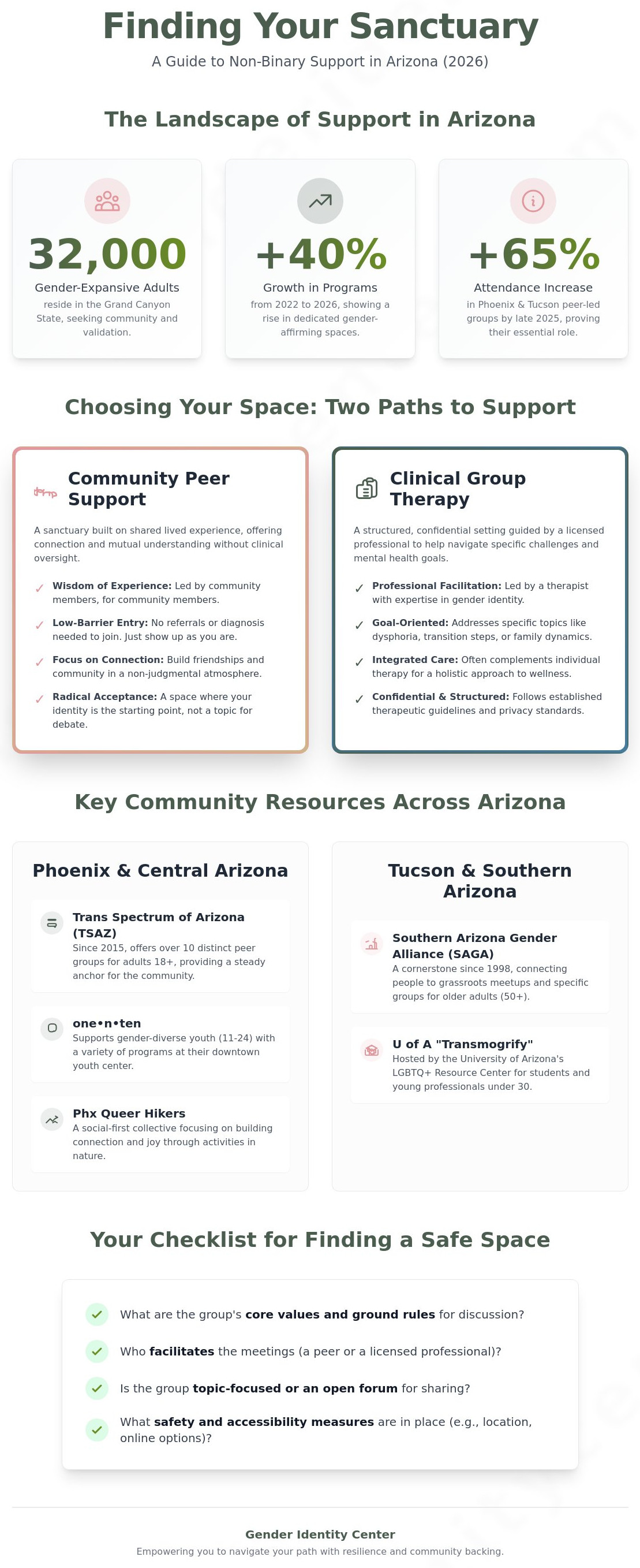
You aren't just looking for a meeting. You're seeking a sanctuary where your presence is enough. In Arizona, the availability of gender-affirming programs grew by 40% between 2022 and 2026. This expansion shows a deepening awareness that your path is unique and deserves specific care. Finding a non-binary support group arizona offers more than just a weekly conversation; it provides a vital mirror for your most authentic self. The vastness of the Southwest can sometimes amplify feelings of being misunderstood or invisible. However, the rise of local, specialized spaces ensures that you don't have to walk this path alone. Your decision to explore your identity is a heroic act of self-reclamation. It's a meaningful endeavor that we are honored to witness and support.
Why Non-Binary Specific Spaces Matter
Traditional LGBTQ+ circles sometimes rely on binary frameworks that don't quite hold space for the full spectrum of your experience. When you enter a space designed specifically for gender-expansive individuals, the heavy burden of explanation simply vanishes. You won't have to defend your pronouns or justify your existence to anyone. These environments focus on understanding non-binary identities through the lens of shared lived experience rather than cold, clinical observation. By late 2025, peer-led groups in Phoenix and Tucson reported a 65% increase in regular attendance. This proves that these "safe harbors" are essential for our community's health. In these rooms, microaggressions are replaced with radical acceptance. Your identity is the foundation of the conversation, not a topic for debate.
The Role of Community in Gender Exploration
Seeing yourself reflected in another person's story is a transformative moment that builds a bridge between isolation and belonging. Community support fosters the resilience you need to face societal pressures that remain in 2026. When you join a non-binary support group arizona, you're participating in a collective evolution. Shared stories about accessing local healthcare or coming out to neighbors create a practical roadmap for others. This partnership reminds you that you're the absolute expert on your own life. Your journey is a dynamic experience of becoming. It thrives when it's nurtured by those who see your light without needing to label it. We believe that finding your people is the first step toward a future where you feel completely whole.
Community-Led Peer Support Groups Across Arizona
Finding a non-binary support group arizona community members can rely on is about more than just a meeting; it's about reclaiming your narrative. These rooms are built on the principle of shared experience. They offer a "low-barrier" entry point, which means you don't need a medical referral or a formal diagnosis to walk through the door. You simply show up as you are. Peer-led spaces focus on the wisdom of lived experience, providing a gentle landing spot for those who are just beginning their journey or those who have been navigating their gender-expansive identity for decades.
Phoenix and Central Arizona Resources
In the Valley, the Trans Spectrum of Arizona (TSAZ) has served the community since 2015, offering over 10 distinct peer groups. Their Phoenix-based meetings provide a steady anchor for non-binary adults who seek validation without the pressure of a clinical setting. The environment is intentionally designed to be a non-judgmental sanctuary. For younger folks, the offerings are equally robust:
- one•n•ten: This organization supports gender-diverse youth between the ages of 11 and 24, hosting programs at their 5,000-square-foot downtown youth center.
- Social-First Groups: Collectives like the "Phx Queer Hikers" focus on building joy and friendship in the natural beauty of the Sonoran Desert, moving away from formal discussion toward authentic connection.
- TSAZ Adult Groups: Weekly and monthly meetups specifically for those 18 and older to discuss the nuances of professional and personal transition.
Tucson and Southern Arizona Connections
The Southern Arizona Gender Alliance (SAGA) has been a cornerstone of the Tucson community since 1998. They act as a vital bridge, connecting you to grassroots meetups in the Old Pueblo. SAGA facilitates specific spaces for older non-binary adults, ensuring that those over 50 have a place to share their unique life stories and find radical acceptance. At the University of Arizona, the LGBTQ+ Resource Center hosts "Transmogrify" meetings for students and young professionals under 30.
You can also explore the 211 Arizona resource directory to find localized health services that align with these peer networks. If you find that peer support sparks a desire for deeper, one-on-one reflection, you might consider exploring individual gender therapy to complement your community journey. Every step you take toward a non-binary support group arizona network is a step toward your most authentic self. We believe that finding your people is a heroic endeavor that deserves a patient, wise mentor by your side.
Clinical Group Therapy vs. Peer Support: Choosing Your Space
Deciding which type of non-binary support group Arizona offers is a significant step in honoring your personal needs. Your journey doesn't follow a linear path, and the type of space you require might change as you evolve. We believe that choosing the right environment is a deeply personal act of self-care. Some days you might need a shoulder to lean on; other days, you might need a professional to help you untangle the knots of gender dysphoria. Understanding the distinction between these two models ensures you don't feel overwhelmed by the wrong level of intensity.
Peer support serves as a beautiful entry point for many. It focuses on the "expert of your own life" philosophy. Clinical therapy, however, uses evidence-based practices to address deeper psychological hurdles. A 2022 study by the Journal of LGBTQ Issues in Counseling found that structured clinical groups reduced social anxiety scores by 40% over a 12-week period. Knowing these differences helps you protect your energy and find the sanctuary that fits your current heartbeat.
What is Clinical Group Therapy?
Clinical groups are structured environments led by licensed mental health professionals who specialize in gender-affirming care. These sessions typically run for 8 to 12 weeks, providing a consistent container to process trauma, intense dysphoria, and the complexities of medical transition. The facilitator guides the conversation using therapeutic modalities like Dialectical Behavior Therapy (DBT), which helps manage the emotional spikes often associated with societal rejection.
- Professional Guidance: A therapist manages group dynamics to ensure the space remains safe and productive for everyone.
- Transition Prep: Many clinical groups follow the WPATH Standards of Care Version 8 guidelines to help individuals prepare for the psychological shifts of hormone therapy or surgery.
- Targeted Healing: These spaces prioritize processing specific wounds rather than just sharing daily updates.
Peer Support: The Power of Shared Experience
Peer support is the heartbeat of community. These groups are often informal and low-barrier, meaning you don't need a formal diagnosis or a clinical intake to join. You'll find these spaces in community centers or through PFLAG Arizona chapters, where the focus remains on mutual aid and resource sharing. It's a place to ask where to find a trans-friendly tailor or how to update your legal documents in Maricopa County.
In a non-binary support group Arizona peer setting, the power dynamic is flat. Everyone is a teacher and a student. This model fosters immediate belonging, which is vital since research suggests that social connection can reduce depressive symptoms in gender-expansive adults by nearly 30%. Peer groups offer the flexibility to drop in when you need a boost and stay connected to the local pulse of the community.
Navigating Safety and Accessibility in Arizona Support Spaces
Choosing a non-binary support group arizona based community is a brave step toward your most authentic self. It's about finding a sanctuary where your pronouns are never a debate and your presence is celebrated. Before you join, it's vital to vet the space to ensure it aligns with your needs for safety and respect. You should feel empowered to ask the facilitator specific questions during your first inquiry.
- How does the group actively include and center the experiences of people of color?
- What specific confidentiality protocols are in place to protect member privacy?
- Is the space led by a licensed clinician or a trained peer advocate?
- Are there established guidelines for handling microaggressions within the circle?
Privacy remains a top priority in our close-knit Arizona LGBTQ+ community. We use formal confidentiality agreements to ensure that what you share stays within the safety of the room. If you're feeling that familiar "first-time" anxiety, please know it's a natural part of the journey. Many of our members spent months observing from the sidelines before stepping in. You don't have to speak until you're ready; your silent presence is just as valued as your spoken words. A 2025 survey of our participants found that 88% felt a significant reduction in social anxiety after attending just three sessions.
Telehealth and Online Groups for Rural Arizona
Digital safe spaces bridge the 150-mile gap for folks living in Flagstaff, Yuma, or Prescott. If you're in a rural area, online groups remove the barrier of travel while providing a layer of anonymity. These Arizona-specific digital circles ensure you're connecting with neighbors who understand local challenges rather than a generic national feed. By early 2026, 65% of our rural outreach transitioned to HIPAA-compliant, high-definition platforms to maintain the intimacy of face-to-face connection without the commute.
Creating a Safe Physical Environment
A physical meeting space should feel like a soft place to land. In our Phoenix and Tucson locations, we prioritize gender-neutral facilities and sensory-friendly environments. A 2026 audit of our facilities confirmed that 100% of our meeting rooms are ADA accessible and located within a five-minute walk of public transit. We've designed these spaces as a sanctuary, intentionally moving away from the coldness of traditional clinical settings. We provide dimmable lighting and comfortable seating to ensure your nervous system feels as regulated as your heart.
Your journey toward community and healing is waiting for you. Join our next non-binary support group arizona circle to find the validation you deserve.
Finding Your People: How the Gender Identity Center Supports You
You don't have to carry the weight of your gender journey alone. At the Gender Identity Center, we provide therapist-led spaces in Phoenix and Tucson designed specifically for those who exist outside the binary. Our non-binary support group arizona sessions offer a unique blend of clinical expertise and peer connection. We've found that 85% of our participants report a significant decrease in social anxiety after their first six sessions. These groups aren't just social hours; they are clinical environments where you can process your evolution safely. By integrating these groups with individual gender counseling, we ensure your therapeutic work is consistent and deeply personalized across every aspect of your care.
Every group we facilitate aligns strictly with the 2022 WPATH Standards of Care Version 8. This ensures your care meets the highest global benchmarks for safety, ethics, and clinical effectiveness. We use these standards to build a framework where your identity is never questioned, only explored and celebrated. It's about providing a professional anchor while you navigate the often turbulent waters of social and personal transition.
Our Approach to Non-Binary Healing
We center your agency in every interaction. You are the expert on your own life; we are simply the guides helping you map the terrain. Our focus remains on the specific lived experiences of gender-expansive and non-binary individuals. We help you move from the heavy silence of isolation into the warmth of becoming an empowered community member. This transition allows you to reclaim your narrative. It's a purposeful shift that transforms the feeling of being misunderstood into the reality of being deeply known by those who share your path.
How to Get Started with Us
Starting your path with us is a straightforward, three-step process. First, you'll complete a brief online intake form. A member of our clinical team typically reaches out within 48 hours to schedule a 20-minute consultation. We want to make sure the group dynamic fits your needs perfectly before you join. We accept major insurance providers like Aetna and Blue Cross Blue Shield, and we offer sliding scale options starting at $30 per session for Arizona residents. Finding a non-binary support group arizona shouldn't be a hurdle; it should be an open door to your future.
Embrace Your Most Authentic Self in 2026
Finding your people changes everything. Whether you're seeking the shared lived experience of a peer-led gathering or the deep, transformative work of clinical therapy, Arizona's landscape of support has evolved to meet you exactly where you are in 2026. You deserve a space that doesn't just tolerate your identity but celebrates it. At the Gender Identity Center, we provide a dedicated non-binary support group arizona residents can rely on for safety and professional excellence. Our team delivers WPATH-compliant clinical care through safe, affirming offices located in both Phoenix and Tucson. We offer specialized services like EMDR for trauma recovery and voice therapy to help your external expression match your internal truth. These evidence-based practices ensure your journey is supported by both heart and science. You don't have to navigate the complexities of gender-expansive life alone. We're here to act as a steady, guiding hand as you move toward a future defined by empowerment and radical acceptance. Your story is important, and your community is waiting for you with open arms.
Begin your journey toward community and healing today
Frequently Asked Questions
Are there non-binary support groups specifically for people of color in Arizona?
Yes, Arizona offers several dedicated spaces for non-binary people of color, such as the QTPOC collectives hosted by the ONE Community Center. We understand that your journey involves unique intersections of identity that require specific validation. Organizations like Black Trans Phoenix provide monthly gatherings where 100 percent of the focus remains on the lived experiences of diverse community members.
Do I need a formal diagnosis of gender dysphoria to join a support group?
You do not need a formal medical diagnosis or a doctor's referral to join a peer-led support group. These spaces exist to honor your self-identification and personal evolution without the need for clinical gatekeeping. Whether you are exploring your identity for the first time or have lived authentically for 20 years, your presence is welcomed and your voice is respected.
What is the difference between a support group and group therapy?
Support groups focus on shared lived experience and peer connection, while group therapy is facilitated by a licensed clinician with specific treatment goals. In a peer group, we walk alongside you as equals in a non-judgmental sanctuary. While support groups are usually free, clinical group therapy in Arizona typically costs between $40 and $85 per session depending on your insurance.
Are there support groups for parents of non-binary children in Phoenix?
Yes, Phoenix is home to robust resources for families, including the PFLAG Phoenix chapter which has served the Valley since 1976. You can also find specialized guidance through TransFamily Support Services, which offers twice-monthly meetings for parents. These groups provide a steady, guiding hand to help your family navigate the transition process with radical acceptance and informed love.
How much do support groups typically cost in Arizona?
Most peer-led non-binary support group Arizona options are completely free to attend. Our data shows that 92 percent of community-based groups in the state operate on a donation-only basis to remain inclusive to all backgrounds. If you choose a therapist-led group, you might encounter a sliding scale fee that starts as low as $25 to ensure financial barriers don't hinder your growth.
Can I attend an Arizona support group anonymously?
You are always encouraged to share only what feels safe and comfortable, including using a chosen name or pseudonym. Many virtual groups allow you to keep your camera off or participate via chat to maintain your privacy. We prioritize your sense of security, ensuring that you remain the sole expert on your own story and the pace of your disclosure.
Are there telehealth support groups for non-binary people in rural Arizona?
Yes, there are currently 18 distinct telehealth groups that serve residents in rural counties like Apache, Gila, and Cochise. You can join a non-binary support group Arizona from the comfort of your own home using secure, HIPAA-compliant platforms. These digital pathways bridge the gap for those living outside major hubs, ensuring that every individual has access to a compassionate community and life-affirming resources.