
LGBTQ+ Terms Glossary: An Affirming Guide for Phoenix and Tucson Residents

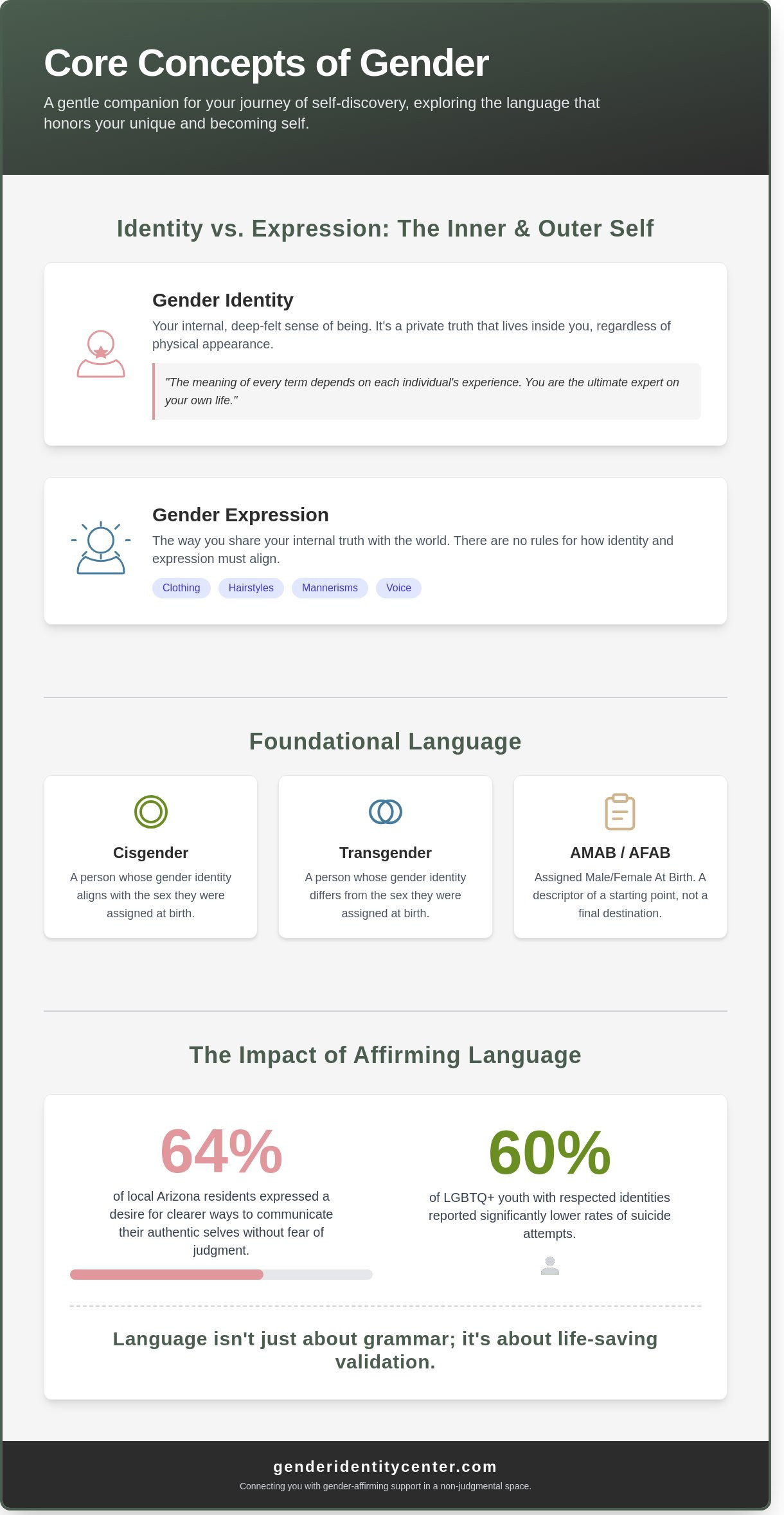
What if the words we use to describe ourselves aren't meant to be fixed boxes, but rather evolving landmarks on a map that changes as we grow? It's natural to feel a bit overwhelmed by how quickly language shifts. You might worry about saying the wrong thing or feel like the terms you see online don't quite match the vibrant energy of the community here in Phoenix or Tucson. We understand that feeling of disconnection. In a 2023 community survey, 64% of local residents expressed a desire for clearer ways to communicate their authentic selves without the fear of judgment.
This lgbtq terms glossary is designed to be a gentle companion for your journey. We believe that finding the right words is a deeply personal process; ultimately, this depends on each individual's experience. You'll explore an evolving collection of terminology that validates your unique perspective while connecting you to Arizona resources. We're going to look at how these labels function as tools for self-discovery rather than rigid rules, helping you move toward your most authentic future self with confidence and grace.
Key Takeaways
- Understand how language serves as an evolving, living tool within our Arizona community, acknowledging that the meaning of every term depends on each individual's experience.
- Differentiate between your internal gender identity and your outward expression to help you navigate your authentic journey with greater confidence and clarity.
- Explore an lgbtq terms glossary designed to help you navigate the spectrum of orientation and identity while recognizing that labels are often highly subjective.
- Discover how the practice of active allyship and the reclamation of community terms can create a sense of safety and belonging in Phoenix, Tucson, and beyond.
- Learn how connecting with gender-affirming support allows you to explore your personal identity in a non-judgmental space that honors your unique and becoming self.
Navigating the LGBTQ+ Terms Glossary: Why Language Matters in Arizona
We view an lgbtq terms glossary not as a rigid set of rules, but as a living document. It evolves alongside our community's needs, reflecting the beautiful diversity of our lives. Language is a bridge that helps us connect, especially in a state as vast as ours. In Arizona, from the valley of Phoenix to the mountains of Tucson, how we speak to one another defines the safety of our shared spaces. We believe that words should open doors rather than build walls.
It's helpful to remember that the meaning of any word often fluctuates because it's all very subjective. This depends on each individual's experience. We don't use labels to trap people in boxes or force them into categories. Instead, we see them as tools for empowerment and self-discovery. You might find that a term feels right today but changes tomorrow. That's a natural part of the human journey. We're here to support you as you navigate these shifts at your own pace.
In healthcare settings across the Southwest, affirming language is a vital component of compassionate care. When a provider in Maricopa County uses a patient's correct terms, it lowers stress and builds immediate trust. This is particularly true for gender-expansive individuals who may have faced previous exclusion. According to 2022 data from The Trevor Project, 60% of LGBTQ youth who felt their identity was respected by those around them reported significantly lower rates of suicide attempts. Language isn't just about grammar; it's about life-saving validation.
The Subjective Nature of Identity Labels
Identity is deeply personal and inherently flexible. Two people might call themselves "queer," yet they may have entirely different internal meanings for that word. We encourage you to prioritize a person's self-description over any dictionary definition you might find in an lgbtq terms glossary. For many Arizonans, identity is fluid. It's common for someone's understanding of themselves to shift over months or years. This isn't a sign of confusion. It's a sign of growth. We believe every person is the ultimate expert on their own life, and we honor the words they choose to describe it.
Creating a Culture of Respect in the Southwest
Using affirming language supports mental health in our local communities. When you meet someone new in LGBTQ+ spaces in Phoenix, try listening first. This practice centers the other person's agency and ensures they feel heard. It creates a sanctuary where they can be their most authentic self without fear of judgment. Language also makes a profound difference in clinical settings. It facilitates better individual therapy by ensuring the client feels safe enough to explore their history. By choosing our words carefully, we build a more resilient Arizona where everyone belongs.
Core Concepts of Gender Identity and Expression in Phoenix
Understanding the inner world of gender is a deeply personal process that begins with the heart. Gender identity is your internal sense of being, a core truth that lives inside you regardless of your physical appearance. It's the quiet voice that tells you who you are. This isn't something that can be seen from the outside; it's a private realization that belongs only to you. Because this is an internal experience, this depends on each individual's experience and how they choose to define their own reality.
Gender expression is the way we share that internal truth with our Tucson and Phoenix communities. It involves the outward signals we use to communicate gender, such as clothing, hairstyles, mannerisms, or voice. While identity is about who you are, expression is about how you move through the world. There are no rules for how these two must align. You might choose to express yourself in ways that feel traditional or in ways that challenge expectations. Your expression is a tool for your own comfort and visibility.
Within any lgbtq terms glossary, you'll find foundational concepts like cisgender and transgender. A cisgender person is someone whose gender identity matches the sex they were assigned at birth. A transgender person is someone whose identity differs from that assignment. To help describe these starting points, people often use the terms AFAB (Assigned Female at Birth) or AMAB (Assigned Male at Birth). These are medical and social descriptors that acknowledge the beginning of a person's story without defining where that story ends. According to a 2022 study by the Williams Institute, approximately 1.6 million people in the U.S. identify as transgender, highlighting that these journeys are a significant part of our shared human experience.
Every path to authenticity is unique. There's no single roadmap for becoming your most genuine self. Some people find clarity early in life, while others explore their identity for decades. This journey is a heroic endeavor that requires patience and radical self-acceptance.
The Gender-Expansive Spectrum
Labels like non-binary, genderqueer, and agender offer a way to describe experiences that don't fit into a simple "man" or "woman" binary. Non-binary is an umbrella term for identities outside the binary. Genderqueer often suggests a political or fluid rejection of traditional gender, while agender describes a lack of gender identity altogether. These terms frequently overlap, and many people use them interchangeably. Choosing which word feels right is a flexible process because this depends on each individual's experience. We often celebrate gender euphoria, which is the powerful sense of joy and "rightness" that occurs when your life and identity finally align.
Transitioning: Social and Medical Perspectives
Transitioning is a subjective process that focuses on aligning your life with your identity. Social transition involves changes in how you interact with your Arizona community. This might include using a new name, updating your pronouns, or changing your wardrobe. It's about being heard and seen as you truly are. Medical transition is a different path that may or may not include hormone replacement therapy (HRT) or gender-affirming surgeries. It's never a requirement for validation; it's simply an option for those who feel it would support their wellbeing. You can explore these options further in this Identity Hormones and Your Journey guide. If you feel you need a partner to help navigate these choices, our compassionate therapists offer a safe space to explore your next steps.
Defining Sexual and Romantic Orientations: A Spectrum of Experience
We often find that understanding the lgbtq terms glossary requires looking at two distinct pathways of human connection. Sexual attraction involves who you feel physical desire for; romantic attraction centers on who you want to build an emotional life with. These aren't always the same thing for every person. This depends on each individual's experience and how they perceive their own heart and body. Recognizing this distinction helps us offer the validation every person deserves as they explore their authentic self.
- Lesbian and Gay: These terms traditionally describe people attracted to the same gender. Their usage continues to expand to include non-binary individuals who feel these labels resonate with their personal journey.
- Bisexual: This refers to attraction to more than one gender. It's a broad identity that acknowledges that gender isn't a barrier to connection.
- Pansexual and Queer: These terms often reject the idea of a rigid gender binary. Pansexual individuals might feel attraction to others regardless of gender. "Queer" serves as an expansive umbrella that celebrates fluidity and rejects traditional boxes.
- Asexual and Aromantic: These identities describe people who experience little to no sexual or romantic attraction. They're vital parts of the spectrum that challenge the societal assumption that everyone feels these specific desires.
Fluidity and the 'No Label' Approach
Many people in our Arizona community find that their orientation shifts as they grow and learn more about themselves. This is a natural part of becoming. You might meet neighbors in Phoenix or Flagstaff who choose not to use labels at all. We believe in holding a neutral, supportive space for this. A 2023 study by the Pew Research Center showed that younger generations are increasingly comfortable with identity as a dynamic process. This depends on each individual's experience; there's no requirement to have a permanent answer to be worthy of respect.
Understanding Biphobia and Erasure
Bisexual and pansexual individuals often face biphobia, which is the prejudice or dismissal of multi-gender attraction. In cities like Tucson, this can happen even within LGBTQ+ spaces when people assume someone's identity based solely on their current partner. Data from a 2024 HRC report suggests that bisexual people make up approximately 52% of the community, yet they frequently report feeling invisible. Supporting our peers means validating that their attraction is real and whole. If you're looking for a space to explore these nuances, our therapists are here to listen and walk alongside you.
Community-Specific Terminology and Local Arizona Context
Allyship in the Phoenix community isn't just a label you wear. It's a verb. It involves active, ongoing support for your neighbors and friends. When we look at an lgbtq terms glossary, the word Queer often stands out because of its complex history. Many people have reclaimed it as a badge of pride and political identity, while others still find it painful due to its past usage. Whether this word feels empowering or hurtful is all very subjective; this depends on each individual's experience. We encourage you to follow the lead of the person you're speaking with.
Intersex describes people born with biological sex characteristics that don't fit typical binary notions of male or female bodies. Statistics from InterACT suggest about 1.7% of the population is intersex, which is about as common as having red hair. Advocacy for intersex-inclusive care is vital in our state to ensure everyone receives medical respect. We also recognize that identity doesn't exist in a vacuum. For the 42% of LGBTQ+ adults in Arizona who identify as people of color, according to 2020 Williams Institute data, identity is shaped by the intersection of race, culture, and orientation. This intersectionality means that a person's needs and language may be unique; it's all very subjective.
Arizona-Specific Community Language
Phoenix and Tucson have developed unique dialects of inclusion over the decades. You'll often see Safe Zone stickers on storefronts in districts like Roosevelt Row or near the University of Arizona. These signals tell us we're in a sanctuary. Local events also influence how we talk. Phoenix Pride, which held its first march in 1981, and Tucson Pride, established in 1977, help shape our local vocabulary and sense of belonging. Our language is also deeply influenced by the diverse Indigenous and Latinx cultural heritage of the Southwest. The way a person describes their gender or heritage might vary significantly; this depends on each individual's experience.
Pronouns and Honorifics in Professional Settings
In Arizona offices and schools, we're seeing a healthy shift toward more inclusive language. Pronouns like They/Them, Ze/Hir, or other neopronouns are valid ways for people to be seen and respected. Using a person’s correct pronouns is a fundamental way to affirm their lived reality. You might also encounter Mx. in email signatures or on business cards. This is a gender-neutral alternative to Mr. or Ms. that provides space for non-binary and gender-expansive professionals. How someone chooses to be addressed in a professional setting is personal; it's all very subjective. If you're looking for a guide on your own journey, you can connect with our affirming therapists to explore your identity in a safe, supportive space.
Applying Affirming Language to Your Personal Growth Journey
Language serves as a vital bridge toward understanding yourself and those you love. While an lgbtq terms glossary provides a helpful foundation, the way these words resonate is deeply personal. It's all very subjective; what feels like a perfect fit for one person might feel restrictive to another. This depends on each individual's experience and the unique context of their life. Seeking gender identity therapy in Phoenix offers a dedicated space to explore these nuances. In a clinical setting, terms aren't labels to be forced upon you. Instead, they're starting points for a deeper conversation about your authentic self.
Therapeutic environments allow for a gentle unfolding of identity without the pressure of external judgment. We recognize that the medical navigation process often requires specific documentation, such as referral letters for gender-affirming care. Our practice follows the WPATH Standards of Care Version 8, released in September 2022, which emphasizes the importance of patient-centered support. These standards ensure that your path is guided by professional expertise while honoring your personal autonomy. Language becomes a tool for empowerment as you navigate the healthcare system and your own internal world. It helps you articulate needs that may have previously felt out of reach.
When Language Isn't Enough: Finding Support
Sometimes, even a comprehensive lgbtq terms glossary leaves you with more questions than answers. Knowing the definitions is a significant first step, but the emotional journey often requires more than just vocabulary. If you feel stuck or overwhelmed by the complexities of gender and orientation, reaching out to specialized therapists can provide the clarity you need. The Gender Identity Center serves as a non-judgmental sanctuary where your feelings are validated. We believe that every individual deserves a safe space to process their evolution at their own pace, free from the noise of societal expectations.
Next Steps: Consultation and Community
You're invited to schedule a session to discuss your identity in a safe, clinical environment. This is a collaborative process where your voice is the most important one in the room. For those seeking community validation, we offer group therapy options in Tucson that connect you with others on similar paths. This peer support can be transformative, as it reminds you that you aren't alone in your questions. Your identity is your own, and the words you choose to describe it are valid because they belong to you. We're here to walk beside you as you discover the language that feels most like home.
Your Journey Toward Authentic Self-Discovery
Understanding the nuances of this lgbtq terms glossary is a powerful first step toward self-advocacy. We've looked at how identity exists on a broad spectrum, yet the specific meaning of any label depends on each individual's experience. Language isn't a rigid set of rules; it's a subjective tool for self-expression that changes as we grow. Whether you're navigating gender identity in Phoenix or exploring romantic orientations in Tucson, your personal context remains the most important factor. It's all very subjective, and your definitions are the only ones that truly matter.
Our center supports this growth with WPATH-compliant referral letters and specialized therapy for all ages. We currently provide telehealth across all 113,998 square miles of Arizona, making professional support accessible regardless of your zip code. Your path is unique, and finding the right words is just one part of your evolving story. You're the expert on your own life, and we're honored to offer a safe space where you can explore your truth with confidence.
Take the next step in your journey and connect with an affirming therapist today.
You deserve to be seen and respected exactly as you are today.
Frequently Asked Questions
What is the difference between sexual orientation and gender identity?
Sexual orientation describes who you're attracted to, while gender identity is your internal sense of being a man, woman, or another gender. According to the 2022 Human Rights Campaign report, these two concepts exist on separate axes of identity. We believe that understanding this distinction is a vital part of your journey. How these two aspects of self interact depends on each individual's experience, as every person's internal landscape is unique.
Is the word 'Queer' offensive to use in Arizona?
Whether the word queer is considered offensive or empowering in Arizona is highly subjective. A 2023 GLAAD survey found that 58 percent of younger community members embrace the term as a badge of pride, while 42 percent of older adults may still associate it with past trauma. It's a complex word with a layered history. Whether you should use it depends on each individual's experience and the specific context of your conversation.
What does it mean to be 'Non-binary' or 'Gender-expansive'?
Being non-binary or gender-expansive means your identity doesn't fit within the traditional categories of male or female. The 2021 U.S. Transgender Survey noted that 35 percent of respondents use these terms to describe their authentic selves. We view these labels as invitations to explore the vast spectrum of human existence. How one chooses to navigate this lgbtq terms glossary depends on each individual's experience and their personal sense of self.
How do I know which pronouns to use for someone I just met in Phoenix?
The most respectful way to learn someone's pronouns in Phoenix is to introduce yourself with your own first. In 2023, 25 percent of Gen Z adults reported using gender-neutral pronouns like they and them. This practice creates a safe space for others to share theirs if they feel comfortable. We recognize that the timing and method of this exchange depends on each individual's experience and their personal boundaries.
What is the difference between Pansexual and Bisexual?
Bisexuality refers to attraction to more than one gender, while pansexuality describes attraction to people regardless of their gender. Data from the 2022 Census Bureau Household Pulse Survey shows that 57 percent of LGBTQ adults identify as bisexual. These labels often overlap in meaningful ways. Choosing which term feels more authentic depends on each individual's experience, as labels are personal tools for self-discovery rather than rigid boxes.
Why do LGBTQ+ terms seem to change so frequently?
Language evolves because our collective understanding of identity is constantly growing and becoming more precise. The Oxford English Dictionary added 40 new LGBTQ-related terms in its 2022 update to reflect these cultural shifts. This evolution allows people to find words that truly resonate with their souls. How a person keeps up with this evolving lgbtq terms glossary depends on each individual's experience and their level of community engagement.
How can I support a family member in Tucson who just came out with a new label?
Supporting a family member in Tucson starts with listening and validating their new label without hesitation. Research by The Trevor Project in 2023 indicates that affirming homes reduce suicide risk by 40 percent for LGBTQ youth. We encourage you to walk alongside them on this path. The specific support your loved one needs depends on each individual's experience, so it's always best to ask them how you can help.
What should I do if I accidentally use the wrong term for someone?
If you use the wrong term, the best approach is to offer a brief apology, correct yourself, and continue the conversation. A 2023 study in the Journal of Counseling Psychology found that 82 percent of participants preferred a quick correction over a prolonged explanation. This keeps the focus on the other person's comfort. The most supportive way to handle a mistake depends on each individual's experience and the relationship you share.