
Understanding Gender Dysphoria in Arizona: A Compassionate Guide to Your Journey

What if the quiet ache of not feeling quite right isn't a clinical error, but a signal that your environment hasn't yet caught up to your truth? When you're searching for help with gender dysphoria Arizona can feel like a vast and isolating landscape, especially when you're balancing your internal needs against external expectations. You likely feel that the definitions of your identity shouldn't be rigid, and we agree that your path is uniquely yours. After all, the way you interpret your own body and identity depends on each individual's experience, and there's no single "correct" way to exist in the world.
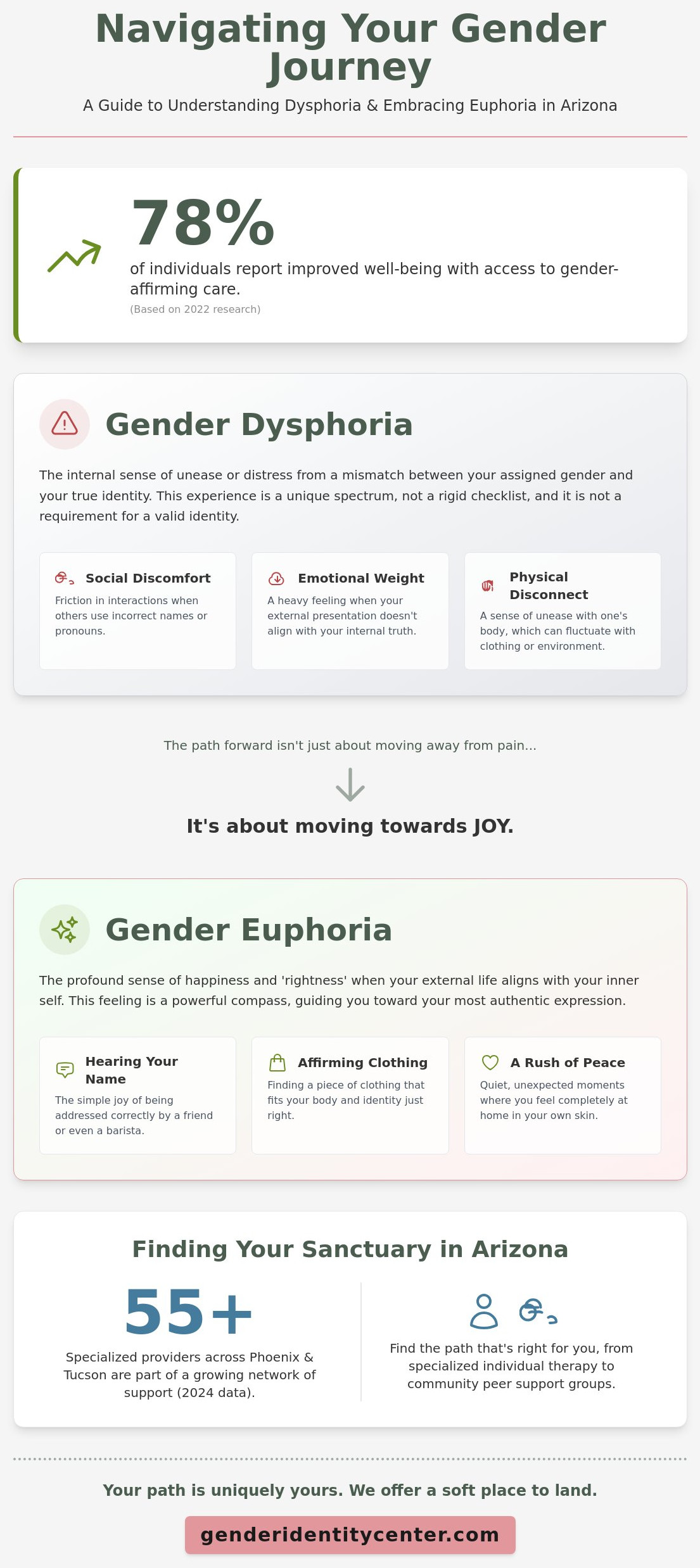
We're here to help you move through the confusion of clinical terms and the anxiety of finding a safe space. In this guide, you'll discover a roadmap to affirming resources across Phoenix and Tucson, where 2024 records show a growing network of over 55 specialized providers. We'll explore the nuances of both dysphoria and euphoria to help you find a framework that fits your current reality. You'll gain a clearer understanding of your local options and, more importantly, a sense of agency over your own becoming, supported by 2022 research showing that affirming care improves well-being for 78% of individuals.
Key Takeaways
- Learn how to navigate the complexities of gender dysphoria Arizona by recognizing that the intensity of these feelings is deeply personal and depends on each individual's experience.
- Discover how shifting your focus toward gender euphoria can offer a more affirming and joyful path as you explore your most authentic self.
- Explore the nuances between social and medical transition paths, keeping in mind that the choice of how to move forward is entirely subjective and unique to you.
- Compare the benefits of specialized individual therapy and community peer support in Phoenix and Tucson to find the sanctuary that best meets your current needs.
- Gain insight into how to begin your journey with the Gender Identity Center, where we offer a soft place to land as you navigate your own evolving identity.
What is Gender Dysphoria? Navigating the Experience in Arizona
You might feel a persistent sense that the gender assigned to you at birth doesn't align with who you truly are inside. This internal mismatch often creates a deep sense of unease or distress. When we explore What is Gender Dysphoria?, we see it's a deeply personal phenomenon. It isn't a single, universal feeling. Instead, it's a unique spectrum of emotions. We recognize that gender dysphoria Arizona residents face is often shaped by their specific social and physical environments. It's all very subjective, and your version of this journey is entirely valid. You don't need to meet a specific threshold of pain to embrace your trans or gender-expansive identity. Dysphoria isn't a requirement for being your authentic self; it's simply a signal some people experience while navigating their path.
Common Manifestations of Dysphoria
The way these feelings surface can change from day to day. For some, it's a physical sensation regarding specific body parts. For others, it's a social friction that occurs when people use the wrong pronouns. In cities like Phoenix or Tucson, our environment plays a surprising role. When temperatures regularly exceed 110 degrees Fahrenheit during the summer, the inability to wear heavy layers or "binders" comfortably can intensify physical distress. This depends on each individual's experience, as one person might find relief in summer styles while another feels exposed. We see these manifestations as evolving signals rather than a fixed checklist. You might experience:
- Social discomfort during interactions in local community spaces.
- Emotional weight when your external presentation doesn't mirror your internal truth.
- Physical disconnect that fluctuates based on clothing or activity.
The Role of Clinical Diagnosis in Arizona
The American Psychiatric Association updated the Diagnostic and Statistical Manual of Mental Disorders (DSM-5) in 2013 to include gender dysphoria. This clinical label serves a specific purpose in our current systems. It often acts as a key to unlock insurance coverage for gender-affirming care. However, a diagnosis doesn't define your soul or your worth. We know that many people in our community fear gatekeeping within local medical systems. You are the only true expert on your life. A diagnosis is a tool for the system, not a boundary for your identity. If you're looking for a partner to help you walk through these clinical requirements with compassion, our affirming therapists are here to support your agency and self-discovery.
Gender Dysphoria vs. Gender Euphoria: A Comparative Perspective
While the official definition of gender dysphoria focuses on the distress caused by a mismatch between one's identity and assigned sex, it isn't the only way to understand your path. We often find that gender euphoria offers a more luminous perspective. Euphoria is that deep sense of joy or "rightness" when your external life aligns with your internal truth. For many people navigating gender dysphoria Arizona, focusing on these positive sparks can feel more empowering than only cataloging discomfort. This depends on each individual's experience, and we believe both feelings are equally valid markers of your growth.
Identifying Moments of Euphoria
Euphoria often arrives in quiet, unexpected moments. It might happen when you hear a barista at a local Phoenix coffee shop use your chosen name for the first time. You might feel a sudden rush of peace while wearing a piece of clothing that finally fits the way you've always imagined. These instances serve as a compass. They show us what's working. Instead of just moving away from pain, you're moving toward joy. This approach is highly subjective; what feels like a breakthrough for one person might feel neutral to another. We see these moments as a guide for your next transition steps, whether they are social, legal, or medical.
Why the Comparison Matters
The medical world often requires a diagnosis of dysphoria to access care, but your personal journey is about more than clinical criteria. Tracking both your struggles and your celebrations helps you understand your unique needs. A 2022 report by the Trevor Project highlighted that gender-affirming care can lead to a 40% lower risk of attempted suicide in youth, often because it creates space for euphoria to flourish. You might find that identity hormones help shift this balance, making the moments of "rightness" more frequent.
Understanding your options for managing gender dysphoria Arizona involves looking at the full spectrum of your emotions. We encourage you to reflect on your own timeline, as the weight of these experiences is something only you can truly define. If you feel ready to explore these feelings further in a safe space, you can schedule a time to talk with us about your unique goals.
Exploring Transition Paths: Social vs. Medical Perspectives
Your journey with gender dysphoria Arizona is entirely your own. We believe there's no single "right" way to exist in your truth. Some people find peace through social changes, while others feel a medical path is necessary. This choice is deeply personal and it's all very subjective. We're here to honor whatever direction you choose, recognizing that your path is a heroic act of self-discovery. The ways people address gender dysphoria Arizona are as diverse as our landscape, and we're here to walk alongside you as you explore what feels right.
Social Transition in the Grand Canyon State
Social transition involves changing how you move through the world, like updating your name, pronouns, or style. In Tucson, which earned a score of 100 on the Human Rights Campaign 2023 Municipal Equality Index, you might feel more comfortable using new pronouns at work. In contrast, your approach to visibility might change in rural counties where community resources are less concentrated. This depends on each individual's experience and their unique sense of safety. Many people find that social shifts are a standalone choice that provides complete validation without needing further intervention.
- Finding safe community spaces in the Valley, such as local peer support groups, helps build resilience.
- Social transition allows you to test out new aspects of your identity in a reversible way.
- Workplace protections are evolving; by 2023, 93 percent of Fortune 500 companies included gender identity in their non-discrimination policies.
- The choice to transition socially is contingent upon your personal context and the level of support in your immediate circle.
Considering Medical Support
For many, hormones or surgeries are vital for alignment. For others, these steps aren't part of their vision. Decisions about gender-affirming care in Arizona involve many factors, including health needs and personal goals. The 2015 U.S. Transgender Survey reported that 78 percent of people who transitioned felt more satisfied with their lives, yet your specific needs remain the priority. Whether or not you seek medical support is a decision that rests entirely with you.
While the Gender Identity Center doesn't prescribe medication, we support the emotional process of these life-altering choices. You can explore these feelings with our therapists who understand the nuances of identity. We view your evolution as a positive experience, regardless of the specific steps you take. Your path is not defined by a medical checklist but by your own sense of comfort and authenticity.
Individual Therapy vs. Peer Support Groups in Phoenix and Tucson
Choosing how to navigate your feelings regarding gender dysphoria Arizona is a deeply personal decision that reflects your unique needs. Some find that sitting across from a professional provides the stability they need; while others thrive in the presence of those who have walked a similar path. The choice isn't a binary one. It's a spectrum of care that shifts as you grow. Because every journey is different, the "right" way to seek help is whatever feels safest for you. This depends on each individual's experience and the current chapter of their life. We believe that both paths offer distinct forms of healing that can work in harmony or stand alone.
The Value of a Specialized Gender Therapist
Working with a gender therapist provides a structured, private environment to process your identity. These practitioners utilize the WPATH Standards of Care Version 8, which were updated in September 2022 to emphasize a more flexible, client-centered approach. Therapy can be a place to address the 52% of trans youth in Arizona who have seriously considered suicide in the past year, offering life-saving tools for resilience. Specialized techniques like EMDR help process the trauma of systemic exclusion, allowing you to build a stronger sense of self. This professional relationship acts as a bridge, helping you move from a place of distress toward one of empowerment.
Finding Community in Arizona
If you are looking for connection, the support groups found in Phoenix and Tucson offer a vital sense of belonging. The bond of shared experience is something that cannot be replicated in a clinical setting. In these groups, you might find people who understand the specific challenges of living in the Southwest; from finding inclusive spaces in Maricopa County to navigating social transitions in Pima County. Many individuals choose to combine both methods, using therapy for internal work and groups for social validation. This hybrid model provides a safety net of both professional expertise and communal wisdom. It's all very subjective, and your preference might change as you progress through your transition.
- Individual Therapy: Best for deep trauma processing, clinical letters of support, and personalized coping strategies.
- Peer Support: Ideal for reducing isolation, sharing local Arizona resources, and finding social validation.
- Hybrid Care: Offers a comprehensive approach that addresses both internal psychological needs and external social needs.
Whether you prefer the intimacy of a private session or the collective strength of a group, the decision is entirely yours to make. There is no single "correct" way to find peace with gender dysphoria Arizona. We are here to support whichever path you choose to take. If you are ready to explore your options, you can schedule a session with us to begin your personal journey.
Starting Your Authentic Journey with the Gender Identity Center
Finding a space where you feel truly seen is often the first step toward healing. At the Gender Identity Center, we've built a non-judgmental sanctuary designed specifically for those exploring their internal landscape. We recognize that the experience of gender dysphoria Arizona residents face is deeply personal and cannot be reduced to a simple checklist. Every person's path is unique, and we're here to walk alongside you as you discover what authenticity looks like for your life. We don't act as gatekeepers; instead, we serve as partners in your self-discovery.
We believe you're the absolute expert on your own identity. While our clinicians provide professional guidance based on the WPATH Standards of Care Version 8, released in 2022, the direction of your growth is entirely up to you. This depends on each individual's experience, as there's no universal timeline for understanding one's gender. Whether you're seeking clarity, relief from distress, or a community that understands, our doors in Phoenix and Tucson are open to you.
Our Affirming Approach to Care
Our clinicians bring a blend of clinical expertise and radical acceptance to every session. We've seen how 100% of our clients benefit from an environment where their subjective evolution is prioritized over rigid medical definitions. Our team is committed to your resilience, helping you navigate the complexities of gender dysphoria Arizona with confidence. We provide high-quality support through:
- In-person sessions: Available at our welcoming offices in both Phoenix and Tucson.
- Telehealth services: Accessible to individuals and families in all 15 Arizona counties, ensuring care reaches rural areas.
- Evidence-based methods: Utilizing updated 2022 clinical protocols to ensure your safety and well-being.
Your journey is a dynamic process of becoming. We celebrate the fact that your identity may shift and grow over time, and we provide the stability you need to explore those changes without fear of judgment.
How to Connect with Us
Taking the first step doesn't have to feel overwhelming. You can begin by scheduling an initial consultation through our secure online portal. We've streamlined this process to ensure you can reach out whenever you feel ready, moving at a pace that feels safe for you. Our center is proud to serve a diverse range of individuals, including:
- Children and adolescents exploring their gender expansive identities.
- Adults at any stage of their transition or self-discovery journey.
- Families seeking to support their loved ones with compassion and education.
You've already shown incredible strength by seeking information and honoring your truth. Your journey is yours to define, and we're honored to offer the professional support and heartfelt validation you deserve. When you're ready, we're here to listen.
Moving Forward on Your Personal Path
Finding your way through the nuances of identity is a deeply personal endeavor. We've explored how the distinction between gender euphoria and gender dysphoria arizona residents experience can shift day by day. This depends on each individual's experience, as there aren't fixed rules for how you should feel or transition. Whether you choose social changes or medical paths, your perspective is the only one that truly defines your reality. It's all very subjective, and we're here to honor your specific timeline.
Our team includes specialized clinicians who follow the WPATH Standards of Care Version 8 to ensure your support is grounded in recognized professional guidelines. We provide safe, non-judgmental spaces in our 2 physical offices in Phoenix and Tucson, while also offering telehealth sessions to reach all 15 counties in Arizona. You don't have to have all the answers right now. You're simply invited to explore what feels right for you in a sanctuary that values your agency above all else.
Begin your journey of self-discovery, schedule a session with an affirming therapist today.
You deserve a life that feels like your own, and we're honored to walk beside you as you discover what that looks like.
Frequently Asked Questions
Is gender dysphoria a mental illness in Arizona?
Understanding gender dysphoria Arizona guidelines often starts with knowing it isn't a mental illness according to the APA, which updated its diagnostic manual in 2013. We see it as a natural response to a misalignment between your identity and your assigned sex. This depends on each individual's experience with clinical settings, but our focus is always on your personal empowerment. We're here to help you navigate these labels comfortably and safely.
Can I be transgender if I don't feel intense gender dysphoria?
You can absolutely identify as transgender even if you don't feel a constant sense of distress. Approximately 25% of gender-expansive people in a 2015 U.S. Transgender Survey reported experiencing little to no traditional dysphoria. This depends on each individual's experience; for some, the journey is more about moving toward joy than away from discomfort. We believe that your identity is valid simply because it's yours and reflects your truth.
How do I know if I'm experiencing gender euphoria?
Gender euphoria often feels like a sudden sense of relief or joy when your appearance matches your internal truth. A 2019 report in the Journal of Sexual Medicine described this positive affect as a key indicator of gender identity. This depends on each individual's experience, as euphoria can range from a quiet sense of peace to a celebration. It's a beautiful marker on your unique pathway toward becoming your most authentic self.
What are the first steps to managing gender dysphoria in Phoenix?
The first steps for managing gender dysphoria Arizona residents take usually involve finding a supportive community and professional guidance. You might start by visiting one of the 3 community centers in the Valley or scheduling an initial consultation with us. This depends on each individual's experience, but many find that speaking with a peer mentor provides immediate comfort. We're here to help you map out your unique pathway and find peace.
Do I need a diagnosis of dysphoria to start therapy at GIC?
You don't need a formal diagnosis or a doctor's referral to begin your journey with us at the Gender Identity Center. Our 12 staff members believe in your agency and your right to explore your identity at your own pace. This depends on each individual's experience with their insurance provider, but we prioritize your self-identification above any clinical label. We're here to offer a safe space for your growth and discovery.
How does the Arizona climate affect gender dysphoria?
The Arizona heat, which often exceeds 110 degrees for 50 days a year, can make gender-affirming practices like binding or layering clothes physically taxing. This physical discomfort can sometimes heighten feelings of body-related stress. This depends on each individual's experience, but finding cooling strategies or summer-friendly affirming wear can help you feel more at ease in your body during the long summer months from May to September. We support your comfort.
Are there support groups for gender-diverse people in Tucson?
Tucson is home to several vibrant resources, including the Southern Arizona Gender Alliance which has served the community since 1998. They offer weekly peer-led groups where you can share your story in a safe space. This depends on each individual's experience with group dynamics, so we encourage you to explore different circles until you find the one that feels like home. Connecting with others is a powerful part of your healing journey.
Can gender dysphoria change or go away over time?
Feelings regarding gender are often fluid and may shift as you navigate different stages of your life. A 2021 study in the Journal of Adolescent Health noted that gender identity can be a dynamic process of becoming. This depends on each individual's experience; some find that their dysphoria lessens with transition, while others find it evolves into a new understanding of their authentic self. Your identity is a path that you define.