
Mental Health Evaluations and Referral Letters for Gender Surgery in Phoenix

A mental health evaluation for gender-affirming surgery in Phoenix may involve one or more evaluations, depending on the procedure and the surgeon’s or insurer’s requirements. A referral letter can summarize an assessment, while counseling can offer support as you consider your goals and next steps. The process is not one-size-fits-all.
It’s understandable to want clarity about what an assessment involves and whether a particular timeline applies to you. Requirements depend on your circumstances and the surgery being considered. This article explains how gender identity, persistent gender dysphoria, informed consent, and mental health considerations may relate to referral letters, and how counseling differs from an evaluation. It also discusses surgery-related time criteria, including guidelines that may refer to living in a gender role or hormone therapy. A respectful assessment should recognize your circumstances, not reduce your identity to paperwork.
Key Takeaways
- Assessment and referral-letter requirements can vary by surgery, surgeon, and insurance policy, so the process may involve one or two mental health evaluations.
- An assessment may consider your goals, capacity for informed consent, and relevant mental health needs; your identity itself is not a diagnosis.
- Counseling and a surgical assessment serve different purposes, and therapy timing requirements depend on the care being considered.
- Some surgery criteria include time living in a gender role or hormone therapy, but the details vary by procedure and policy.
Gender dysphoria and gender identity
Gender identity is a person’s inner understanding of their gender. It may differ from the sex assigned at birth, and each person describes their experience in their own way. Gender dysphoria is a clinical term for distress related to a mismatch between gender identity and aspects of a person’s body or social experience. Being transgender or gender-diverse does not, by itself, mean someone experiences this distress. One person may seek surgery to reduce distress, while another may pursue it for reasons connected to comfort or self-expression.
A Swedish population study analyzed health records for 2,679 people diagnosed with gender dysphoria between 2005 and 2015. That figure describes the study group, not every transgender person or everyone considering surgery. A diagnosis is a clinical assessment, while gender identity is personal. Keeping those ideas distinct can help make conversations about evaluation more respectful and precise.
Does insurance cover gender-affirming surgery evaluations in Arizona? Coverage depends on the individual plan and its terms. An evaluation or referral letter may be handled differently from surgery itself, so review the plan’s behavioral-health and surgery benefits to understand what it covers.
For an assessment, clinicians may consider whether a person can make a fully informed decision about treatment. Some policies also require a qualified mental health professional’s assessment and a diagnosis meeting DSM-5 criteria. These are policy requirements, not a definition of someone’s identity. The relevant criteria can differ by surgery and coverage policy, so one person’s experience may not predict another’s.
How can I verify a Phoenix evaluator’s credentials and experience with transgender patients? Ask about the evaluator’s professional credential, relevant training, and experience supporting transgender and gender-diverse people. Compare the stated credential with their public professional profile, and ask how the assessment process addresses your goals, privacy, and any specific requirements.
In a respectful conversation, you should be able to explain what surgery means to you without being asked to fit someone else’s story. Gender counseling can offer space to explore identity, goals, and questions at your own pace. The focus is your individual experience, not a single expected path.
Mental health assessments and referral letters for surgery
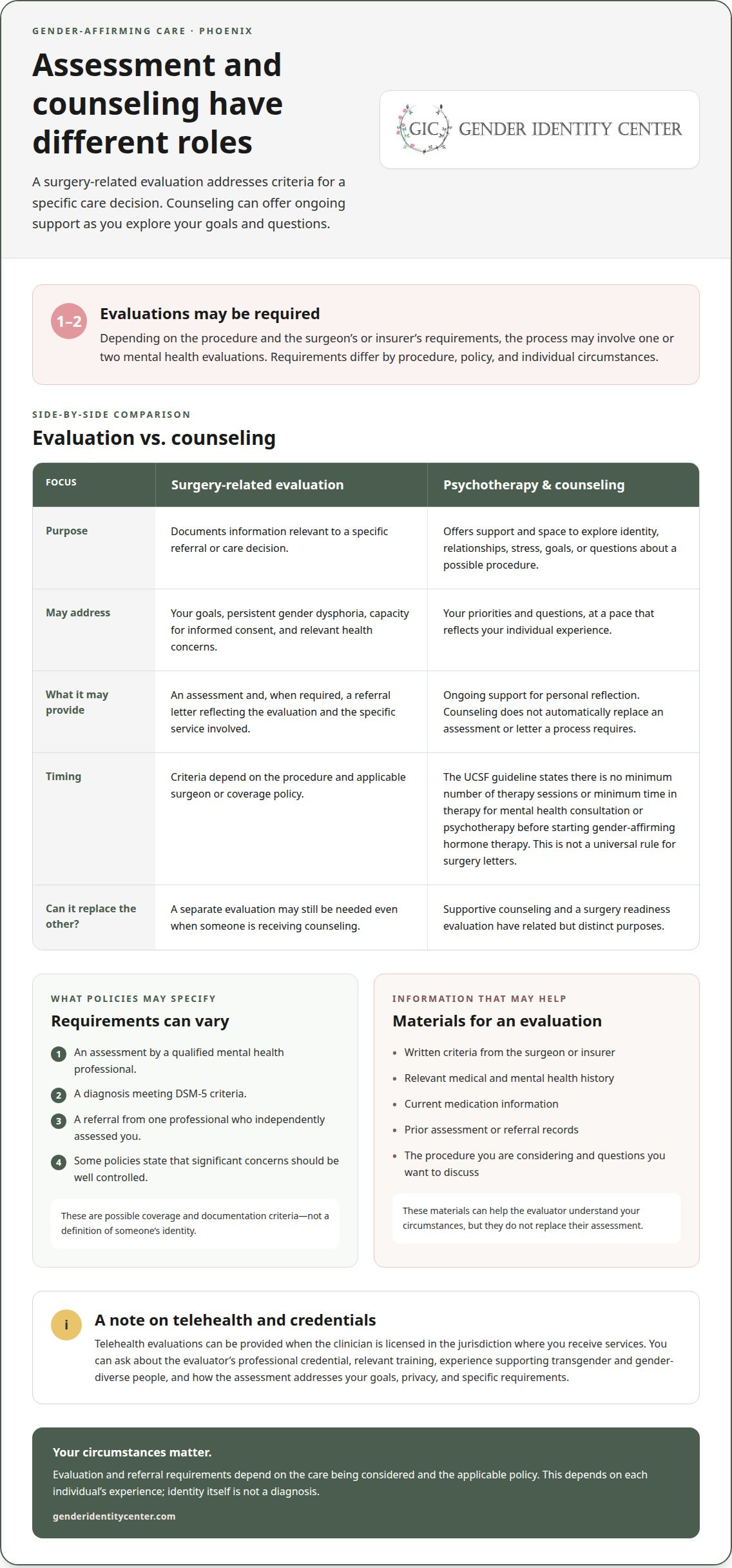
A mental health evaluation for gender-affirming surgery in Phoenix considers the procedure you’re pursuing and the relevant referral criteria. An assessment and therapy have different purposes: the evaluation documents information for a care decision, while counseling can offer ongoing support. Depending on the procedure and policy, the process may call for one or two evaluations.
What are Arizona laws or insurer rules for mental health letters for gender-affirming surgery? Requirements can vary by insurer, plan, and procedure. A policy may require assessment by a qualified mental health professional, a diagnosis meeting DSM-5 criteria, and a referral from one professional who independently assessed you. These criteria concern coverage and documentation, not the validity of your identity.
An assessment may address your goals, persistent gender dysphoria, capacity for informed consent, and relevant health concerns. Some policies state that significant concerns should be well controlled. The applicable policy may define a qualified mental health professional as someone with a master’s degree or equivalent in a clinical behavioral science field. A letter should reflect the assessment and the specific service involved.
Can telehealth clinicians provide surgery readiness evaluations for Arizona residents? Telehealth evaluations can be provided when the clinician is licensed in the jurisdiction where you receive services. For a mental health evaluation for gender-affirming surgery in Phoenix, the assessment still needs to address the relevant referral and policy criteria.
What documents and information should I bring to a gender-affirming surgery evaluation? Helpful materials may include written criteria from the surgeon or insurer, relevant medical and mental health history, current medication information, and prior assessment or referral records. Note the procedure you’re considering and any questions you want to discuss. This information helps the evaluator understand your circumstances, but does not replace their assessment.
If a referral letter is part of your next step, a WPATH-aligned referral letter may support the process. What the evaluation covers depends on the procedure, applicable criteria, and your experience.
Psychotherapy and counseling
Psychotherapy and a surgery readiness evaluation have related but distinct purposes. Counseling can offer space to explore identity, relationships, stress, or questions about a possible procedure. An evaluation focuses on criteria relevant to a specific referral or care decision. One does not automatically replace the other. Ongoing therapy may support personal reflection, for example, while a separate assessment addresses information requested for a surgery letter.
The UCSF guideline says there is no minimum number of therapy sessions or minimum time in therapy for people seeking mental health consultation or psychotherapy before starting gender-affirming hormone therapy. This statement concerns hormone therapy, not a universal rule for surgery letters. Surgical assessment requirements may differ by procedure and coverage policy. Distinguish supportive counseling from any assessment or letter a particular process requires.
Counseling can center on your priorities. You might discuss how you understand your goals, what questions remain, or how a possible change could affect relationships or daily routines. A conversation about family support, for example, may focus on communication and boundaries rather than proving readiness. Your experience, language, and pace matter; therapy need not follow one expected personal story.
The UCSF guideline also says primary care providers should include a mental health history and assess active mental health concerns during every care intake. That is not the same as requiring psychotherapy before surgery. If a concern affects your ability to make an informed decision, additional support may help clarify what you need. The focus is on the concern’s effect and potentially useful support, rather than treating a diagnosis alone as a reason to dismiss your goals.
Counseling gives some people a steady place to process uncertainty before or after an evaluation. Others may need a focused assessment or practical support first. Needs can change over time. Therapy can help you explore what matters while keeping referral requirements specific to the surgery and policy involved.
Surgery-related time criteria
Time criteria can refer to different parts of care, so the relevant period depends on the procedure and policy. A criterion may refer to living in a gender role, hormone therapy, or both. These timelines are not interchangeable: time living in a gender role does not automatically equal the same duration of hormone therapy. Identifying which period applies can help you interpret a surgeon’s or insurer’s requirements.
For vaginoplasty or phalloplasty, a UCSF guideline lists 12 months living in a role congruent with your gender identity, unless contraindicated. It also lists 12 months of hormone therapy, unless contraindicated. These are separate criteria in that guideline. A medical contraindication can affect whether hormone therapy applies, while the living-in-role criterion addresses a different aspect of preparation.
Jefferson Health Plans’ policy describes 12 continuous months living full-time in a gender role congruent with the member’s gender goals for some covered surgeries. It allows consideration for members under 18 after 12 continuous months of physician-supervised hormone therapy and 12 continuous months living full-time in that role, subject to the policy’s medical exception for hormone therapy. This illustrates how policy terms and age criteria may differ from one guideline or procedure to another.
That combination differs from the periods of living in a gender role listed for some procedures. It also shows why the timeline for one surgery should not automatically be applied to another.
A practical next step is to identify the exact procedure and distinguish each time criterion: living in a gender role, hormone therapy, or voice therapy. The applicable requirements depend on the policy and surgery involved, and this depends on each individual’s experience. Discuss your surgery-related timeline as you consider the next step.
Gender Identity Center
Gender Identity Center provides gender counseling and mental health support in Phoenix and Tucson. If you’re weighing evaluation criteria alongside personal goals, therapy can help you reflect on what matters and identify areas where support would be useful. The right approach depends on your circumstances and preferences.
Individual Therapy offers space for personal reflection, while Family Therapy or Group Therapy may suit people seeking support with family or peers. EMDR Therapy is also available. These services support mental health and personal exploration; they are not surgical procedures or hormone prescriptions.
To discuss what kind of support could fit your needs, contact Gender Identity Center.
Choose a Next Step That Fits Your Goals
A useful first step is identifying what support would help you now. A mental health evaluation for gender-affirming surgery in Phoenix may be one part of your path, alongside time to consider your priorities. The questions you bring, the pace you prefer, and the support you want around you are personal.
Gender Identity Center provides Individual Therapy, Family Therapy, and Group Therapy in Phoenix and Tucson. These options can support personal reflection or conversations with loved ones as you consider what comes next. The right support depends on your circumstances and preferences, and you can decide what feels relevant to your journey.
If you’d like to explore your options, Contact Gender Identity Center. You can take the next step at your own pace, with your goals at the center.
Frequently Asked Questions
What mental health evaluation is required for gender-affirming surgery in Phoenix?
Requirements depend on the procedure and the surgeon’s or insurer’s criteria. Some procedures may call for one or two mental health evaluations, while others have different requirements. A policy may ask for an independent assessment and a referral letter, for example. A Phoenix evaluation should address the specific surgery being considered, rather than assume one checklist applies to everyone.
What are WPATH SOC-8 assessment and referral letter requirements for gender-affirming surgery?
WPATH standards inform referral letters, but assessment details may depend on the procedure and the surgeon’s or insurance plan’s requirements. A letter may document the clinician’s assessment and support the next step in care. Before an appointment, identify which surgery the letter concerns and whether the receiving office has specific documentation criteria.
How long does it take to get an evaluation and referral letter in Phoenix?
An evaluation may involve one to four or more sessions, depending on your circumstances and the information needed. This range does not establish a calendar wait time or promise when a letter will be ready. The number of conversations may depend on your goals, relevant history, and the documentation requested for the specific procedure.
What happens during a gender-affirming surgery mental health evaluation?
The clinician typically discusses why you’re considering surgery, your goals, relevant health history, and your understanding of the decision. You can describe what the procedure means to you and raise concerns about recovery or support. The conversation also considers whether health concerns could affect decision-making and whether further discussion or support would help before the next step.