
My Husband Is Transitioning: Arizona Support Guide

What if you don’t have to choose between supporting your husband and making room for your own feelings? If you’re wondering, “my husband is transitioning what do i do az,” you may be carrying love, uncertainty, fear, or several feelings at once. Having questions doesn’t mean you’re undermining him. It means you’re finding your footing in a change that can feel personal and unfamiliar.
There’s no single way a transition affects a relationship or family. Your husband’s experience is his own, and your feelings deserve space, too. You can move at a pace that feels manageable, listen with care, and talk about what each of you needs without having every answer right away.
This guide offers practical ways to begin conversations, reflect on your own needs, and explore affirming support in Arizona. We’ll look at individual, couples, and family therapy as possible spaces for support, depending on what feels useful to you. Gender Identity Center offers therapy in Phoenix and Tucson, as well as confidential video sessions for clients located in Arizona. The next steps are yours to shape, one conversation at a time.
Key Takeaways
- Your response may include uncertainty, worry, relief, grief, or mixed feelings. There’s no single reaction you’re expected to have.
- Transition can mean different things to different people. Avoid assuming a particular timeline, step, or outcome for your husband.
- For “my husband is transitioning what do i do az,” start with a calm conversation: ask, listen, reflect back what you heard, and share your own experience when you’re ready.
- Support can give you space to explore your needs while respecting your husband’s privacy and autonomy.
- Individual, couples, or family therapy may offer an affirming space for reflection and shared conversations, depending on what feels helpful to you.
My Husband Is Transitioning: Start by Making Room for Your Own Response
Uncertainty, worry, relief, grief, curiosity, or several feelings at once may arise when your husband shares that he’s transitioning. You might feel close to him and unsettled about what may change. Or you may need time before you can name your reaction. If “my husband is transitioning what do i do az” is on your mind, you don’t have to answer every part of it today.
This depends on each individual’s experience. There’s no required emotional response, and a feeling isn’t a verdict on your husband or your marriage. Feeling afraid doesn’t automatically mean you want the relationship to end; feeling hopeful doesn’t mean you have everything figured out. Emotions can be information to notice, not decisions you must act on immediately.
Give yourself room to observe what’s coming up before trying to resolve every question. It may help to write down what you feel, what you’re worried about, and what you don’t know yet. Keep those separate: “I feel anxious” describes your present experience; it doesn’t predict what your relationship will become. You’re allowed to take time to understand the difference.
Why your feelings may be complicated
Change can bring emotions that seem to pull in different directions. You may feel glad your husband is sharing something important and also worry about how daily life, family conversations, or your sense of the future might shift. There’s no need to sort these reactions into “supportive” or “unsupportive” categories. Try naming them gently and noticing what each one is connected to, without using a first reaction to define your values or commitment.
A useful first step is to pause and ask yourself: What do I know right now? What am I imagining or anticipating? What might I need more time to understand? You don’t have to find answers immediately. These questions can help you stay present with your experience while leaving room for new information and conversation.
What your husband’s transition does and does not tell you
Transition can involve personal, social, or medical aspects, and the mix differs from person to person. This overview of gender transition describes some of these dimensions, but it can’t tell you what your husband’s experience means to him. His understanding, choices, and pace are his to express. Your feelings and decisions are yours to explore.
A transition doesn’t, by itself, determine your identity, your role in the relationship, or whether you’ll stay together. You and your husband may understand particular changes differently, and your perspectives may develop over time. Rather than treating today’s uncertainty as a forecast, allow each of you to speak for yourselves. You can respect his agency while making space for your needs, without forcing either person toward a specific conclusion.
Understand Transition Without Assuming What It Means for Your Husband
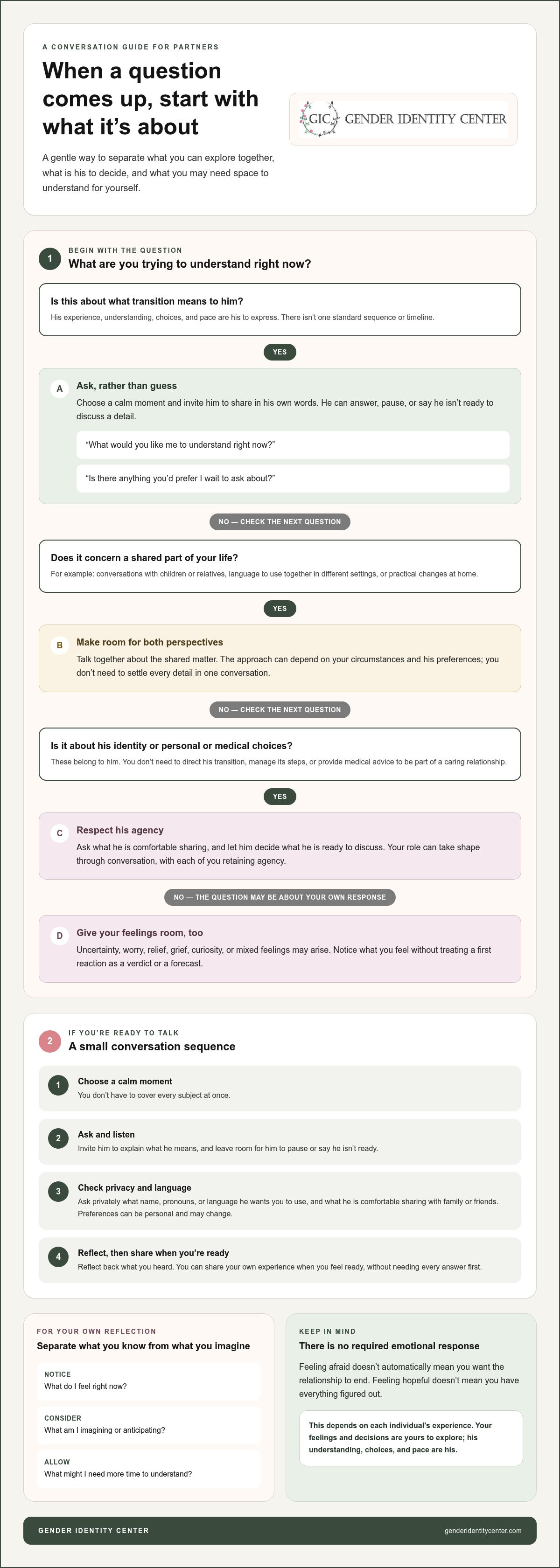
Once you’ve made space for your own response, the next step may be learning what transition means to your husband. It can involve personal, social, or medical considerations, but there isn’t a standard sequence, timeline, or endpoint that applies to everyone. Two people may use the same word while describing very different experiences. Your husband is the best source for what he means, and he can decide what he’s ready to share.
Questions don’t automatically signal rejection, just as agreeing with one detail doesn’t mean you’ve settled every feeling. You may be trying to understand what could change in your shared life, while he may be considering what feels right for him personally. Both perspectives can be present without either one defining the whole relationship.
Ask what transition means to him, rather than guessing
Choose a calm moment and invite him to share in his own words. You could ask, “What would you like me to understand right now?” or “Is there anything you’d prefer I wait to ask about?” If you’re unsure what name, pronouns, or language he wants you to use, ask privately and respectfully. Preferences can be personal and may change, so you can check in again without treating a change as a problem.
It may also help to ask what he wants kept private and what, if anything, he’s comfortable sharing with family or friends. Don’t assume one conversation covers every subject. An open question leaves him room to answer, pause, or say he isn’t ready to discuss a particular detail. The PFLAG guide for loved ones of transgender individuals offers additional perspective for family members who are learning how to listen and support.
Separate shared information from decisions that are his
Some conversations may concern both of you: how to talk with children or relatives, what language to use together in different settings, or how to handle practical changes at home. You can discuss these as shared matters, while recognizing that the right approach depends on your circumstances and his preferences.
His identity and personal or medical choices belong to him. You don’t need to direct his transition, manage its steps, or provide medical advice to be part of a caring relationship. Your role can take shape through conversation, with each of you retaining agency. If you’re asking yourself, “my husband is transitioning what do i do az,” start with the next question you both feel ready to discuss rather than trying to plan every future step at once.
If a supported space for your own questions would feel useful, you can explore scheduling a therapy conversation without needing to reach a particular conclusion first.
How to Talk About Your Relationship While Your Husband Is Transitioning
A relationship conversation doesn’t need to settle everything at once. Choose a private, unhurried time when neither of you is rushing to another commitment. You might begin by saying, “I want to understand what this means for you, and I’d also like us to find room to talk about how we’re both feeling.” That opens a door without demanding an immediate answer.
A simple sequence can help you stay present: ask, listen, reflect, then share. Ask one open question and give him time to respond. Listen for what he says without preparing a rebuttal or jumping straight to advice. Reflect back what you heard, then check whether you understood. Once you’ve made space for his perspective, share your own experience using “I” statements. For instance: “I’m still taking this in, and I’d like to understand what kind of support feels helpful to you.”
Questions that invite understanding
Open questions can make a conversation feel less like an interview and more like an invitation. You could ask, “What would support from me look like right now?” or “Is there anything you’d like me to know about how you’re feeling?” If family or friends come up, try, “What are you comfortable sharing with them, and what would you prefer to keep private?” Listen without assuming the answer or rushing to fix what you hear.
If you’re unsure what to say, a pause can be more respectful than filling the silence with guesses. You might reflect, “I hear that you want me to use this language with you,” or ask, “Did I understand that the way you meant it?” You can also acknowledge uncertainty without asking him to resolve every part of it: “I have questions, and I’m still sorting through some feelings. I don’t expect you to answer everything for me right now.”
Discuss shared needs, privacy, and boundaries
Some parts of the conversation may involve shared decisions, especially around what to tell relatives or friends. Talk together about what information can be shared, with whom, and whether either of you wants to be present for those conversations. Don’t assume that one person’s comfort speaks for both of you. Privacy preferences can differ, so take time to hear each other’s needs and agree on what feels workable in that situation.
Boundaries can be expressed with care. For example, you might say, “I’m not ready to discuss this with my family yet,” or “I’d like us to talk before either of us shares personal details.” A boundary names what you need or can participate in; it doesn’t have to direct your husband’s identity or choices. His needs matter, and so do yours. The balance depends on each individual’s experience and circumstances.
There may not be one conversation or agreement that covers every future situation. Preferences, questions, and comfort levels can shift, so revisit the discussion when something changes or either of you wants to check in. If “my husband is transitioning what do i do az” is still on your mind, a helpful next step may be to choose one immediate need to discuss rather than trying to resolve the whole future together.
Care for Yourself and Your Family Without Taking Over His Journey
Supporting your husband doesn’t require setting aside your own needs or becoming responsible for managing his transition. You can care about what he’s experiencing while finding a separate space to consider your questions, limits, and hopes. Support is most useful when it helps you reflect and choose your next steps, rather than steering him toward a particular decision or outcome.
If the question “my husband is transitioning what do i do az” keeps returning, try narrowing it to what you need today. That might be time to process a conversation, a trusted person who can listen without judgment, or a clearer sense of what you’re comfortable discussing with others. No coping approach can predict how a relationship will unfold, but making room for your own experience can help you understand it more fully.
Find space for your own questions and feelings
Private reflection can be a starting point. You might write down what’s on your mind or talk with someone you trust who will respect both your feelings and your husband’s privacy. Individual therapy can offer a separate space to explore your experience without requiring a particular conclusion. You don’t have to become an expert on transition or coordinate every part of your husband’s journey to be a caring spouse.
Before sharing personal details, it may help to notice what kind of support you’re seeking. Are you looking for someone to listen, help you sort through a decision, or sit with uncertainty? A simple request, such as “I need to talk this through, but please keep what I share private,” can clarify what would feel supportive. Your husband may also choose his own support; each person’s needs and preferences are individual.
Consider how family members may need different support
Children, relatives, and close friends may have their own questions, and their responses can vary. You don’t need to predict how they’ll react or share details your husband wants kept private. If a family conversation is being considered, discuss together what information can be shared and what language feels respectful. Family therapy may offer a shared space to talk, depending on what feels appropriate for those involved.
Some relatives may want practical information, while others may need time or a chance to ask questions. A child’s understanding may differ from an adult family member’s, too. Rather than assuming one explanation will work for everyone, consider what each person is asking and what your husband is comfortable sharing. You can support family communication while respecting individual privacy and autonomy.
Gender Identity Center offers individual, couples, and family therapy as possible spaces for these conversations and personal reflection. To explore support for your own needs, schedule an individual therapy session. You can begin with your questions, without deciding what the future of your relationship will be.
Explore Affirming Support for Partners and Couples in Arizona
You don’t have to work through every question alone. Affirming therapy can offer a confidential space to explore your feelings, communication, and relationship concerns without requiring you to reach a particular conclusion. For some people, individual support feels like a useful first step; others may prefer a shared conversation with a partner or family. What fits depends on each individual’s experience and what feels manageable now.
Gender Identity Center provides individual, couples, and family therapy in Phoenix and Tucson, as well as confidential video sessions for clients located in Arizona. Couples therapy specializes in LGBTQ+ couples. Therapy can support reflection and communication, but it doesn’t promise a specific relationship outcome or replace your husband’s autonomy in his own journey.
What affirming therapy can make space for
A therapist can help you explore what you’re feeling, identify questions you want to discuss, and consider how you and your husband communicate. An affirming approach respects each person’s identity, pace, and choices rather than steering the couple toward a predetermined answer. You can learn more about the clinicians through the therapist directory as you consider what kind of support may suit your needs.
Confidentiality can matter when you’re sharing personal concerns. Gender Identity Center keeps client information private and does not disclose it without both verbal and written/signed permission. This policy can help clarify expectations around privacy as you consider whether an individual or shared therapy space feels right.
Choose a next step that feels manageable
There isn’t one required way to begin. Individual therapy may offer you space for your own questions; couples therapy can provide a setting for shared conversations; family therapy may be an option when family communication is part of what you want to explore. These are distinct forms of mental-health support, and the best fit depends on the people involved and what they hope to discuss.
Therapy is a space for emotional and relational exploration, not HRT prescribing or surgery. If those medical questions arise, they remain separate from the purpose of therapy. You can start with a modest aim, such as understanding your own needs or finding words for a conversation, and reassess as you go. There’s no need to decide on a long-term plan before considering support.
If you’re still asking, “my husband is transitioning what do i do az,” a conversation with an affirming therapist may help you explore that question without pressure to choose a particular outcome. If you’d like to take a look, explore therapy options at a pace that feels comfortable to you.
Take Your Next Step at a Pace That Feels Right
You don’t need to know exactly where this path leads before deciding what might help today. A next step could be giving yourself time to reflect, choosing one question to bring into a conversation, or seeking a space where you can speak openly. The right pace and kind of support depend on each individual’s experience. You can move thoughtfully without making a decision about the future of your relationship all at once.
If you’re asking, “my husband is transitioning what do i do az,” let the question guide you toward the support that feels most relevant now. Therapy can offer room to explore your own feelings or consider shared conversations, without requiring a predetermined conclusion. You’re welcome to explore affirming support at your own pace when you feel ready.
Whatever you choose, your husband’s autonomy and your own needs can both have space. There’s no need to have every answer today. When you’re ready, schedule a therapy session with Gender Identity Center in Phoenix, Tucson, or by Arizona-only telehealth.
Frequently Asked Questions
What should I do first if my husband tells me he is transitioning?
Begin by asking whether he feels ready to talk and what he most wants you to understand. If you’re wondering “my husband is transitioning what do i do az,” focus on one immediate step rather than planning everything ahead. For example, agree on a time to continue the conversation if either of you needs a pause. You can also write down questions to return to later, without expecting yourself to resolve them right away.
Does my husband's transition mean our marriage has to end?
No, a transition doesn’t by itself decide whether a marriage continues. Each partner may have different feelings and needs, and these can change as you learn more about each other. Rather than making a permanent decision under pressure, you might separate immediate matters from larger questions about the future. What feels right depends on each individual’s experience; no one can predict your relationship’s outcome from this information alone.
Is it wrong to feel uncertain or upset when my husband is transitioning?
Feeling uncertain or upset doesn’t, on its own, make you a bad spouse or determine what you’ll choose. Notice when these feelings arise and whether certain situations, such as family conversations, bring them forward. If you feel too activated to speak with care, you can take a break and return when you feel more settled. Your response may shift over time, and you don’t have to judge it as final.
How can I support my husband without pretending I have no questions?
You can offer support honestly, without presenting yourself as certain about everything. For example, you might say, “I care about you, and I’m still learning what questions I have.” Ask what kind of support he wants now, then consider which questions need his input and which you may want to explore privately. You can also agree on a time to revisit a difficult topic, so neither person has to solve it in one conversation.
Can my husband and I go to couples therapy together?
Yes. Gender Identity Center offers couples therapy specializing in LGBTQ+ couples. You might use a session to work on one shared concern, such as how to talk about changes in your relationship or handle a recurring disagreement. Couples therapy can offer space for each partner to speak and listen, but it doesn’t guarantee a particular decision or result. Individual or family therapy may be other options, depending on what each person wants to explore.
Will a therapist tell my husband what I share in therapy?
Gender Identity Center keeps all client information private and does not disclose it without both verbal and written/signed permission. If you’re attending individual therapy, you can discuss your own concerns in that setting. This privacy policy applies to client information and permission to disclose it.
Can I attend telehealth therapy if I live outside Arizona?
No. Gender Identity Center’s telehealth sessions are for clients located in Arizona and use a confidential video platform. In-person offices are in Phoenix and Tucson. Telehealth is not a nationwide service, so being able to connect online doesn’t mean you can attend from another state. If you live in Arizona, you can choose between virtual sessions and in-person care in Phoenix or Tucson.