
Questioning Gender in Your 30s? Support in Phoenix

What if questioning your gender in your 30s isn’t a sign you’re late, but simply a point when you have more room to listen to yourself? If you’re looking for support for questioning my gender in my 30s Phoenix residents can explore affirming individual therapy without arriving with a label or a decision about transition. You may feel pressure to have everything figured out. It’s understandable to want support without judgment or pressure, and your experience can unfold at your own pace.
Gender exploration is personal, and this depends on each individual’s experience. Therapy can offer a collaborative space to reflect on what feels meaningful to you without assigning an identity or directing your choices. This article looks at what questioning gender in your 30s might involve, how counseling can support reflection, and what in-person sessions in Phoenix or confidential video telehealth for clients located in Arizona can look like. All client information is private and will not be disclosed without both verbal and written or signed permission.
Key Takeaways
- Gender exploration looks different for everyone. Questions in your 30s don’t have to point toward one particular identity.
- Consider how gender questions intersect with relationships, family, work, and mental health without assuming there’s one right way to explore them.
- Gender-affirming therapy can make room for reflection and goals you choose, without requiring a label or a predetermined transition plan.
- Gentle reflection prompts can help you notice what feels affirming, uncertain, or difficult. They aren’t a checklist and don’t require a decision.
- Explore support for questioning my gender in my 30s phoenix through Gender Identity Center’s individual gender-focused therapy in Phoenix, shaped around your pace and priorities.
Questioning Gender in Your 30s: Phoenix Starting Point
Gender questions can arise at different ages and in different circumstances. You might have been thinking about them for years, or they may feel newly present now. Neither experience is more real or valid than the other. Reaching your 30s without a settled answer doesn’t mean you’ve missed a deadline or should already know. There’s no single timeline or required sequence for understanding yourself.
Exploration might involve reflecting on your sense of self, the language that feels comfortable, or how you relate to expectations around gender. It doesn’t prove you have a particular identity, and you don’t have to reach a conclusion for your questions to matter. The concept of gender identity can offer a starting point for understanding how a person’s internal sense of gender may relate to, but isn’t the same as, sex assigned at birth. What that means in your life is yours to consider.
Gender exploration is individual, and its meaning depends on each person’s experience. Support for questioning my gender in my 30s Phoenix can begin by making room for that experience, without treating age as evidence for or against any particular conclusion.
Why gender questions can surface in your 30s
Life changes can shift what you notice about yourself. A change in a relationship, new responsibilities at work, evolving family roles, or a different understanding of your needs may bring gender questions into focus. These circumstances don’t cause a particular identity; they may simply offer new opportunities to reflect on how you feel and what matters to you.
People arrive at these questions by different paths. You might remember wondering about gender earlier in life, even if you didn’t have language or a safe-feeling opportunity to explore it then. Or the questions may be just beginning, without a clear connection to childhood. Some people have come out in another part of their lives and are now revisiting what feels right; others haven’t shared these thoughts with anyone. There isn’t one expected backstory.
Your present-day context can shape what exploration feels possible. You may be weighing questions alongside caring for relatives, parenting, partnerships, friendships, work demands, or changes in your social circle. You don’t need to set those parts of life aside or resolve them first. Their relevance depends on your circumstances.
Exploration does not require a label or deadline
You can be curious without choosing a label. You can try out a word privately, feel unsure about it, or decide that no label feels useful right now. Uncertainty may shift over time, or it may remain part of how you understand yourself. None of those possibilities predicts a particular identity or decision.
It may help to notice what you’re wondering about without turning each question into a test. What feels affirming, uncomfortable, or unclear? What would you like to understand better? You can return to those reflections when it suits you. If you’re looking for support for questioning my gender in my 30s phoenix, start with your own questions, not a deadline to answer them.
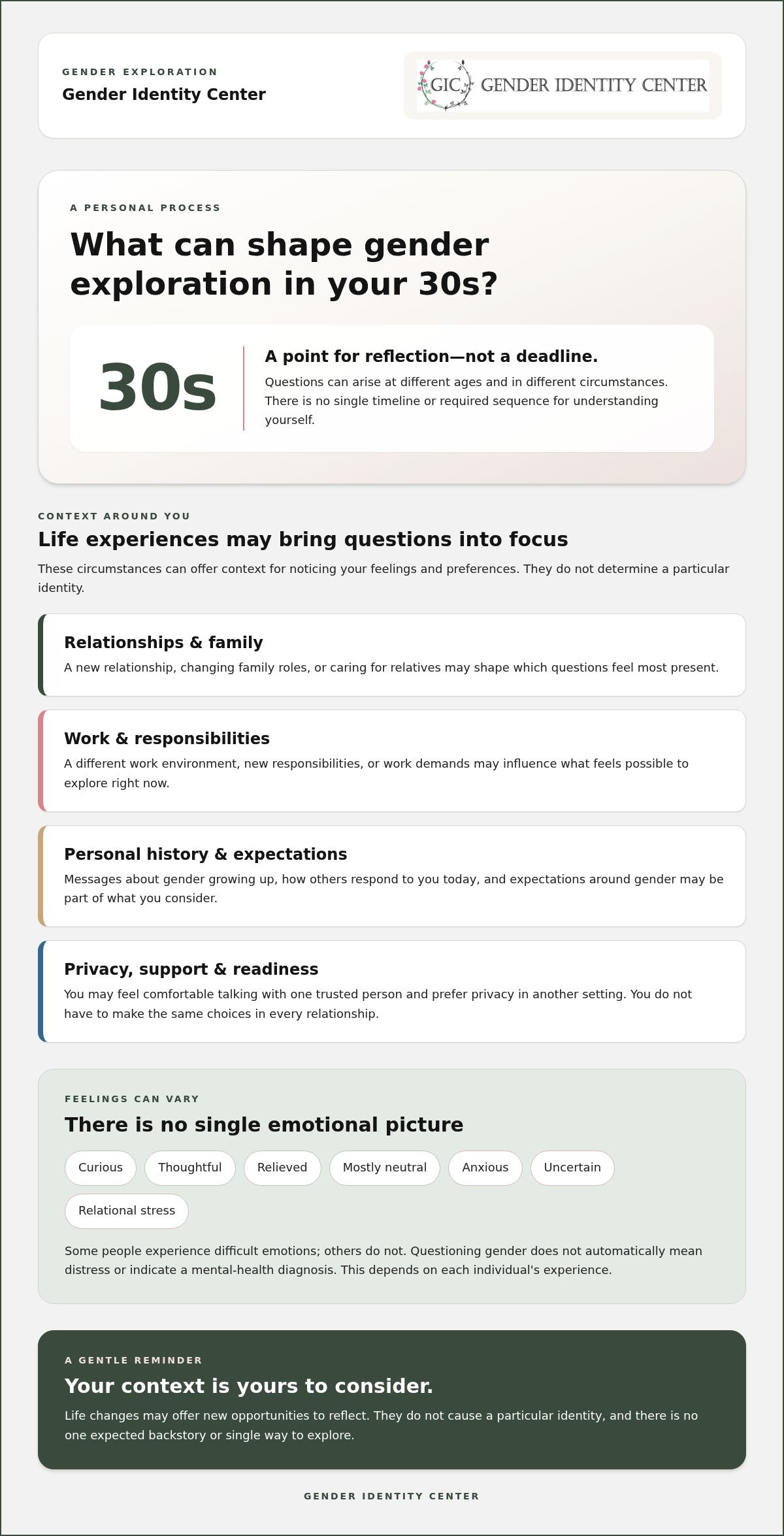
What Can Shape Gender Exploration in Your 30s?
Gender questions don’t usually arrive in isolation. They may sit alongside changing responsibilities, close relationships, work demands, or questions about emotional well-being. You might be considering how you want to be seen while also managing a job change, caring for someone, building community, or navigating a relationship. These parts of life can influence which questions feel most present, but they don’t determine a particular identity.
Gender exploration can coexist with other life experiences, and the mix differs by person. Your history and circumstances may shape what feels important to consider now. That could include messages you received about gender growing up, how others respond to you today, or what feels possible in different parts of your life. There’s no single combination of experiences that explains everyone’s questions.
Relationships, work, and changing responsibilities
Roles and expectations can bring certain feelings into focus for some people. A new relationship, a shift in family responsibilities, or a different work environment might prompt reflection on how you present yourself or what feels comfortable. These changes don’t cause a gender identity; they can offer context for noticing your reactions and preferences.
Your sense of privacy, support, and readiness may vary by setting. You might feel comfortable discussing your questions with one trusted person but prefer to keep them private at work or with some relatives. You may have supportive connections, complicated ones, or no clear place to talk yet. You don’t need to make the same choices in every relationship or disclose anything before it feels right for you.
Emotions and experiences that may accompany exploration
For some people, gender questions come with anxiety, depression, shame, self-esteem concerns, or relational stress. Others may feel curious, thoughtful, relieved, or mostly neutral. Questioning gender doesn’t automatically mean you’re distressed, and it doesn’t by itself indicate a mental-health diagnosis. The emotional picture depends on each individual’s experience and can change with time and circumstances.
Sometimes it’s hard to tell what is connected to gender and what may relate to another part of life. Tension in a relationship might make it harder to speak openly, while work stress may leave less energy for reflection. These experiences can overlap without one simple explanation. You can consider them together or separately, depending on what feels useful.
Therapy can make space for gender questions alongside other concerns, rather than asking you to separate your identity from the rest of your life. In individual therapy, you can decide which topics matter most and explore how they relate, if they do. Gender Identity Center’s gender-focused therapists offer space for that kind of reflection.
As you reflect, notice which settings allow you to feel more at ease and which bring up uncertainty or pressure. You might consider whether a reaction feels connected to your own preference, someone else’s expectations, or a mix of both. You don’t have to draw a firm conclusion. These observations can simply help you decide what you want to make room for next.
What Gender-Affirming Therapy in Phoenix Can, and Cannot, Offer
Exploratory therapy doesn’t require you to arrive certain about your identity, choose a label, or set a transition goal. You can bring questions as they are, including mixed feelings or no clear answers. The purpose is to support reflection and emotional well-being, not to direct you toward a particular identity or outcome. What feels useful to explore depends on your experience and priorities.
For someone seeking support for questioning my gender in my 30s Phoenix, it may help to understand the scope of therapy. Gender Identity Center is a mental-health therapy practice. It provides counseling, not medical treatment.
How collaborative therapy can support exploration
In individual therapy, you and your therapist can talk through questions, feelings, relationships, and personal goals at a pace that feels workable. You might focus on language that feels comfortable, uncertainty about how others see you, or emotions connected to a life change. You choose what to discuss and what you hope to get from the conversation.
Your therapist can offer support and help you reflect, while you remain the expert on your identity and experience. Therapy doesn’t have to lead to a label, transition decision, or any other specific conclusion.
Understanding the boundaries of mental-health care
Counseling and medical treatment serve different roles, and one doesn’t diminish the value of the other. Therapy can support reflection and emotional needs. It doesn’t provide hormone replacement therapy prescriptions or gender-affirming surgery. Knowing this distinction can help you understand the kind of support you’re choosing.
Supportive therapy can offer: A collaborative place to discuss gender questions, feelings, relationships, and goals you choose, without requiring certainty or a predetermined outcome.
Outside the scope of this therapy: Hormone prescriptions and surgical procedures.
The distinction isn’t a judgment about what choices may matter to you. It clarifies the focus of a mental-health therapy practice. To learn about the clinicians who provide gender-focused counseling, explore Gender Identity Center’s gender-focused therapy team.
You can use a therapy conversation to identify the support you’re hoping for, whether that means sorting through feelings or putting words to questions you haven’t shared elsewhere. The focus can stay on your experience. You decide what feels useful to discuss without needing to define a larger plan first.
How to Prepare for Gender Support in Phoenix Without Rushing Decisions
You don’t need a complete story or a clear goal before beginning therapy. A little reflection may help you decide what you’d like to talk about, but preparation isn’t an entrance requirement. You can arrive with a question, a feeling, or only a sense that something is worth exploring. Your priorities may shift as you make room for them.
Reflection prompts to bring into a therapy conversation
If it feels helpful, pause with these prompts. You can think about them privately, jot down a few words, or leave them unanswered. Notes are optional, and you can change direction at any point.
- What moments or settings have prompted me to think about gender?
- What feels affirming, uncertain, uncomfortable, or difficult to put into words?
- Is there something I hope to understand, even if I can’t yet say what the answer might be?
- What would help me feel heard and respected in a conversation?
You might notice that a particular form of address feels comfortable in one setting but not another. Or you may want to talk about how to raise your questions with someone close to you. These observations don’t have to point to a conclusion. They can help you identify what you’d like to explore now, while leaving room for your focus to change later.
Choosing in-person or Arizona telehealth support
In Phoenix, you can consider in-person therapy or confidential video telehealth. Telehealth sessions are for clients located in Arizona. The format that feels most workable depends on your circumstances and preferences. If learning about clinicians would help you feel more oriented, explore the gender-focused therapist profiles.
Standard individual therapy sessions are 50 minutes and may be scheduled weekly or bi-weekly, based on client needs. The standard fee is $130.00 per 50-minute session. This gives you a general sense of the time, rhythm, and cost involved without requiring you to map out a fixed plan. You could also consider what would make it easier to attend, such as choosing a format that fits your routine or setting aside a few minutes afterward to reflect.
If you decide you’d like to arrange a conversation, the online scheduling page offers a way to take that step. You can move forward when it feels right or give yourself more time. There’s no need to prepare every question before you begin; you can start with what feels most present and let the conversation develop from there.
Finding Gender-Questioning Support with GIC in Phoenix
Exploring gender in your 30s can bring questions that feel personal, layered, or still taking shape. Gender Identity Center offers individual gender-focused therapy in Phoenix, where you can talk through what matters to you without needing a settled label or predetermined goal. Support for questioning my gender in my 30s Phoenix can begin with a conversation about your priorities, not a decision about what your experience should mean.
What support at Gender Identity Center can look like
Licensed mental-health clinicians provide gender-focused counseling and individual therapy for people exploring gender. Sessions can make room for identity questions alongside related mental-health concerns, with the focus shaped collaboratively around what you want to discuss. Your pace and priorities help guide the work; your therapist doesn’t assign an identity or promise a particular outcome.
Therapy is a place for reflection and emotional support. It doesn’t prescribe hormones or provide gender-affirming surgery. The work centers on your thoughts, feelings, and goals rather than medical treatment. You can bring uncertainty, revisit questions over time, or focus on a concern that feels more pressing in a given session. What feels helpful can vary by person and change as your circumstances do.
Privacy can be an important part of considering support. All client information is private and will not be disclosed without both verbal and written or signed permission. You can decide what you feel ready to share in therapy, and the conversation can develop at a pace that feels appropriate to you.
For Phoenix clients, sessions are available in person. Confidential video telehealth is also available for clients located in Arizona. The format may offer a different way to take part depending on where you live and what feels manageable. Either way, the conversation can stay centered on your questions and choices.
Taking a next step at your own pace
It may help to learn about the clinicians before deciding whether to begin. The therapist profiles for gender-focused care introduce the clinicians and their backgrounds, so you can consider what feels like a fit for your needs. You don’t have to know exactly what you want from therapy before exploring that information.
If you decide you’d like to arrange a conversation, the online scheduling page offers a way to take that step. You can move forward when it feels right or give yourself more time. There’s no required timeline for seeking support, and beginning therapy doesn’t commit you to a particular label or outcome. Gender Identity Center also has an office in Tucson, alongside its Phoenix office, and offers Arizona telehealth. If an affirming space to reflect feels useful, you’re welcome to explore individual therapy at your own pace.
Let Your Next Step Be Your Own
You don’t have to map out the whole path before taking one small step. You might begin by giving yourself permission to stay curious, or by choosing one question you’d like to hold with care. There’s no need to turn uncertainty into a decision before you feel ready. What feels supportive can change as your understanding and circumstances evolve.
If you’re looking for support for questioning my gender in my 30s Phoenix, consider whether talking with a therapist feels like a useful next step. The choice is yours, and taking time to decide is also a choice. To explore individual therapy with Gender Identity Center, visit the website.
Your questions deserve room to unfold in a way that respects your experience. You can move forward at your own pace, one thoughtful step at a time.
Frequently Asked Questions
Is it possible to question my gender in my 30s without having questioned it before?
Yes, gender questions can begin at different points in life. You may find yourself reflecting after a change in your circumstances, relationships, or understanding of yourself, even if these questions weren’t present earlier. You don’t need to trace them back to childhood or explain why they’re coming up now. You can start with what you notice today and take time to understand what, if anything, feels meaningful.
Can I explore gender without telling my family or coworkers?
Yes, you can explore privately without telling family or coworkers. Sharing personal information is your choice, and what feels comfortable may differ between settings or relationships. You might want support from one trusted person while keeping your questions private elsewhere, or you may not be ready to share them with anyone. In therapy, you can think through privacy and support without being required to disclose your exploration to others.
How can I talk with my partner about questioning my gender?
There’s no single script for this conversation. You could share that you’ve been thinking about gender, explain what you’re still unsure about, and say what kind of listening or support would feel helpful. You can choose how much detail to share and when. For example, you might begin by asking for time to talk without needing to reach a decision together that day. Your approach depends on your relationship and comfort.
Can questioning my gender affect my relationship with my body?
It can, though people relate to their bodies in different ways. You might notice discomfort with certain features, feel more at ease in particular clothes, or find it difficult to name your reactions. Those feelings don’t determine an identity on their own. If body-related thoughts are affecting your well-being or daily life, you can bring them into therapy as one part of your experience, without needing to arrive at a fixed interpretation.
What if my understanding of gender changes over time?
Your understanding and the words that feel useful may change, and that doesn’t make earlier feelings false. You might use one description now and later find another fits better, or decide that labels aren’t helpful. If that happens, you can revisit what you’ve noticed and what matters to you in the present. There’s no need to defend a past description or treat a change as proof that you were mistaken.
Can gender questions and sexuality questions come up together?
Yes, you may find yourself reflecting on gender and sexuality around the same time, though they describe different aspects of experience. You don’t have to resolve one question before talking about the other. For example, you could explore how you understand attraction while also considering what forms of gender expression feel comfortable. How these questions relate, if they do, depends on your experience, and therapy can make room for more than one concern.
Does exploring gender in therapy mean I have to pursue transition?
No. Therapy can focus on what you want to understand, without requiring a transition plan or a particular outcome. Gender Identity Center provides mental-health therapy, not hormone prescriptions or surgical procedures. If you’re seeking support for questioning my gender in my 30s Phoenix, you can use therapy to talk through your thoughts and priorities while keeping decisions your own. What you choose to explore, and when, depends on your experience.