
Non-Binary Voice Therapy Near Me: Affirming Your Authentic Expression in Arizona

What if your voice didn't have to choose a side to feel like it truly belongs to you? Many people searching for non-binary voice therapy near me are looking for something more than just a higher or lower pitch. They're often seeking a way to exist comfortably in the middle or entirely outside of traditional expectations. We understand that the pressure to sound a certain way can lead to vocal fatigue from DIY practice or a deep sense of anxiety in clinical spaces that don't quite grasp the nuances of being non-binary. It's a heavy burden to carry when your voice feels like it's betraying your internal sense of self.
Because every person's identity is unique, the right vocal path often depends on each individual's experience and what feels most authentic to them. We believe that your voice should be a tool for your own self-realization, not a performance for others. This article explores how specialized speech therapy and gender counseling in Phoenix and Tucson can help you cultivate a voice that feels like a natural, flexible extension of who you are. We'll look at how professional support can help reduce gender dysphoria and provide the tools for a sustainable, affirming vocal journey.
Key Takeaways
- Discover how non-binary voice therapy focuses on vocal androgyny and personal alignment, allowing for an expression that exists outside of traditional binary poles.
- Explore how the path to vocal euphoria is a deeply subjective journey, as the ideal sound often depends on each individual's experience and identity.
- Locate affirming providers of non-binary voice therapy near me in the Phoenix and Tucson areas, with options for in-person or telehealth support.
- Learn how to set intentions for your sessions by exploring what vocal alignment feels like to you, rather than following a pre-set clinical standard.
- See how combining speech therapy with holistic gender counseling can provide a secure space for your personal growth and self-discovery.
What is Non-Binary Voice Therapy?
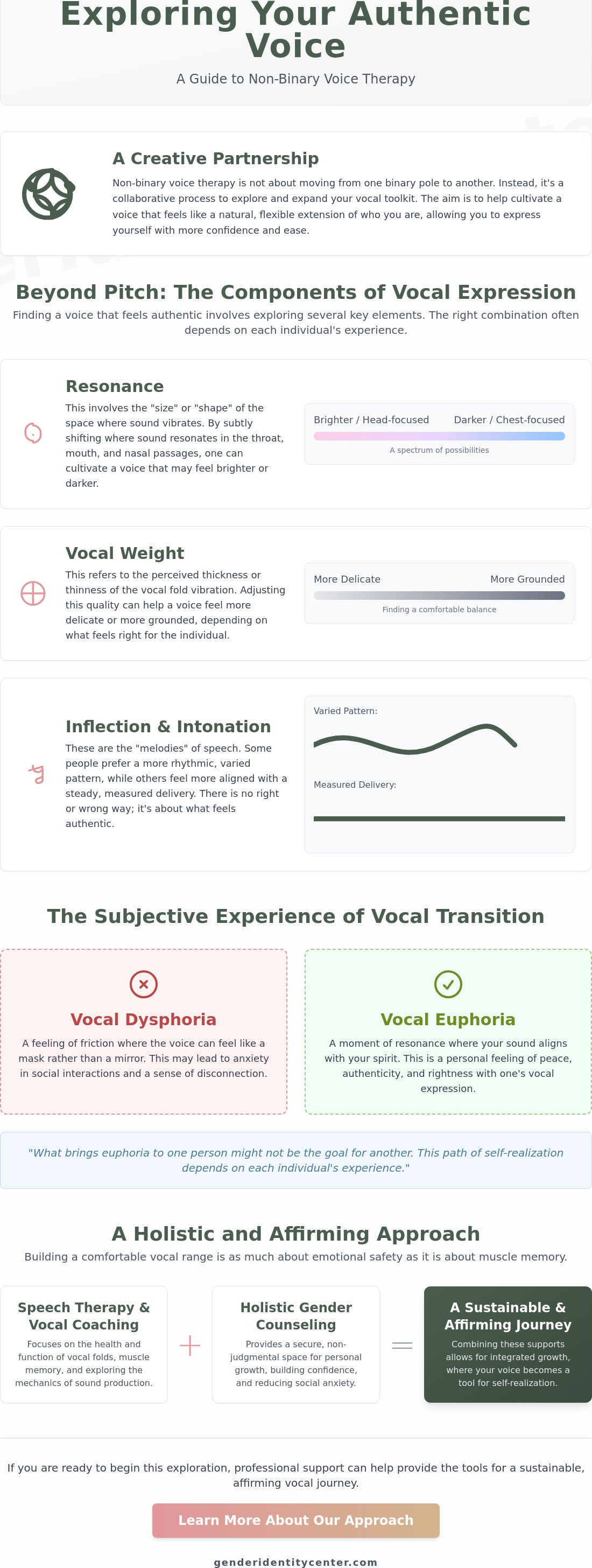
Non-binary voice therapy is a collaborative and creative partnership where we work together to explore how your vocal expression can better reflect your internal sense of self. If you are searching for non-binary voice therapy near me, you are likely looking for a professional who understands that the human voice exists on a vast spectrum. This process isn't about meeting a rigid clinical standard or moving from one binary pole to the other. Instead, it focuses on expanding your vocal toolkit so you can express yourself with confidence and ease. Whether you choose to lean into a more masculine, feminine, or androgynous sound depends on each individual's experience and personal goals.
Many people begin their journey by researching Transgender voice therapy to understand the basic mechanics of how sound is produced. While these foundations are useful, non-binary therapy often moves into more flexible, less defined territory. It's helpful to distinguish between clinical speech-language pathology, which focuses on the health and function of the vocal folds, and gender-affirming vocal coaching, which centers on the aesthetic and social aspects of communication. In an affirming environment, these two worlds blend to support your overall well-being and self-realization.
Beyond Pitch: The Components of Vocal Expression
While pitch is often the first thing people think about, it is only one small part of how a voice is perceived. A more holistic approach looks at several key elements that can be adjusted to find your unique sound:
- Resonance: This involves the "size" or "shape" of the space where sound vibrates. By subtly shifting where sound resonates in the throat and mouth, you can create a voice that feels brighter or darker.
- Vocal Weight: This refers to the thickness or thinness of the vocal fold vibration. Adjusting weight can help a voice feel more delicate or more grounded, depending on what feels right to you.
- Inflection and Intonation: These are the "melodies" of your speech. Some people prefer a more rhythmic, varied pattern, while others feel more aligned with a steady, measured delivery.
Why "Neutrality" is a Valid Goal
For many in our community, the ultimate objective is not to sound like a man or a woman, but to inhabit a comfortable middle ground. Seeking a "neutral" or androgynous voice is a deeply valid path that prioritizes flexibility. Having a versatile voice allows you to navigate different social contexts with less anxiety, giving you the agency to choose how you present yourself in any given moment. A secure, non-judgmental space for exploration is essential for this work. If you are ready to begin this exploration, you can learn more about our approach by visiting our therapists page to see how we support your journey.
The Subjective Experience of Vocal Transition
Vocal transition is rarely a straight line. For many, the search for non-binary voice therapy near me begins at a point of friction where the voice feels like a mask rather than a mirror. Vocal dysphoria can make simple tasks, like ordering coffee or answering the phone, feel like a high-stakes performance. It is a weight that impacts your daily social interactions and your overall sense of peace. However, the opposite of this weight is vocal euphoria. This is the moment of resonance where your sound finally matches your spirit. Because identity is nuanced, what brings euphoria to one person might not be the goal for another. This depends on each individual's experience and how they define their own sense of belonging.
Professional support, such as Voice and communication therapy, helps frame your voice as a tool for self-realization rather than a medical problem to be solved. There is no "right" way to sound as a non-binary person. Your voice is yours to shape, and its evolution may vary based on your personal context. Finding non-binary voice therapy near me is often the first step toward resolving the friction between how you sound and how you feel.
Intersection of Mental Health and Voice
Our bodies often hold onto our emotions in ways we don't realize. When you feel anxious or hyper-aware of your surroundings, your vocal muscles can tighten. This tension can change your perceived pitch or make your voice feel strained and tired. Building a comfortable vocal range is often as much about emotional safety as it is about muscle memory. It takes a great deal of confidence to explore new sounds, and it's natural to feel vulnerable during this process. Acknowledging these feelings is a vital step toward a voice that feels like home.
Navigating Social Environments in Arizona
Living in Arizona means moving through a variety of social spaces, from the bustling streets of Phoenix to the quieter communities in Tucson. Your vocal choices might shift depending on where you are and how safe you feel in those environments. The fluidity of your voice is a strength, not a flaw. You might find that your goals change over time as you become more comfortable with your expression. Having a steady, guiding hand through these shifts can make the journey feel much less daunting. If you are looking for a secure space to start this exploration, you might consider scheduling a conversation to discuss your unique path.
Finding Non-Binary Voice Therapy in Phoenix and Tucson
Locating a provider who truly understands the non-binary experience within the local Arizona landscape can feel like a significant task. Whether you are in the heart of Phoenix or the desert surroundings of Tucson, searching for non-binary voice therapy near me is a step toward finding a community that respects your identity. Access to these services is expanding, but the quality of your experience often depends on finding a practitioner who values your personal perspective over a one-size-fits-all approach. We believe that your comfort is the foundation of any successful vocal exploration.
In Arizona, many individuals find that the availability of gender-affirming voice and communication services varies by region. While metropolitan areas offer more physical clinics, the state's geography can sometimes make travel difficult. This is where the choice between in-person and virtual support becomes a personal decision based on your own comfort and lifestyle. Both paths offer unique benefits, and the right fit is whichever one allows you to feel most present and secure.
In-Person vs. Telehealth Sessions
Choosing a format for your sessions is a subjective process. In-person therapy in Phoenix or Tucson offers the benefit of hands-on guidance, where a therapist can observe your posture and breath in real-time. For some, this physical presence creates a stronger sense of connection. Conversely, telehealth has become a vital resource for those living in rural Arizona or for anyone who feels more secure exploring their voice from the privacy of their own home. Each format has its own strengths, and the best choice depends on each individual's experience and what makes them feel most at ease during their sessions.
What to Look for in an Affirming Therapist
When evaluating a potential provider, it is helpful to look for those who demonstrate a deep commitment to non-binary inclusivity. This often includes experience with WPATH standards and a history of working with gender-diverse populations. A supportive therapist will focus on holistic progress, acknowledging that your voice is connected to your mental health and social safety. You might want to check out our specialized therapists who understand these nuances and prioritize your agency in the therapeutic process.
Insurance considerations for gender-affirming care in Arizona can be complex. Coverage often depends on specific plan details and provider networks. It is usually a good idea to speak directly with your insurance carrier or a potential clinic to understand how your benefits might apply to your specific situation. This ensures that you have the information needed to make a choice that feels sustainable for your future. We are here to help you navigate these practical steps so you can focus on your personal growth.
Preparing for Your First Voice Therapy Session
Taking the step to search for non-binary voice therapy near me is a significant act of self-care. It marks the beginning of a journey toward a more congruent life, where your voice becomes an ally in your expression. Before your first session, it can be helpful to sit with your thoughts about what vocal alignment actually means to you. For some, it might mean finding a specific resonance that feels "right," while for others, it is simply the ability to speak without physical strain or social anxiety. This depends on each individual's experience and how they define their own sense of comfort.
You might consider recording your voice to hear how it sounds in different contexts, though this is entirely optional. Some find it useful to track personal progression over time, while others find it causes unnecessary distress. If you choose to do so, keep it as a private tool for your own reflection. Gathering a few questions about resonance, pitch, and vocal health can also help you feel more grounded during your initial meeting. It is helpful to remember that progress is rarely a straight line. Some days your voice will feel exactly as you wish, and other days it may feel less accessible. This non-linear nature is a normal part of the process of self-discovery.
Setting Intentions, Not Strict Deadlines
It is often more productive to focus on how you feel in your body when you speak rather than how you sound to the outside world. When you prioritize internal comfort and ease, the external sound often follows more naturally. Your therapy sessions should be a secure environment where trial and error are not just allowed, but encouraged. You might try identifying specific social situations where you feel most or least comfortable with your voice. Do you feel more aligned when talking to close friends versus in a professional setting? Understanding these nuances helps your therapist tailor their support to your specific lived reality.
The Logistics of Getting Started
On a practical level, it is a good idea to check your insurance benefits before your first appointment. Many plans in Arizona categorize these services under "speech therapy" or "gender-affirming care," but the specifics of coverage vary widely. When preparing for a consultation, think about what you are most comfortable sharing. You don't need to have every goal mapped out perfectly. Simply describing your current frustrations and your hopes for your vocal future is a wonderful place to start. If you feel ready to begin this exploration, you can explore scheduling an appointment to discuss your journey with a professional who honors your unique path.
Holistic Support at the Gender Identity Center
At the Gender Identity Center, we believe that your voice is deeply connected to your emotional well-being. When you search for non-binary voice therapy near me, you aren't just looking for a set of exercises; you're looking for a way to feel whole. We integrate our speech therapy services with mental health and gender counseling to ensure that every aspect of your identity is acknowledged and respected. Creating a secure environment is our highest priority because radical self-acceptance often flourishes best when you feel truly seen and validated. This holistic approach ensures that your vocal work is supported by a foundation of emotional resilience.
Our commitment to the LGBTQ+ community in Phoenix and Tucson extends beyond the therapy room. We understand that transition is a multi-faceted process that may include medical, social, or legal steps. To support this, we provide WPATH referral letters for those who feel these steps are right for their specific path. Whether these letters or specific medical interventions are a part of your journey depends on each individual's experience and their personal goals for their future. We are here to provide the clinical authority you need alongside the heartfelt support you deserve.
A Multi-Disciplinary Approach to Transition
We offer a variety of ways to support your personal growth. Some individuals find that combining vocal work with EMDR therapy helps them process gender-related trauma and build a stronger sense of internal safety. Others may find strength in family or group therapy, where they can navigate social changes alongside loved ones or peers who share similar lived experiences. Our Phoenix-based gender therapy provides a safe start for those beginning to explore the many layers of their identity in a non-judgmental space. This multi-disciplinary framework allows for a more comprehensive and personalized experience.
Your Journey, Your Pace
We prioritize your agency in every therapeutic interaction. Transition is a meaningful endeavor of self-discovery, and there is no pre-set timeline you must follow. Your sound and your identity are yours to define, and we act as a bridge between where you are and where you wish to be. We invite you to join a community that celebrates every step of your progress, no matter how small it may feel. Finding non-binary voice therapy near me can be the beginning of a lifelong commitment to living as your most authentic self. Your future is a dynamic and positive experience, and we are honored to walk beside you as you explore it.
Embracing Your Unique Vocal Path
Your voice is a powerful part of how you move through the world, and finding a sound that feels aligned with your identity is a deeply personal endeavor. We have explored how non-binary voice therapy near me can provide the tools for vocal flexibility and reduced dysphoria, though the specific outcomes always depend on each individual's experience. Whether you are seeking a neutral middle ground or a more fluid range, your sound is yours to define at your own pace. This process of self-discovery is a meaningful journey that honors your agency and your future self.
Our team of WPATH-compliant clinicians is specialized in gender-diverse mental health, offering a secure space where your self-realization is the ultimate objective. With offices in Phoenix and Tucson and flexible telehealth options, we are committed to providing accessible and affirming support to the LGBTQ+ community across Arizona. You don't have to navigate these complexities alone; a steady, guiding hand is available to help you find the resonance that feels most like home.
Begin your vocal exploration by scheduling a consultation today. We look forward to supporting you as you step into a voice that feels like a natural and affirming extension of your true self.
Frequently Asked Questions
Is non-binary voice therapy covered by insurance in Arizona?
Insurance coverage for non-binary voice therapy near me in Arizona often depends on the specifics of your individual plan. While some providers categorize these services under speech therapy or gender-affirming care, others may have different requirements. It's usually helpful to contact your insurance carrier directly to ask about their specific policies for out-of-network or in-network providers. We can also help you navigate these questions during your initial consultation to ensure you have the information you need.
How long does it typically take to see changes in my voice?
The timeline for seeing changes in your voice is a deeply subjective experience that varies for everyone. Some individuals might notice subtle shifts in their resonance or pitch within a few weeks, while for others, the process of building muscle memory takes several months. This depends on each individual's experience and how often they feel comfortable practicing. We believe in moving at a pace that feels sustainable and safe for your unique vocal health.
Do I need a medical referral to start voice therapy?
Whether you need a medical referral often depends on the requirements of your insurance provider or the specific clinic you choose. Some individuals find that a referral from a primary care doctor or a gender specialist simplifies the billing process, while others prefer to start directly with a therapist. It is a good idea to check with your insurance company to see if they require a formal diagnosis or referral to cover your sessions.
Can voice therapy help me achieve a more androgynous sound?
Achieving an androgynous sound is a very common objective for those seeking non-binary voice therapy near me. This process involves exploring the middle ground of resonance and vocal weight to find a sound that doesn't lean too far toward masculine or feminine poles. Because neutrality is a personal definition, your therapist will work with you to identify the specific vocal qualities that feel most aligned with your identity and comfort.
What is the difference between voice therapy and vocal coaching?
The primary difference between voice therapy and vocal coaching lies in the scope of practice and professional background of the provider. Speech therapy is typically provided by licensed speech-language pathologists who focus on the health, function, and mechanics of the voice. Vocal coaching often emphasizes the aesthetic or performance-based aspects of sound. Both can be valuable, and the choice between them often depends on whether you seek clinical support or stylistic guidance.
Is telehealth as effective as in-person sessions for voice work?
Telehealth sessions are widely considered to be an effective option for voice work, offering a level of comfort that in-person visits may not provide. For many, the ability to practice in their own secure environment reduces anxiety and allows for more authentic exploration. While some prefer the physical presence of a therapist in Phoenix or Tucson, virtual sessions offer increased access for those in rural areas or those with busy schedules.
Will my voice permanently change, or do I have to "do" the voice?
Transitioning your voice usually begins as a conscious effort that gradually becomes a natural habit over time. In the early stages, you may feel like you are "doing" a specific voice as you learn new techniques. As your muscles adapt and your confidence grows, these sounds often start to feel like a natural extension of yourself. The degree of permanence depends on each individual's experience and how they choose to integrate these sounds into their daily life.
What happens if my goals for my voice change during therapy?
It is completely natural for your vocal goals to change as you move through your journey of self-discovery. Your identity is dynamic, and your voice can evolve alongside your internal sense of self. We view therapy as a collaborative and flexible process where we check in regularly to ensure we are still moving toward what feels most affirming to you. You are always the expert on your own life and your own sound.