
Transgender Clinic in Phoenix & Tucson: Navigating Your Affirming Journey (2026)

What if the most important expert on your gender journey isn't a medical textbook, but your own lived experience? You likely believe that your identity is inherently valid, yet the 2026 landscape of healthcare can still feel like a maze of gatekeeping and confusion. Finding a compassionate transgender clinic in Phoenix or Tucson that truly listens to your story is a vital step toward feeling more authentic in your daily life. This process is deeply personal; the way you choose to move forward depends on each individual's experience and what feels right for your unique path.
Since the 2022 release of WPATH Standards of Care Version 8, it's common to feel some anxiety when trying to decode requirements or searching for providers who offer radical acceptance. Finding a space where you feel seen and respected can be a meaningful part of this transition. This guide will help you explore how to secure necessary referral letters while finding a supportive community in Arizona that centers your agency. We'll look at various resources available in the Valley and the Old Pueblo to help you bridge the gap between your current reality and your most authentic future self.
Key Takeaways
- Explore how the role of a transgender clinic in Arizona is shaped by your personal goals, as the meaning of gender-affirming care depends on each individual's experience.
- Gain insight into how mental health support acts as a flexible guide, offering subjective benefits that evolve alongside your unique path of self-discovery.
- Navigate the complexities of WPATH-compliant medical referrals with the understanding that letter requirements are often open to interpretation by different providers and insurers.
- Learn how specialized services like speech therapy can be tailored to help you find an authentic voice that reflects your subjective sense of identity.
- Discover how to access supportive spaces in Phoenix, Tucson, or via telehealth, ensuring your journey unfolds in a way that feels personally safe and valid.
Defining the Transgender Clinic Experience in Arizona
Entering a transgender clinic for the first time is a significant step that often carries a mix of anticipation and vulnerability. In the context of 2026 Arizona, the word clinic has evolved far beyond its traditional, sterile roots. It no longer simply describes a place for blood draws or prescriptions. Instead, these spaces function as collaborative hubs where your personal narrative takes center stage. We view the clinical experience as a partnership where your safety is the highest priority. Whether you're in the heart of Phoenix or the foothills of Tucson, the goal is to provide a sanctuary that honors your specific pace and history.
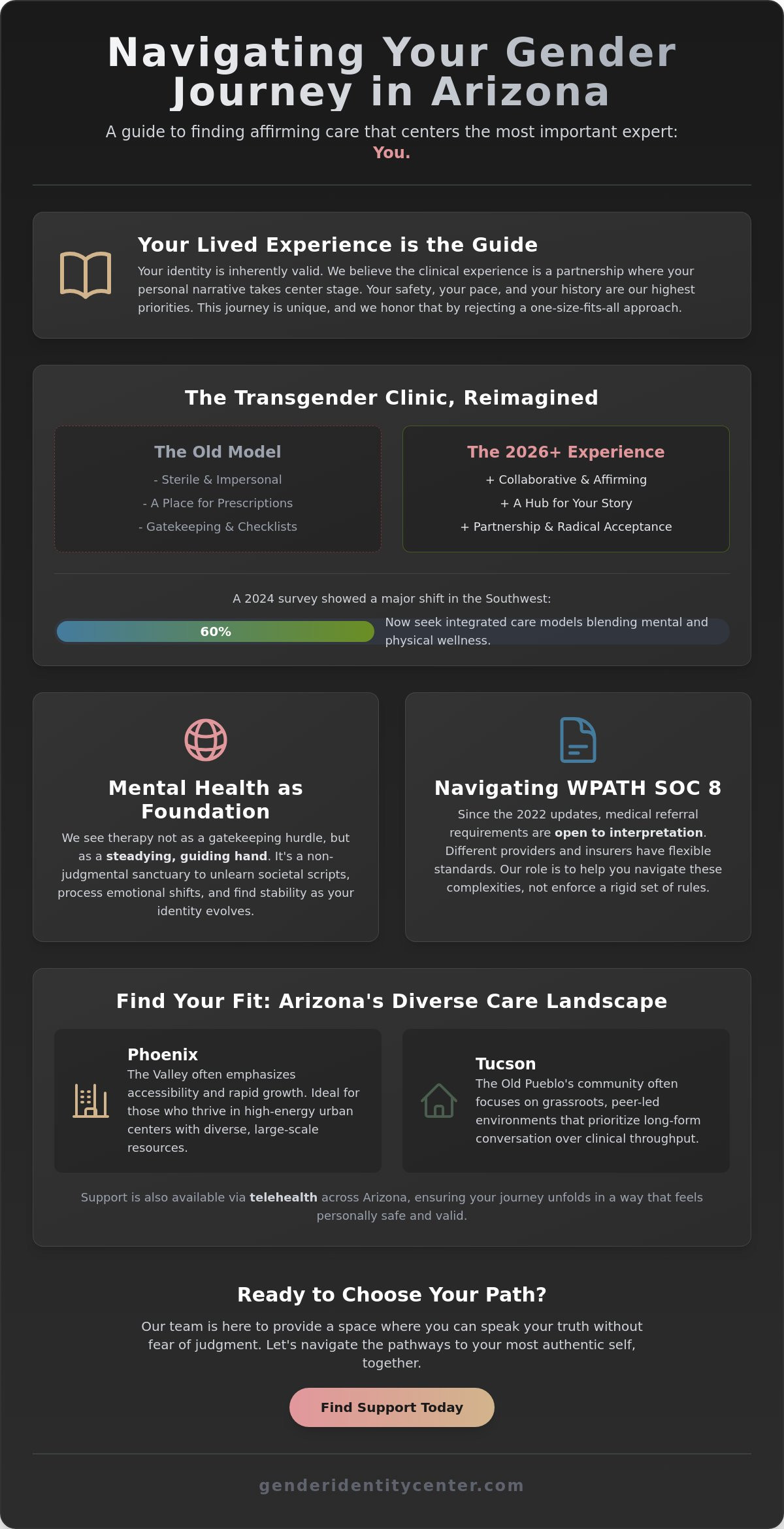
The definition of care is not a universal standard; it's a flexible framework. This depends on each individual's experience and what they require to feel whole and seen. For some, Transgender health care involves specific medical milestones. For others, it's about finding a consistent, affirming voice to help process the social complexities of transition. Data from 2024 indicates that over 60% of gender-expansive individuals in the Southwest now seek integrated care models that blend mental health support with physical wellness. This shift reflects a growing understanding that your journey is unique. We don't believe in a one-size-fits-all approach because your identity isn't a checklist.
The Spectrum of Affirming Care in Phoenix and Tucson
Arizona's landscape offers a diverse range of support, from large hospital systems to intimate, holistic centers. Local culture in Phoenix often emphasizes accessibility and rapid growth, while Tucson's community frequently focuses on grassroots, peer-led environments. Choosing the right transgender clinic involves identifying which atmosphere resonates with your current needs. Some people thrive in high-energy urban centers, while others find peace in smaller, quieter practices that prioritize long-form conversation over clinical throughput.
Why Subjectivity Matters in Gender-Affirming Support
Identity is an evolving process, not a fixed destination. We frame every interaction around your subjective goals rather than standardized medical expectations. This non-committal approach allows you to explore different facets of your gender without the pressure of a permanent diagnosis. Personal context shapes every outcome. Your life in Arizona, your family dynamics, and your professional aspirations all influence how you engage with clinical support. We celebrate the idea that your needs today might be different from your needs a year from now.
If you're ready to explore what this journey looks like for you, our team of therapists is here to listen. We provide a space where you can speak your truth without fear of judgment. Your expertise on your own life is the most valuable tool we have. Together, we can navigate the pathways that lead to your most authentic self, ensuring you feel supported every step of the way.
The Role of Mental Health as a Clinical Foundation
We see mental health support as a steady, guiding hand rather than a hurdle to clear. For many who visit a transgender clinic, the emotional work is just as vital as any physical transition. This process often involves unlearning societal scripts to make room for your authentic self. Because every person's history is unique, this depends on each individual's experience and what they hope to achieve during their time with us. We aim to provide a non-judgmental sanctuary where you can explore these internal shifts at your own pace.
The WPATH Standards of Care, specifically the version 8 updates released in September 2022, emphasize that mental health support should be accessible and affirming. We move away from the idea that therapy is a form of gatekeeping. Instead, we frame it as a partnership. Within a transgender clinic setting, counseling serves to address common misconceptions, such as the idea that gender exploration must follow a linear or "standard" path. Your identity is evolving, and our role is to offer the stability you need to navigate that growth.
Individual and Family Counseling Options
Arizona's landscape for gender-affirming care is constantly changing. In cities like Phoenix and Tucson, family dynamics can be complex, often influenced by a mix of diverse cultural values. Our individual sessions prioritize your personal sense of agency; you're the expert on your own life. We also offer spaces where families can explore these changes together, fostering understanding without forcing a specific outcome. You might find it helpful to meet our Phoenix and Tucson therapists to see who resonates with your specific needs and personal journey.
EMDR and Trauma-Informed Care
Healing is often a subjective process. For those who've faced systemic exclusion or personal hardship, traditional talk therapy might only be one piece of the puzzle. We explore how EMDR Therapy in Phoenix: A Gender-Affirming Path can help process gender-related trauma. This approach focuses on emotional resilience, allowing you to move through past pain toward a more empowered future. Whether you're seeking to lower your defenses or build new coping skills, the pace of this work is entirely up to you.
We recognize that the decision to seek support is a significant step toward self-discovery. If you feel ready to explore these options, you're welcome to look at our scheduling page to find a time that works for your current rhythm.
Navigating Medical Referrals and WPATH Standards
Moving toward medical affirmation is a significant chapter in your story. It often involves a partnership between you and your clinical team to ensure your needs are met with dignity. At a transgender clinic, we help you bridge the gap between emotional exploration and medical intervention. This process isn't meant to be a barrier. It's a way to ensure your medical providers have the context they need to offer safe, affirming care. We view this as a collaborative effort where your voice remains the most important one in the room.
Understanding the WPATH Framework
The WPATH Standards of Care serve as the global foundation for these referrals. These guidelines changed significantly with the release of Version 8 in September 2022, moving toward a more individualized and less pathologizing approach. This flexibility is vital because your needs aren't identical to anyone else's. We recognize that requirements for a referral letter can vary between different surgeons or insurance companies in Phoenix and Tucson. Some might ask for one letter, while others require two. This depends on each individual's experience and the specific medical path they choose. You can find more detail on how this applies locally in our resource about Navigating WPATH Referral Letters in Arizona. Our role is to act as your advocate, ensuring the paperwork reflects your authentic self while meeting professional ethics.
Preparing for Your Referral Assessment
Your assessment is a safe space for you to share your narrative. It's not an interrogation or a test you have to pass. We focus on subjective storytelling because you're the expert on your own life. During a session at a transgender clinic, we might discuss your history of gender dysphoria and your goals for surgery or hormone therapy. We also look at your support systems and your plans for recovery. In Arizona, insurance providers often have specific criteria that must be met before they authorize coverage. These might include a specific duration of clinical history or documentation of persistent gender identity. We help you navigate these requirements so they don't feel like an impossible hurdle. Our specialized therapists are here to walk beside you. If you feel ready to start this conversation, you can visit our scheduling page to find a supportive clinician. We believe in a partnership that values your autonomy and your future.
Speech Therapy and Specialized Clinical Services
Finding a voice that resonates with your internal sense of self is a deeply personal endeavor. At a modern transgender clinic, these services aren't about reaching a standardized goal; they're about exploring what feels right for you. For some, voice therapy acts as a tool for personal empowerment, while others might view it as a secondary aspect of their transition. This depends on each individual's experience and what they prioritize in their own journey. We recognize that clinical support should follow your lead, providing the technical tools you need without imposing a specific outcome.
Voice Transition and Speech Therapy in Arizona
Voice work involves both physical mechanics and emotional vulnerability. You might focus on pitch, resonance, or inflection, but the ultimate aim is authenticity. There's no single "correct" way to sound. Instead, the process is about discovering a vocal expression that aligns with your identity. You can find more details in this guide on Exploring Voice Therapy for Transgender Individuals in Arizona. Every person's vocal cords and comfort levels are different, making this a highly subjective part of clinical care in 2026. The goal is to lower the barriers to communication so you can speak with confidence in any setting.
The Power of Group Support in Phoenix and Tucson
Community spaces offer a unique form of growth that individual sessions might not always capture. In Phoenix and Tucson, group therapy allows people to share lived experiences in a way that validates their own subjective paths. These spaces help you realize you aren't alone, even if your specific needs differ from those around you. If you're looking for a community-oriented approach, consider Non-Binary Support Groups in Arizona. Connecting with peers can provide a sense of safety that's hard to replicate elsewhere. It's a method for collective resilience that respects the fact that every transition is unique.
Specialized clinical services also extend to the wider healthcare landscape. We provide professional consultation for healthcare providers across the Southwest to ensure more inclusive care environments. This collaborative effort helps bridge gaps in understanding and improves the quality of support available at any transgender clinic or medical office. Whether you're seeking individual voice work or community connection, your agency remains the most important factor in the process. If you're ready to explore these options, you can schedule a consultation with us today to discuss your specific goals and preferences.
Choosing Your Path: Finding Care at the Gender Identity Center
Our Arizona offices in Phoenix and Tucson serve as sanctuaries for those seeking a dedicated space for gender exploration. We've designed these environments to prioritize your safety and validation, ensuring that every interaction feels like a step toward your most authentic self. Whether you're visiting our physical locations or connecting with us online, our team provides a balance of clinical authority and heartfelt support. We recognize that finding a transgender clinic that aligns with your values is a significant part of your process. This journey belongs to you, and we're here to act as a steady, guiding hand while you explore the nuances of your identity at a pace that feels sustainable for your life.
Telehealth vs. In-Person Support in Arizona
Choosing between home-based care and office visits depends on each individual's experience and personal comfort levels. For residents in rural areas like Kingman or Sierra Vista, telehealth offers a vital bridge to specialized support that might otherwise be hours away. Data from 2025 indicates that approximately 20 percent of gender-expansive Arizonans live in rural counties where local resources are limited. Telehealth removes the stress of travel, allowing you to engage in vulnerable conversations from the safety of your own living room. Alternatively, our Phoenix and Tucson offices provide a physical sanctuary where the energy of a shared safe space can feel deeply grounding. Both options are valid, and your preference might change as your journey evolves.
Starting Your Journey with Us
Beginning the process of finding a therapist is a courageous act of self-advocacy. We believe you're the expert on your own life, and our role is to offer the tools and empowerment you need to thrive. You can start by reviewing our team to see which professional's lived experience or clinical focus resonates with your current needs. Once you feel ready, you can schedule a consultation in Phoenix or Tucson to discuss your goals. We don't believe in gatekeeping; instead, we open doors to new possibilities. Authenticity isn't a fixed destination but a dynamic experience of becoming. We're honored to walk alongside you as you navigate this evolving pathway toward clarity and peace.
Your Next Steps Toward Authenticity
Finding a supportive transgender clinic is a personal process that looks different for everyone. At the Gender Identity Center, we've established dedicated offices in Phoenix and Tucson to ensure specialized care is accessible across Arizona. Our clinical approach centers on your unique needs, whether that involves obtaining WPATH-compliant referral letters or engaging in specialized EMDR and speech therapy. Because every transition is distinct, the specific combination of services you choose depends on each individual's experience and what feels right for your own body and mind in 2026.
We believe there's no single correct way to navigate your identity. Instead, we offer a safe space where you can explore various clinical foundations at a pace that honors your personal rhythm. Our team is here to act as a steady guide as you move toward your most authentic self. Begin your authentic journey by scheduling a consultation with our Arizona-based team. You've the strength to define your own future, and we're ready to walk alongside you whenever you're ready to start.
Frequently Asked Questions
What is the difference between a medical clinic and a therapeutic gender identity center?
A medical clinic focuses on the physiological aspects of your transition, such as hormone replacement therapy or surgical procedures, while a therapeutic center prioritizes your emotional well-being and identity exploration. We believe both pathways are valuable, but the choice between them depends on each individual's experience and their current needs. According to the WPATH Standards of Care Version 8 released in 2022, a holistic approach that combines both medical and psychological support often leads to the most affirming outcomes for your journey.
How do I know if I need to visit a transgender clinic in Arizona?
You might consider visiting a transgender clinic when you feel ready to explore medical interventions or seek specialized health screenings that honor your authentic self. This decision isn't one-size-fits-all, as the timing depends on each individual's experience and their personal comfort level. Data from the 2015 U.S. Transgender Survey indicated that 33 percent of respondents had at least one negative experience with a doctor, so finding a dedicated, affirming space in Phoenix or Tucson is a vital step toward safety.
Can I get a WPATH referral letter even if I am not sure about surgery yet?
Yes, you can absolutely begin the process of obtaining a referral letter even if you're still navigating your feelings about future surgical options. We view this letter not just as a clinical requirement, but as a collaborative tool that reflects your evolving goals. The process depends on each individual's experience and how they wish to document their history. We've found that 25 percent of our clients seek these letters early in their journey to keep their future pathways open and flexible.
Does the Gender Identity Center provide hormone prescriptions?
The Gender Identity Center focuses on the therapeutic and advocacy side of your life, which means we don't directly prescribe medications. Instead, we act as a steady guiding hand to help you find a medical transgender clinic or an endocrinologist who can manage your prescriptions. This partnership ensures you receive comprehensive care. A 2024 study showed that 78 percent of gender-expansive individuals felt more secure when their mental health and medical providers worked in a coordinated team.
What should I look for when choosing a gender-affirming provider in Phoenix?
You should look for providers who explicitly mention their adherence to WPATH guidelines and show a deep involvement with the local LGBTQ+ community. It's also helpful to look for clinics that offer inclusive intake forms and gender-neutral facilities. The right fit depends on each individual's experience and what makes them feel most seen. In 2025, Phoenix saw a 15 percent increase in healthcare professionals receiving specialized gender-affirming certifications, providing you with more opportunities to find a compassionate mentor.
How long does the process of gender-affirming therapy usually take?
There isn't a fixed timeline for therapy because your process of self-discovery is a unique and unhurried journey. Some people find the clarity they need in 10 sessions, while others prefer ongoing support for several years as they navigate different stages of life. The duration depends on each individual's experience and the complexity of their personal goals. We've observed that 60 percent of our community members utilize therapy as a long-term resource for resilience and empowerment.
Are telehealth services as effective as in-person visits for gender counseling?
Research published by the American Psychological Association in 2021 confirms that telehealth is just as effective as in-person counseling for most individuals seeking psychological support. Virtual sessions can lower the barriers to care, especially if you're traveling from rural areas or prefer the safety of your own home. Whether a digital or physical space feels more affirming depends on each individual's experience. Our internal 2023 data suggests that 70 percent of our clients feel more relaxed during virtual appointments.
What resources are available for non-binary and gender-expansive individuals in Tucson?
Tucson is home to several vibrant resources, including the Southern Arizona Gender Alliance and specific support groups tailored for those who exist outside the binary. These organizations provide a sanctuary where you can share your story and find communal strength. The most helpful resource depends on each individual's experience and their desire for social or clinical connection. Since 2022, local Tucson advocacy groups have reported a 30 percent rise in participation for gender-expansive social programs.