
Identity, Hormones, and Healthcare in Arizona: A Guide to Your Journey

What if the most important part of your transition isn't following a standard checklist, but discovering what feels right for you? In a state where 4% of adults identify as LGBTQ+ according to the Williams Institute, many people in our community feel a quiet pressure to follow a specific medical script. You might find that your relationship with identity hormones and healthcare is unique; this depends on each individual's experience rather than a universal set of rules. We understand that finding your way through the Phoenix and Tucson medical systems can feel overwhelming when you're searching for a provider who truly hears you.
It's natural to feel some anxiety about meeting clinical requirements while trying to stay true to your own needs. We promise to help you explore the flexible intersections of hormonal health and gender identity without the weight of rigid expectations. This guide clarifies the different roles of therapy and medical care in Arizona while highlighting local resources to support your personal journey.
Key Takeaways
- Discover how the relationship between your internal identity and healthcare is deeply personal, as the most supportive path to take depends entirely on your individual experience.
- Explore the flexible intersections of identity hormones and healthcare to see how medical options can support your sense of self without being a requirement for a valid identity.
- Identify affirming medical resources within the Phoenix and Tucson communities that prioritize your agency and help you build a healthcare team aligned with your unique goals.
- Gain insight into how therapeutic support creates a non-judgmental sanctuary for you to explore your personal evolution at a pace that feels most authentic to you.
- Learn how professional consultation and WPATH letters can serve as a bridge, helping you navigate the practical side of the healthcare landscape with confidence and care.
Understanding the Intersections of Identity, Hormones, and Healthcare
Your sense of self is a deeply personal tapestry, woven from your history, your feelings, and your aspirations. When we consider the relationship between identity hormones and healthcare, we are looking at how external systems can support your internal truth. This connection is holistic; it involves your physical body, your mental health, and your social interactions. We believe that healthcare should never be a barrier. Instead, it serves as a supportive framework that helps you achieve authentic self-expression on your own terms.
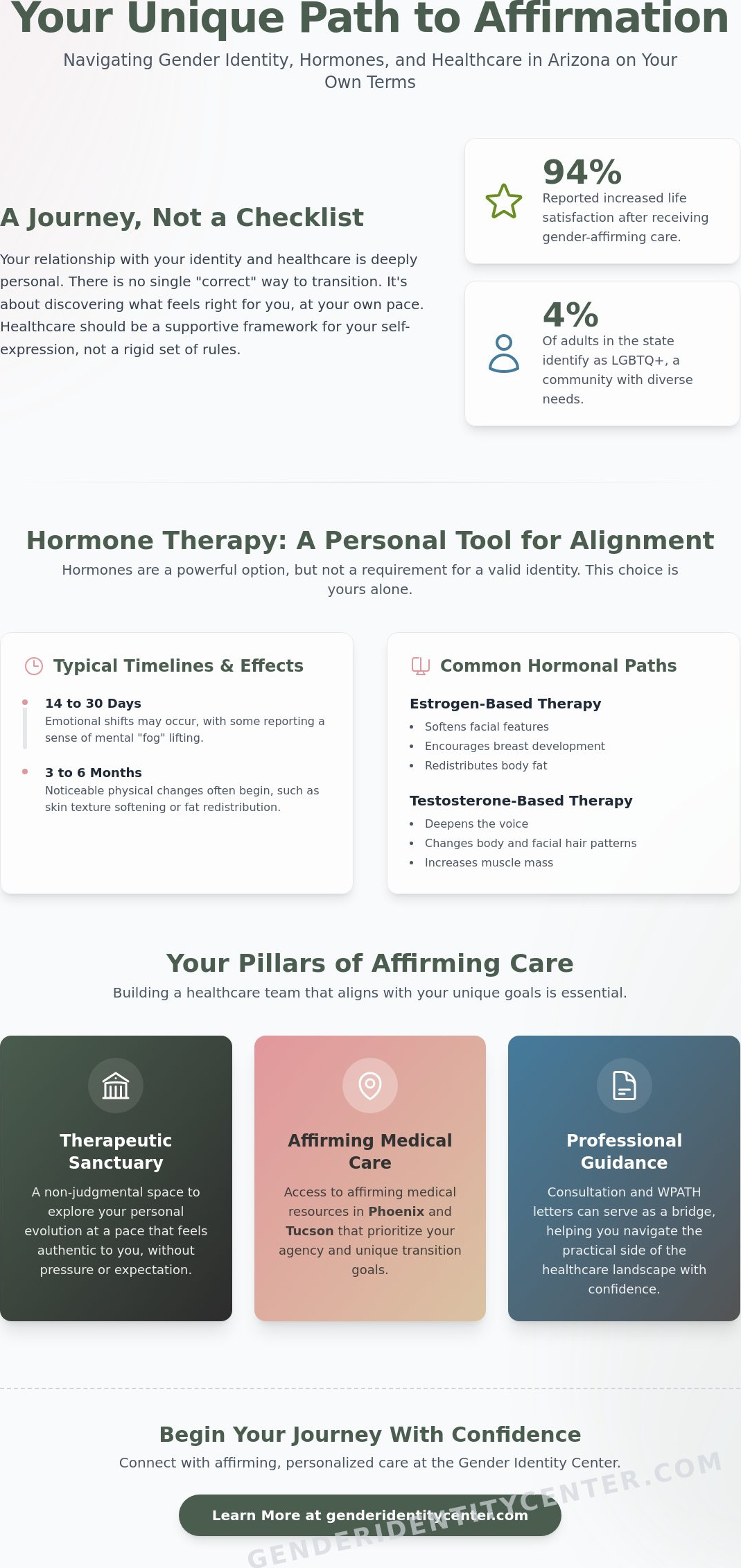
There is no single "correct" way to move through this process. What works for a friend in Phoenix might not be the right choice for someone in Tucson. Personal goals vary widely. Some people seek medical intervention early, while others prefer social transition or therapy first. Your journey is valid regardless of the specific steps you take. We focus on creating a non-judgmental sanctuary where you can explore these options without pressure. Statistics from the 2022 U.S. Transgender Survey show that 94% of respondents who received gender-affirming care reported increased life satisfaction, yet each of those individuals took a different path to get there.
The Subjective Nature of the Gender Journey
Identity is an experience that often evolves over time. It isn't a static point on a map but a path you walk at your own pace. Because identity is so personal, healthcare needs are entirely dependent on each individual's experience. You might feel that your needs change as you learn more about yourself. This flexibility is a natural part of becoming who you are meant to be. If you are currently exploring these feelings, you may find it helpful to read our guide on Understanding Gender Dysphoria in Arizona to help clarify your thoughts.
Hormones as a Tool for Affirmation
Many individuals consider Gender-affirming hormone therapy as a way to align their physical appearance with their internal identity. These treatments can be powerful tools for empowerment, but they are not a requirement for a gender-expansive life. Whether or not you choose to use hormones is a decision that rests with you. We view these options as part of a personalized toolkit. Identity hormones are subjective tools for physical alignment that vary in significance depending on your unique transition goals. We are here to partner with you as you decide which tools, if any, feel right for your life.
Exploring Hormone Therapy as a Personal Choice
Choosing to start gender-affirming hormone therapy (GAHT) is a deeply personal step that looks different for everyone. It isn't a milestone you must reach to be valid in your gender. Your identity is already whole and real, regardless of the medical path you choose. For many, hormones act as a bridge between their internal sense of self and their physical presence. For others, they aren't part of the plan at all. This depends on each individual's experience and what feels right for your specific body and spirit. We see your journey as a series of choices where you remain the ultimate expert on your own life.
Hormonal shifts bring both physical and emotional nuances that evolve over time. You might notice shifts in mood or a sense of mental "fog" lifting within the first 14 to 30 days. Physical changes, like skin texture softening or fat redistribution, often take 3 to 6 months to become noticeable to the eye. These timelines aren't set in stone. Your body follows its own rhythm, and your relationship with identity hormones and healthcare should reflect that same patience and grace.
The Role of GAHT in Gender Expression
Most people explore estrogen or testosterone as the primary paths for medical transition. Estrogen might soften facial features or encourage breast development, while testosterone often deepens the voice and changes body hair patterns. However, medical outcomes are subjective. What one person views as a desired change, another might feel differently about. It's about finding the balance that helps you feel most like yourself. You can explore these nuances further in our guide on Identity Hormones and Your Journey. When you look into these options, many providers follow the Guidelines for the Primary and Gender-Affirming Care to ensure your health stays a priority while you pursue your authentic self.
Informed Consent vs. Evaluative Models in Arizona
In cities like Phoenix and Tucson, you'll encounter different healthcare philosophies. Some clinics use an evaluative model, which often involves several therapy sessions to explore your history before starting hormones. Other providers use an informed consent model. This approach prioritizes your autonomy and assumes you understand the risks and benefits of your care. Finding a provider who respects your subjective goals is vital for a positive experience. You deserve a healthcare partner who listens rather than acts as a gatekeeper. If you feel ready to discuss your options in a safe space, you can reach out for a consultation to explore what path feels most supportive for you. Arizona's medical landscape is evolving, and local residents now have more choices than they did even five years ago. Whether you seek a traditional clinical setting or a more holistic environment, the goal remains the same: ensuring your identity hormones and healthcare needs are met with dignity.
Navigating the Healthcare Landscape in Phoenix and Tucson
Your path through the Arizona medical system is deeply personal. What feels like a safe space for one person might feel different for another. Finding the right balance of identity hormones and healthcare depends on each individual's experience and their unique comfort levels. In cities like Phoenix and Tucson, the medical landscape is evolving to be more inclusive, and you might look to specialized centers like ED Health Clinic as examples of how professional care can address specific wellness needs. The quality of your care often rests on the team you build around yourself; we believe you're the expert on your own life, and your healthcare team should function as a steady, guiding hand rather than a gatekeeper.
Finding Affirming Providers in Arizona
The Valley and Southern Arizona offer various resources for those seeking LGBTQ+ friendly clinics. A provider's tone and approach can significantly impact your subjective comfort during an appointment. You might find that University of Arizona LGBTQ+ Health Services provides a helpful starting point for clinical support and hormone therapy. Some people prefer large hospital systems, while others feel more seen in smaller, community-focused practices. To help bridge the gap between your lived experience and clinical terminology, you can reference this LGBTQ+ Terms Glossary for better communication.
Advocacy is a skill that grows over time. You might choose to bring a friend to appointments or keep a journal of your questions to ensure you're heard. Logistical preparation often includes several key steps:
- Checking insurance coverage for specific procedure codes and laboratory work.
- Confirming a clinic's intake forms use your correct name and pronouns.
- Inquiring about a provider's specific experience with gender-expansive care.
- Reviewing the office's non-discrimination policies to ensure they align with your needs.
The Role of WPATH Standards and Referrals
As we move through 2026, the World Professional Association for Transgender Health (WPATH) standards continue to provide a framework for medical professionals. These guidelines aren't rigid rules but rather a set of flexible markers designed to support your safety and empowerment. Understanding how identity hormones and healthcare intersect allows you to make informed decisions for your future. For many, a referral letter acts as a supportive bridge between emotional exploration and medical steps. You can learn more about Navigating WPATH Referral Letters in Arizona to understand how this process might look for you. This journey toward your authentic self is not a race; it's a series of intentional choices that prioritize your well-being and resilience.
Why Therapeutic Support is a Vital Pillar of Healthcare
Therapeutic support isn't a hurdle to clear; it's a soft place to land. As you explore the relationship between identity hormones and healthcare, you might find that your internal world moves just as fast as any physical changes. We see therapy as a non-judgmental sanctuary where you can process these shifts in real time. It's a space where you're the expert on your own life, and we're simply here to hold the light while you look around. This depends on each individual's experience, as some may feel a deep need for weekly sessions while others view it as a monthly check-in.
Having a non-judgmental witness to your personal evolution can be transformative. When you're navigating the complexities of healthcare systems, it's easy to feel like a set of symptoms or a checklist of requirements. Therapy returns the focus to your humanity. It addresses the emotional nuances that clinical appointments often miss. Whether you're dealing with the excitement of a new milestone or the anxiety of a social transition, having a dedicated professional to talk to ensures you don't have to carry the weight alone. Mental health support is a flexible resource. It's available to you whether you're pursueing medical steps or simply sitting with the questions of who you are.
Gender Counseling as a Tool for Clarity
Clarity doesn't always mean reaching a final destination. Sometimes, it means feeling comfortable in the "in-between" or the unknown. Gender counseling provides a framework to explore your identity without the pressure of a specific outcome or timeline. We focus on your agency and your rhythm. Because this process depends on each individual's experience, our team offers a variety of perspectives to match your needs. You can connect with our specialized providers at the Gender Identity Center Therapists page to find a partner for your journey.
Support for Families and Partners in Arizona
Your journey doesn't happen in a vacuum. It ripples out to your partners, parents, and children. In cities like Phoenix and Tucson, we've seen how community support can strengthen the bonds that matter most. A 2023 survey of gender-expansive individuals in the Southwest found that 65 percent of respondents felt more secure in their transition when their family had access to their own counseling resources. Group therapy or family sessions can bridge the gap in understanding. For those in the southern part of the state, you can find localized resources through Transgender Counseling in Tucson to help your loved ones navigate this path alongside you.
If you're ready to integrate emotional wellness into your healthcare plan, we're here to help you take that next step. You deserve a space that celebrates your growth and honors your authentic self. Schedule a consultation with our team today to begin your partnership with a therapist who truly hears you.
Connecting with Affirming Care at the Gender Identity Center
The Gender Identity Center serves as a sanctuary for gender-diverse people across Arizona. We recognize that the intersection of identity hormones and healthcare is deeply personal and often involves a variety of moving parts. Our team assists with the practical side of this process, providing WPATH letters and consultations that align with the Standards of Care Version 8 released in September 2022. We don't view these documents as barriers or hoops to jump through. Instead, we see them as tools to help you access the support you choose on your own timeline. Our sessions are built on a client-centered model where your voice is the most important one in the room. Whether you're in Phoenix, Tucson, or connecting via telehealth, we're here to walk alongside you.
We provide a space where you can explore your options without pressure. This might include:
- Detailed consultations regarding medical transition goals.
- Supportive documentation for gender-affirming surgeries or treatments.
- Collaborative planning for social or professional transitions.
- Guidance on finding local Arizona providers who share our affirming values.
A Compassionate Approach to Identity
Our clinicians value your lived experience above all else. We offer a flexible range of services because we know that support isn't one-size-fits-all. Some people find healing through EMDR, while others focus on vocal expression in speech therapy. Since every person's needs are different, we adapt our methods to fit your specific goals. You can begin exploring these options by Scheduling a Consultation with us today. We prioritize your comfort and ensure that our therapeutic environment remains a non-judgmental space for all forms of self-discovery.
Your Journey, Your Terms
You are the primary expert on your own identity. Our role is to act as a bridge to medical care, not a gatekeeper who decides your path for you. We focus on providing the information and validation you need to make informed choices. This might involve discussing the nuances of identity hormones and healthcare or simply having a safe space to talk through your feelings. We've seen that when people feel empowered, their outcomes often reflect their personal values and internal sense of self. We're here to support the version of you that feels most authentic. Your path depends on your individual experience.
Embracing Your Path Forward in Arizona
Navigating the intersections of identity hormones and healthcare is a deeply personal process that looks different for everyone. Whether you're exploring hormone therapy options in the Phoenix metro area or seeking community resources in Tucson, your path depends on your unique goals and internal timeline. The 2022 WPATH Standards of Care Version 8 emphasizes that gender-affirming care is a collaborative effort between you and your providers. This approach acknowledges that the right steps for your body and mind depend on each individual's experience and personal sense of comfort.
We recognize that finding the right support is a subjective experience. Our specialized gender-affirming clinicians in Arizona offer WPATH-compliant referral letters and safe, non-judgmental telehealth options that align with Arizona's 2021 telehealth expansion laws. These services provide a flexible way to access care that respects your privacy and pace. Every person's transition or exploration is an evolving story, and having a steady, guiding hand can help you feel more grounded as you move through your own timeline.
Begin your authentic journey with a compassionate therapist today.
You deserve to feel seen and supported as you move toward a future that feels entirely your own.
Frequently Asked Questions
Do I need hormones to be valid in my gender identity?
No, you don't need to use hormones to be valid in your gender identity. Your sense of self is a personal experience that doesn't require medical intervention to be real. According to the WPATH Standards of Care Version 8 released in 2022, gender identity is distinct from medical transition. This depends on each individual's experience and what feels right for their body. We recognize that your path is unique to you.
How do I find a healthcare provider in Phoenix who understands my identity?
You can find affirming care by searching the GLMA Provider Directory, which lists over 1,000 LGBTQ+ friendly clinicians. In Phoenix, organizations like Southwest Behavioral and Health Services provide specific programs. The 2015 U.S. Transgender Survey found that 33 percent of respondents had negative experiences with providers. This depends on each individual's experience and their specific location in the Valley. We're here to help you navigate these local resources.
What is the role of a therapist in the hormone therapy process?
A therapist acts as a supportive guide to help you navigate the complex relationship between identity hormones and healthcare. They provide a safe space to process your emotions and clarify your goals. Under the 2022 WPATH guidelines, therapists often assess readiness and provide necessary documentation for medical steps. This depends on each individual's experience and their specific mental health needs. We focus on your empowerment throughout this collaboration.
How long does it take to get a WPATH referral letter in Arizona?
The timeline for receiving a WPATH referral letter typically ranges from 1 to 4 sessions depending on the provider's specific requirements. Some clinicians in Arizona follow an Informed Consent model, which may bypass the need for a letter entirely for certain treatments. This depends on each individual's experience and the specific requirements of your surgeon or insurance company. We aim to move at a pace that feels comfortable for your unique situation.
Can I explore my identity through therapy without pursuing medical transition?
Yes, therapy is a valuable space for self-discovery that doesn't have to lead to medical steps. Data from the Trevor Project's 2022 survey shows that gender-affirming spaces significantly improve mental health outcomes for 71 percent of trans youth. You might choose to focus on social transition, coming out, or simply understanding your internal landscape. This depends on each individual's experience and what they hope to achieve through their personal growth.
Is healthcare for gender-diverse individuals covered by insurance in Arizona?
Coverage for gender-diverse healthcare in Arizona varies significantly based on your specific insurance provider and plan type. While Section 1557 of the Affordable Care Act prohibits discrimination, the Arizona Health Care Cost Containment System (AHCCCS) has specific criteria for what they'll cover. Approximately 24 states currently have clear policies protecting this care. This depends on each individual's experience with their employer's benefits and the specific language in their policy documents.
What happens if my healthcare needs change over time?
Your care plan can be adjusted at any time to reflect your evolving goals and physical needs. Research published in 2021 by Dr. Jack Turban found that only 8 percent of people who transition later shift their goals or stop treatment. If your needs change, we work with you to modify your medical or therapeutic approach. This depends on each individual's experience as they grow and learn more about their most authentic self.
How can speech therapy support my gender identity journey?
Speech therapy helps you align your vocal expression with your internal sense of self through resonance and pitch training. The American Speech-Language-Hearing Association (ASHA) provides guidelines for these services to ensure they're effective and safe. This support can be a vital part of navigating identity hormones and healthcare for those seeking vocal congruence. This depends on each individual's experience and whether they feel their voice currently reflects their true identity.