
21 Crucial Questions to Ask a Gender Therapist Before Your First Session

What if the "perfect" therapist isn't a universal standard, but a subjective alignment that only you can truly define? When you're searching for support in Phoenix or Tucson, it's natural to feel a sense of weight behind every search for the right questions to ask a gender therapist. You might worry about facing gatekeeping or feel lost in clinical acronyms like WPATH or EMDR. We recognize that this process can feel overwhelming, especially as you navigate the evolving landscape of care and your own identity. This feeling of uncertainty is a valid part of your journey, and it's okay to move at a pace that feels safe for you.
Whether a provider is the right match often depends on each individual's experience and their specific goals for self-realization. Discover how to navigate the subjective process of finding a therapist who aligns with your unique gender journey and personal needs. We've gathered 21 vetting points to help you explore the difference between clinical expertise and personal resonance. This guide provides a framework to help you move toward an initial consultation with a sense of quiet confidence and agency over your own care.
Key Takeaways
- Understand how framing therapy as a collaborative space for self-discovery can help you prioritize your own path over a fixed clinical diagnosis.
- Learn the essential clinical questions to ask a gender therapist to understand their familiarity with WPATH standards and their history of supporting gender-diverse individuals.
- Explore ways to assess a therapist's personal philosophy to help ensure you feel safe from gatekeeping and fully seen in your identity.
- Navigate the logistics of care in Phoenix and Tucson by learning how to inquire about insurance, sliding scales, and different session formats.
- Discover how the best therapeutic fit often depends on each individual's experience, giving you the confidence to move toward a consultation at your own pace.
Why Asking the Right Questions is a Personal Journey
Beginning therapy is a deeply personal step that carries significant emotional weight. It's common to feel a mix of hope and vulnerability as you look for a space where you can be truly seen. We view gender therapy not as a clinical path toward a fixed diagnosis, but as a collaborative environment designed for your self-discovery. This process is about your growth, and the interview stage is a powerful exercise of your own agency. Preparing a list of questions to ask a gender therapist is an act of self-advocacy that ensures your needs remain at the center of the therapeutic relationship.
The "right" therapist is not a universal standard. Instead, the ideal match often depends on each individual's experience and their current goals for self-realization. By asking intentional questions, you're not just checking a resume; you're exploring whether a clinician can offer the steady, guiding hand you deserve during your transition journey.
The Role of Subjectivity in Your Care
Perspectives on gender and identity can vary greatly between different people and clinicians. Because of this, there are no "right" or "wrong" answers to the questions you pose. A therapist’s clinical background is only one piece of the puzzle. While their training is relevant, your internal sense of safety and validation is often a more reliable indicator of a good fit. We encourage you to prioritize how you feel during the interaction. If a clinician's approach feels rigid or doesn't resonate with your lived experience, it's okay to keep looking. Your comfort is a vital component of successful Transgender health care, and trusting your intuition is a key part of the vetting process.
Setting Your Intentions for Exploration
Your reasons for seeking support are unique to you. You might be looking for specific outcomes like WPATH referral letters, or perhaps you're seeking trauma support or a general space for exploration. It's helpful to remember that your goals might shift over time. A therapist who is a great fit today should be able to adapt as your needs evolve. At the Gender Identity Center, we believe therapy should mirror the rhythmic and intentional pace of your own life. You can find more information about our approach and our team of therapists who specialize in this work. When you're considering questions to ask a gender therapist, don't hesitate to ask how they handle changing goals. This flexibility ensures that the support you receive remains relevant to your personal context, no matter where your path leads.
Core Clinical Questions: Experience, WPATH, and Specialized Care
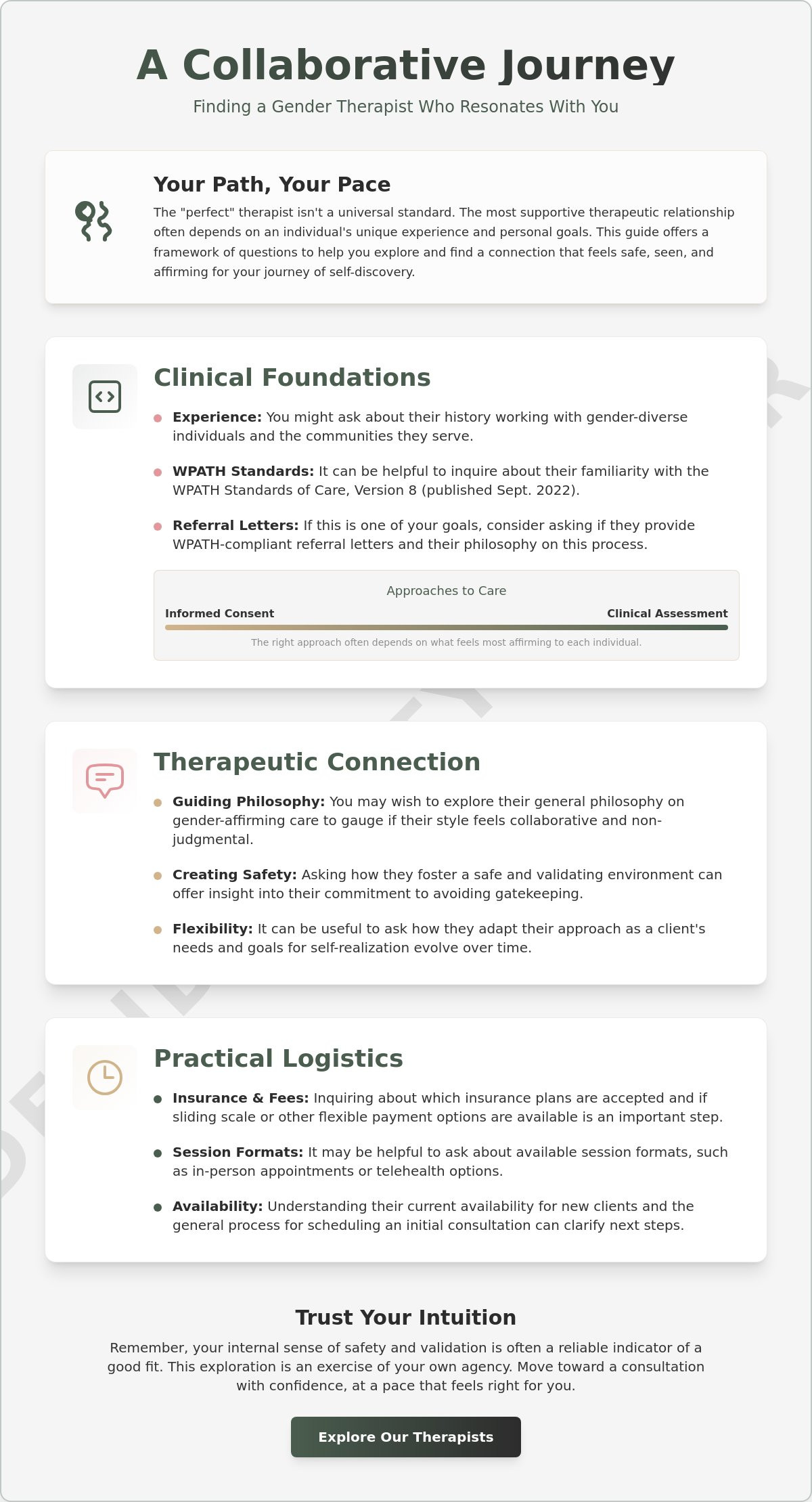
Finding a clinician who possesses both the heart and the technical expertise to support your journey is a vital step. While clinical resumes don't tell the whole story, specific questions to ask a gender therapist can help you understand their foundational approach. You might begin by asking how long they've worked with gender-diverse individuals and if they're familiar with the latest WPATH Standards of Care, currently version 8, published in September 2022. This knowledge often informs how they approach medical documentation and clinical advocacy. If your goals include gender-affirming procedures, it's helpful to clarify if they provide WPATH-compliant referral letters. Some people prefer an informed consent model that prioritizes their autonomy, while others might find value in a more traditional clinical assessment. Neither path is inherently better; the right choice often depends on each individual's experience and what feels most affirming to them.
The therapeutic landscape is diverse, and how a clinician views their role can significantly impact your progress. You may want to ask if their practice is primarily focused on gender counseling or if it's one of many general areas they cover. Understanding their philosophy on gender-affirming care helps you gauge if their style will feel like a steady, guiding hand or a more rigid clinical structure. If you're ready to explore how these clinical foundations can support your specific path, you might consider looking at our team of specialists to see whose background resonates with you.
Specialized Modalities: EMDR and Voice Therapy
Sometimes, the journey involves more than traditional talk therapy. If you've experienced gender-related trauma or high levels of dysphoria, you might ask if the therapist offers EMDR therapy. This specialized approach can help process difficult memories in a way that feels safe and regulated. Similarly, for those exploring their vocal expression, asking about speech therapy for voice transition is a proactive step. These services are often integrated into a broader therapeutic plan, but their availability depends on the clinician's specific training. Asking how these tools are used allows you to decide if they align with your current needs for self-discovery.
Continuing Education and Community Involvement
The language and needs of the LGBTQ+ community are constantly evolving. It's helpful to ask how a therapist stays updated on these changes and if they participate in ongoing professional consultation. A clinician's involvement in community-oriented work or advocacy can also be a meaningful indicator of their commitment to lived experience. You might also inquire about their experience with intersectionality, especially if your identity involves diverse cultural or racial backgrounds. Perspectives on these topics vary, and finding a therapist who acknowledges the complexity of your whole self is essential for creating a secure, non-judgmental environment.
Exploring the Therapeutic Connection: Subjective Questions for Your Comfort
Beyond the clinical credentials discussed earlier, the emotional resonance you share with a provider is often the most significant factor in your progress. Many people carry a valid fear of being "gatekept" or judged during their most vulnerable moments of self-exploration. This anxiety is understandable, especially if you've faced systemic exclusion in the past. When you're identifying questions to ask a gender therapist, it's helpful to look for a sense of radical acceptance. A clinician's personal philosophy on gender identity can greatly influence the therapeutic environment. You might ask how they view the process of self-realization or if they see themselves as a collaborator rather than a traditional authority figure. This shift in perspective can help create a secure space where you feel truly acknowledged.
The pace of your work together should mirror your own needs. Some individuals prefer a therapist with a quiet resilience and an unhurried rhythm, while others might look for a more active, conversational style. Gauging a therapist's warmth and patience during an initial call can give you a glimpse into how they will handle your unique story. It's often helpful to ask, "How do you support clients who are still unsure about their specific goals?" This invites the therapist to demonstrate their capacity for holding space without rushing you toward a conclusion.
Vibe and Communication Style
The way a therapist communicates can be just as important as the advice they offer. Do they use inclusive language that makes you feel respected and seen? It's also revealing to ask how they handle mistakes, such as misgendering or using outdated terminology. A therapist who can acknowledge an error with humility and grace often fosters a deeper sense of trust. You might also inquire if a typical session follows a rigid structure or a gentle flow. Whether a specific style is "good" or "bad" often depends on each individual's experience and what makes them feel most at ease. If you're curious about how our team approaches these conversations, you can learn more about our specialized therapists and their personal styles.
The "Right Fit" Test
Ultimately, the success of your therapeutic journey is highly subjective. Outcomes are frequently dependent on personal context rather than universal rules or clinical benchmarks. You are the expert on your own life and lived experience; a therapist is there to act as a bridge between your current reality and your future self. If the initial connection doesn't feel supportive, it's okay to move on and explore other options. Prioritizing your own agency is a vital part of the healing process. When you feel ready to take that next step, our scheduling page is a simple way to begin your search for a partner who aligns with your path.
Practical Logistics for Arizona Residents: Phoenix, Tucson, and Beyond
When you're looking for support in the Valley or the Old Pueblo, local logistics can feel like a significant hurdle. Whether you're searching for questions to ask a gender therapist to clarify their physical location or their virtual presence, your comfort with the setting is a priority. Some individuals find that a physical office in Phoenix or Tucson provides a sense of groundedness and stability. Others may prefer the flexibility of digital spaces. You might ask if a provider offers a hybrid model that allows you to transition between formats as your needs change. If you're ready to see who is available in your area, you can view our Phoenix and Tucson therapists to explore their current openings and session styles.
Financial accessibility is another area where perspectives vary based on the person. Many therapists in Arizona operate as out-of-network providers. This means you might pay a fee upfront and seek reimbursement from your insurance company later. It's helpful to ask if a clinician provides "superbills" or if they offer sliding scale options based on your income. Because of the evolving regulatory environment, such as the Arizona Board of Behavioral Health Examiners' requirement for detailed informed consent documents by January 1, 2027, you have the right to clear communication about the professional nature of your therapeutic relationship from the very start.
Navigating Telehealth in Arizona
Telehealth has become a dependable resource for those in more remote parts of the state or those with demanding schedules. When interviewing a therapist, you might ask about the security and privacy of their specific online platform. Confirming that a clinician is licensed to practice within the state of Arizona is also a vital step for your protection. The experience of virtual support can feel different for everyone. For some, the comfort of their own home creates a secure environment for deep emotional work. For others, the lack of a neutral physical space might feel less supportive. This choice depends on each individual's experience and what helps them feel most acknowledged.
Family and Group Therapy Options
Your journey doesn't have to be a solitary one. If you're a parent or partner, you might inquire about family therapy or specialized support for youth. In the Phoenix and Tucson areas, group therapy can also offer a sense of community and shared resilience. You might ask a potential therapist how they facilitate these sessions and how they handle the involvement of loved ones in your individual progress. These options can act as a bridge between your personal growth and your social support systems. If you're looking for a partner to help you navigate these choices, you can explore our gender counseling services to find a path that honors your unique family dynamic.
Moving Toward Self-Discovery: Your Next Steps in the Journey
Prioritizing your own agency is the most vital part of this process. As you reflect on the questions to ask a gender therapist, remember that your subjective comfort is a valid guide. This search isn't just a clinical task; it's a meaningful endeavor that marks the beginning of your self-realization. Finding a partner for your care is a dynamic and positive experience. It allows you to practice setting boundaries and identifying what makes you feel acknowledged. Whether a clinician is the right fit often depends on each individual's experience and their current emotional capacity. We believe that you're the expert on your own life, and the right therapist will act as a bridge to your future self.
Taking a small, manageable step can help lower the anxiety that often accompanies a new beginning. You don't have to commit to a long-term plan right away. A brief consultation is a gentle way to test the waters and see how a therapist's rhythm aligns with your own. The Gender Identity Center remains a permanent and dependable resource for those in Arizona, offering a steady, guiding hand as you explore your path. We're here to provide a secure environment where your lived experience is valued as much as professional expertise.
Preparing for Your First Consultation
When you prepare for an initial meeting, keep the pressure low. You don't need to bring a detailed history or a list of specific outcomes. Instead, you might bring a simple notebook with your preferred questions to ask a gender therapist to help guide the conversation. Using these notes can provide a sense of stability when you feel vulnerable. The goal of a consultation is a mutual discovery process where both you and the therapist explore if your paths align. It's perfectly okay to focus on the "vibe" and how safe you feel in the conversation. You aren't being interviewed; you're exploring a potential partnership.
Booking Your Safe Start
Reaching out for support should feel like an invitation to grow rather than a hurdle to overcome. At the Gender Identity Center, we've designed our process to be as accessible as possible for Phoenix and Tucson residents. We prioritize creating an immediate sense of validation from the very first interaction. Our team is committed to intersectional advocacy and radical acceptance, ensuring that you feel seen and respected. If you're ready to begin this chapter of your journey in a non-judgmental environment, you can schedule your initial session with our affirming team today. We look forward to walking alongside you at a pace that feels right for you.
Embracing Your Path to Self-Realization
Choosing a supportive partner for your care is a significant step toward living authentically. By preparing specific questions to ask a gender therapist, you've already begun the work of centering your own needs and agency. Whether you require WPATH-compliant referral letters or specialized support like EMDR and Speech Therapy, the right fit often depends on each individual's experience and their unique goals. We understand that this process is deeply subjective, and we're here to offer a steady, guiding hand that respects your pace.
With physical offices in Phoenix and Tucson, alongside Arizona-wide telehealth options, finding a secure environment has never been more accessible. We invite you to explore a partnership that values your lived experience as much as clinical expertise. You don't have to navigate these transitions alone; we're ready to provide the radical acceptance you deserve. Begin your journey with a compassionate advocate; book your session at the Gender Identity Center today. Your future self is waiting to be acknowledged, and we're honored to act as a bridge to that destination.
Frequently Asked Questions
How do I know if a gender therapist is truly affirming or just "trans-friendly"?
An affirming therapist actively centers your self-realization as the ultimate goal, while a trans-friendly one might simply be open to working with you without specialized expertise. This distinction often depends on each individual's experience and what they require to feel seen. You might look for a clinician who uses inclusive language and demonstrates a deep understanding of intersectionality. Asking how they stay updated on community needs can help you gauge their level of commitment to active support.
Can I ask a therapist about their own gender identity or lived experience?
You are always welcome to ask about a therapist's lived experience, though their decision to share is a personal professional boundary. Some clients find that shared identity creates an immediate sense of safety, while others prioritize clinical expertise. Whether this information is necessary for a successful partnership depends on the person and what helps them feel most acknowledged. A non-judgmental therapist will respect the question even if they choose not to disclose.
What should I do if I feel like my therapist is gatekeeping my transition?
The most empowering step is to address your feelings directly in session if you feel a therapist is gatekeeping. A collaborative therapist will listen to your concerns and work to align their approach with your personal goals. If the environment remains restrictive, exercising your agency to find a new provider is a valid choice. Your path to self-discovery should feel like a progression, not a series of barriers that restrict your access to care.
How many sessions does it usually take to get a WPATH referral letter in Arizona?
The number of sessions required for a referral letter varies based on the clinician's philosophy and your specific needs. Since the release of WPATH Standards of Care version 8 in September 2022, many providers have moved toward more streamlined, affirming models. Some may provide a letter after one or two sessions, while others prefer a longer period of exploration. This depends on each individual's experience and the complexity of their unique journey.
Is online gender therapy as effective as meeting in person in Phoenix?
Online gender therapy can be just as effective as in-person sessions, provided the platform used is secure and private. For many in Phoenix or more remote parts of Arizona, telehealth offers a convenient way to access specialized care without travel stress. The "best" format is subjective. Some people feel more resilient in their own home, while others find that a physical office provides a necessary sense of stability and separation.
What if I am still questioning my gender and not ready to transition?
Gender counseling is a supportive space for exploration, even if you are unsure about transition or not ready for medical steps. You don't need a fixed destination to benefit from therapy. A wise mentor will act as a steady, guiding hand while you navigate your identity at your own pace. This stage of self-discovery is a meaningful endeavor in itself, and a secure environment can help lower the defenses of those who are still questioning.
Do gender therapists in Arizona take insurance for WPATH assessments?
Some gender therapists in Arizona accept insurance for assessments, though many specialists operate as out-of-network providers. This means you might pay the full fee and seek reimbursement from your insurance company afterward. It's helpful to include this in your questions to ask a gender therapist during your first call. Because insurance coverage varies so much, checking your specific plan's requirements for gender-affirming care is always a proactive step.
Can a gender therapist help me with voice transition or speech therapy?
Yes, some specialized providers offer speech therapy specifically for voice transition as part of their clinical services. This service is often integrated into a broader plan for self-realization and personal growth. If vocal expression is a priority for you, it's helpful to ask if the clinician has specific training in this area. Whether this is a necessary component of your care depends on the person and their personal goals for their transition journey.