
How to Support Your Transitioning Wife in Arizona: A Compassionate Guide

What if supporting your wife through transition begins not with having the perfect words, but with listening and letting her set the pace? If the question on your mind is “how to support my transitioning wife arizona,” it’s understandable to feel uncertain about what to ask, how your relationship may change, or where your own feelings fit.
You don’t need every answer before you can show care. Your wife’s experience is her own, and what feels supportive may depend on her preferences and change over time. Staying curious, asking what she needs, and making room for honest conversations can help you remain connected without taking over her choices.
This guide offers practical ways to communicate with care, respect your wife’s pace, and look after your relationship while making room for change. It also covers how individual or family therapy in Arizona may provide space for reflection, depending on what feels right for each of you.
Key Takeaways
- Start by listening. Your wife’s transition is personal, and asking what it means to her can help you avoid assumptions.
- Use a gentle conversation sequence: ask permission, listen, reflect, clarify, and agree on next steps together.
- Make room for your own feelings, too. Uncertainty, grief, relief, and hope can all be part of your experience.
- Discuss names, pronouns, privacy, and introductions in different settings, then check in as preferences change.
- Individual or family therapy may offer space for communication and reflection, depending on what feels useful to you.
Supporting Your Transitioning Wife in Arizona Starts with Listening
Wanting to support your wife is a caring place to begin, even if you’re unsure what to say or do next. Transition can mean different things to different people. It may involve social, medical, legal, or personal changes, or a combination of these. There’s no single path that applies to everyone. A neutral overview of the process of gender transition can offer context, but your wife’s own words are the best guide to what her experience means to her.
Start with four steady practices: listen, ask, respect, and follow through. A supportive partnership is care guided by the needs she tells you she has, not a plan made on her behalf. This leaves room for connection and change without asking you to predict what she’ll want at every stage.
Ask what support feels helpful to her
You might ask, “Would it help more if I listened, helped with something practical, gave you space, or talked this through with you?” A specific, open question can be easier to answer than “What do you need?” if she’s still sorting through her thoughts. Listen without rushing to solve the problem. Her preferences may shift, so check in again and adjust together.
Respect her words, identity, and boundaries
Use the name and pronouns she asks you to use. Before sharing personal information with relatives, friends, or coworkers, talk about what she wants kept private and what, if anything, she’s comfortable sharing. Agreement in one conversation doesn’t mean you can speak for her in another setting. If you’re unsure, pause and ask rather than deciding on her behalf.
Everyday choices can build trust when you follow through consistently. Support might mean using her name at home, checking how she wants to be introduced to someone, or simply being present while she talks. The details depend on each individual’s experience, so don’t treat one helpful gesture as a permanent answer. Keep listening as you learn what feels respectful and reassuring in different moments.
How to Talk About Transition Without Making Assumptions
Stay curious about what transition means to your wife instead of assuming it includes particular medical, social, or legal changes. Respectful communication begins with asking, not presuming. The American Psychological Association’s overview of understanding transgender people may offer helpful background, while her perspective remains central to your conversations.
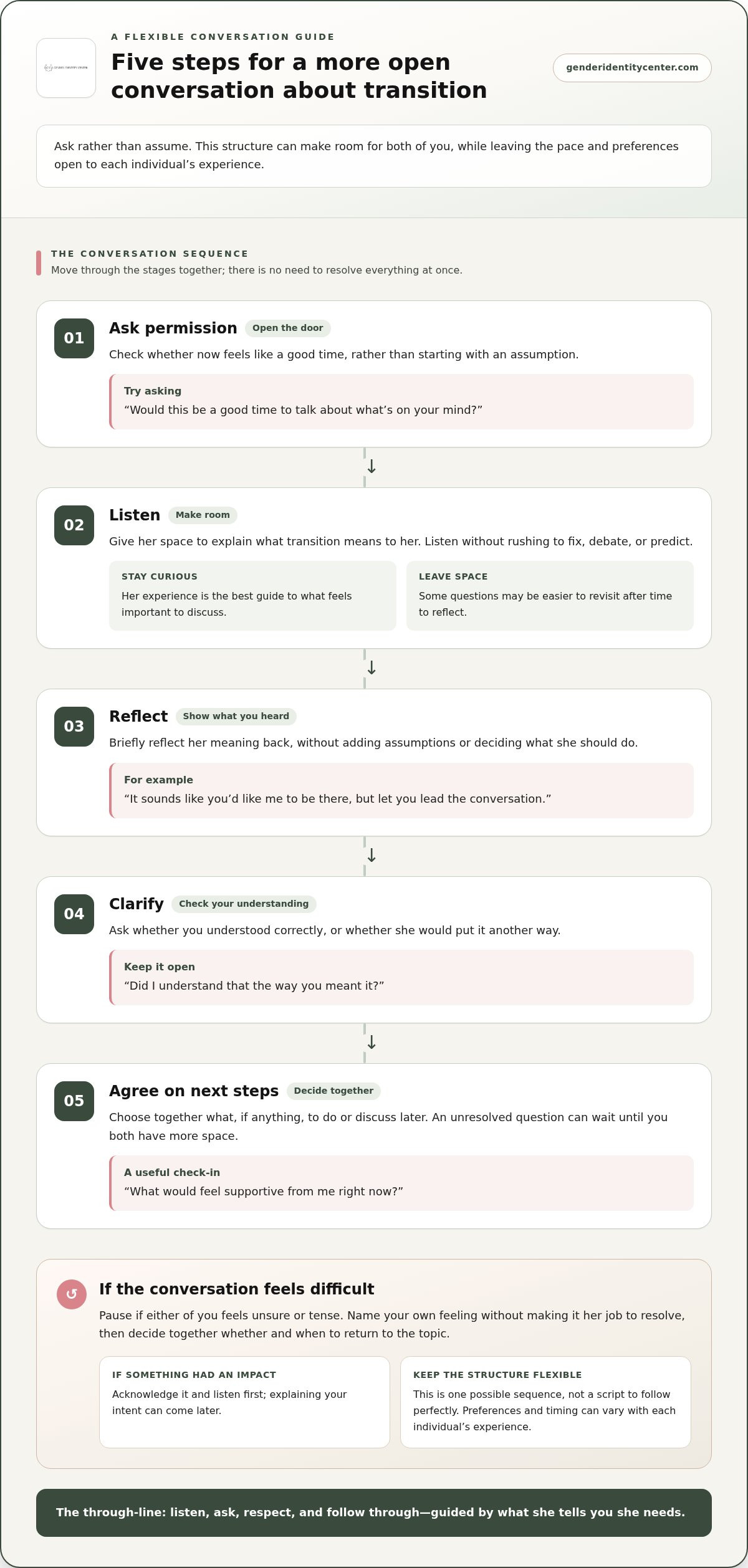
A simple structure can help you listen without turning the discussion into an interview or trying to resolve everything at once:
- Ask permission: “Would this be a good time to talk about what’s on your mind?”
- Listen: Give her room to explain without jumping in to fix, debate, or predict.
- Reflect: Briefly share what you heard, such as, “It sounds like you’d like me to be there, but let you lead the conversation.”
- Clarify: Ask whether you understood correctly or if she’d put it another way.
- Agree on next steps: Decide together what, if anything, you’ll do or discuss later.
This isn’t a script you have to follow perfectly. It’s one way to make space for both of you, and you can adapt it to what feels natural in your relationship.
Questions that invite conversation instead of pressure
Open-ended questions can help you understand her preferences without guessing. Try, “What would feel supportive from me right now?” or “Are there topics you’d like to talk about, and anything you’d rather keep private?” Let her know she doesn’t need to answer immediately. Some questions may feel easier to revisit after she’s had time to reflect.
What to do after a difficult conversation
If either of you feels unsure or a conversation becomes tense, pausing may help. Name your own feeling without making it her job to resolve, then agree on whether and when to return to the subject. If something you said had an impact, acknowledge it and listen first. For example: “I can see that landed differently than I intended. Would you tell me what felt difficult?” Explaining your intent may have a place later, but it doesn’t need to come before hearing her experience.
One conversation doesn’t have to settle every concern. You could agree to return to an unresolved question when you both have more space for it. If a supportive setting for exploring communication feels useful, gender-focused therapy may offer room for reflection at your own pace.
Your Feelings Matter Too, Without Making Her Transition Your Responsibility
Your wife’s transition may bring up feelings you didn’t expect. You might experience uncertainty, grief, relief, hope, or several emotions at once. These reactions are personal experiences, not proof that either of you is wrong. You can care about your wife and the relationship while also needing time and space to understand your own response.
Support doesn’t require you to suppress every concern or decide the future of your marriage right away. Her identity and transition choices are hers, while your feelings and questions also deserve thoughtful attention. The Gottman Institute’s perspective on when your partner comes out as trans may offer another starting point for reflecting on how partners can experience this moment differently.
Separate your feelings from decisions about her identity
Try naming what you feel without making your wife responsible for changing it or reassuring you on demand. You might write privately, “I feel uncertain about what will change, and I need time to understand that.” Journaling or talking with a trusted, affirming support person may help you sort through feelings before bringing them into a conversation together. Her identity and transition decisions aren’t negotiations for approval. You can reflect on your feelings while respecting her agency.
Make room for the relationship to keep developing
You don’t have to predict what transition will mean for your marriage or intimacy. Those experiences vary from person to person. Instead, notice what helps you feel connected now, such as sharing a meal, keeping a familiar routine, or making time to talk about questions as they arise. These small points of connection don’t need to answer every larger question.
You and your wife may adapt at different paces. You can acknowledge that without treating either person’s feelings as a verdict on the relationship. You might say, “I’m still working through some uncertainty, and I want to stay connected while I do.” If your feelings seem difficult to hold on your own, individual therapy may offer space for personal reflection. Family therapy may be an option if you both want support exploring communication. Seeking support doesn’t need to direct her transition or determine the relationship’s future.
Practical Ways to Support Your Wife Day to Day in Arizona
Support often takes shape in ordinary moments: deciding how to introduce one another, checking what feels comfortable in a particular setting, or making room for a private conversation later. Agree together on names, pronouns, privacy, and introductions with relatives, friends, or coworkers. Her preferences might differ by setting or change over time, so revisit the conversation rather than assuming one agreement covers every situation.
Build small, specific habits of support
A few thoughtful check-ins can help you respond to what she wants in the moment. Before offering to attend an appointment, you might ask, “Would you like me to come with you, or would you rather go on your own?” In social settings, follow her lead about whether she wants you to correct someone who uses the wrong name or pronouns. You can also agree on a quiet way to check in privately, rather than asking her to explain personal matters in front of others.
Everyday support doesn’t have to be elaborate. A brief conversation before a family gathering might clarify how she’d like to be introduced and what she wants kept private. These details are personal and may vary from one situation to another. For additional context about gender-focused support in Phoenix, see this guide to gender identity therapy in Phoenix.
Find space for your own questions in Arizona
You may also want a separate place to reflect on your feelings and communication needs. Individual therapy can offer that space, while family therapy may be relevant if you and your wife want to explore relationship concerns together. Neither is a requirement, and the right format depends on each person’s preferences. The Gender Identity Center offers individual and family therapy in Arizona, with services in Phoenix and Tucson and through telehealth. Explore its therapy and counseling options to learn more.
Therapy can support reflection without directing your wife’s transition or deciding what the relationship should become. If you’d like to take a next step, explore scheduling options for a conversation about individual or family therapy.
When Arizona Couples or Family Therapy May Offer Support
Therapy can provide an optional, nonjudgmental space to explore communication, relationship needs, and each person’s experience. It doesn’t need to be a requirement or a way to direct your wife’s transition. For couples thinking through how to support one another, family therapy may offer a setting to slow down, talk through questions, and reflect on what feels important to each of you.
There isn’t one format that suits every couple. Individual therapy may give either partner space to focus on personal feelings, while family therapy can make room for shared conversations. You might choose one approach, another, or neither for now. What feels useful depends on each individual’s experience and preferences.
What family therapy can make room for
In family therapy, partners may explore communication patterns, boundaries, and ways to stay connected as circumstances change. Each person can bring different hopes or concerns, and a supportive conversation doesn’t require you to agree on every detail. The focus can be understanding one another and considering what respectful communication looks like for your relationship. The process and its value depend on each individual’s experience.
Taking a first step at your own pace
You might talk together about whether shared support or individual space feels more comfortable. If you’re both open to it, discuss what you hope to explore before deciding on a format. The Gender Identity Center offers gender-focused individual and family therapy in Phoenix and Tucson, as well as through telehealth. These services can support reflection and communication without setting the pace or direction of anyone’s transition.
If broader care questions are part of what you’re discussing, this guide to identity, hormones, and healthcare may provide additional context. Therapy is one possible source of support, not a step every couple has to take. If counseling feels useful for you or your family, you can explore scheduling options. There’s room to consider support when the time feels right and move at a pace that respects everyone involved.
Keep Building Connection at a Pace That Feels Right
Supporting your wife through transition doesn’t require perfect words or a complete plan. Listening, asking rather than assuming, and respecting her choices can help you stay connected while you both make room for change. Your feelings matter, too. You can seek space to reflect without making her responsible for them or for deciding the future of your relationship.
What helps can vary between people and over time. Gender-focused individual, family, and group therapy may offer space for communication and reflection, depending on what feels useful to you. The Gender Identity Center offers services in Phoenix and Tucson, as well as through telehealth.
There’s no single pace or format that fits every couple. If support feels helpful, explore the Gender Identity Center’s services and consider scheduling when the time feels right. Each thoughtful conversation can be a next step toward understanding, care, and connection.
Frequently Asked Questions
How can I support my wife during her transition?
Support her by listening, asking what feels helpful, and respecting the choices she shares with you. Transition can mean different things to different people, so avoid assuming what changes she wants or needs. Agree together on how to handle names, pronouns, privacy, and introductions in different settings. Small, consistent actions and open check-ins can help you adapt as her preferences evolve.
What should I say to my wife if she tells me she is transitioning?
You might say, “Thank you for telling me. I care about you, and I want to understand what this means for you.” Then ask whether she’d like you to listen, talk, or give her time. You don’t need every answer in that moment. The conversation can continue later, and asking what she’s comfortable discussing can help you respond without making assumptions or putting pressure on her.
Is it normal to have complicated feelings when my wife transitions?
It can be understandable to experience uncertainty, grief, relief, hope, or several feelings at once. Those emotions describe your experience; they don’t prove that you or your wife is wrong. You can make room for your feelings without asking her to change her identity or reassure you on demand. Journaling, talking with a trusted and affirming person, or considering individual therapy may give you space to reflect.
How do I know what name and pronouns to use for my wife?
Ask your wife what name and pronouns she wants you to use, and whether her preference differs across settings or with particular people. You could also ask how she’d like you to respond if someone uses different language. Discuss privacy before sharing information with relatives, friends, or coworkers. If you’re uncertain in a specific moment, a private check-in may be more respectful than making an assumption or speaking for her.
Can couples therapy help when one partner is transitioning?
Family therapy may offer a space to explore communication, boundaries, and relationship needs together. Each partner can bring their own questions, hopes, and concerns, and therapy doesn’t have to direct anyone’s transition or decide the relationship’s future. Whether shared therapy feels useful depends on each person’s experience and preferences. Individual therapy may also be an option if one or both partners want separate space to reflect.
Where can my wife and I find gender-affirming therapy in Arizona?
The Gender Identity Center offers gender-focused individual, family, and group therapy in Phoenix and Tucson, as well as through telehealth. You and your wife might consider whether individual or shared support feels more comfortable, knowing there’s no universal right format. Counseling can provide space to explore communication and personal experiences at your own pace. Therapy may be one possible source of support, not a required step.