
Overcoming Fear of Social Transition: Navigating Your Path to Authenticity

What if the anxiety you feel about showing your true self to the world isn't a sign that you're doing something wrong, but rather a natural response to a deeply personal evolution? It's incredibly common to feel "stuck" between the version of yourself that feels safe and the person you know yourself to be. You might worry about how coworkers will react or feel a heavy weight when thinking about family gatherings. These feelings are valid, and it's helpful to remember that overcoming fear of social transition is a complex, non-linear process. This journey depends on each individual's experience, and there's no single right way to move forward.
We're here to explore a gentle, subjective framework that helps you understand these fears without the pressure to "crush" them. You deserve a path that respects your specific needs and honors your unique timeline. In the following sections, we'll discuss how to build a manageable plan for coming out and look at ways to reduce social anxiety by centering your own agency. Whether you take small steps or larger ones, your pace is the correct one for your life.
Key Takeaways
- Understand that fear is often a valid signal of safety needs rather than a barrier, allowing for a more compassionate approach to your personal growth.
- Recognize that the timeline for aligning your external life with your internal identity is entirely subjective and depends on each individual's experience.
- Discover how gender counseling can serve as a secure environment to process anxieties at a pace that feels comfortable and sustainable for you.
- Learn practical strategies for overcoming fear of social transition by identifying "safe harbors" for gradual experimentation and authentic expression.
- Explore how professional support can facilitate a smoother identity journey while centering your agency as the expert on your own life.
Understanding the Fear of Social Transition
Social transition is not a rigid checklist or a pre-defined destination. Instead, it is a deeply subjective process of aligning your external life with your internal identity. This journey might include changing your name, updating your pronouns, or shifting how you present yourself in social spaces. Because this process involves the way you interact with the world, feeling a sense of apprehension is a natural response to such a significant environmental change. Overcoming fear of social transition starts with the realization that your feelings are valid responses to a world that isn't always easy to move through.
The way this fear manifests is unique to you. For some, it feels like a quiet hesitation before entering a room; for others, it is a paralyzing weight that makes even small changes feel impossible. For those living in Arizona, specific environmental factors can influence this emotional state. Local community attitudes or shifting legal landscapes can create real concerns about physical and emotional safety. It is important to acknowledge that your level of comfort depends on each individual's experience and their specific surroundings. Whether you are in a bustling part of Phoenix or a smaller community, your perception of risk is a personal truth that deserves respect.
The Intersection of Dysphoria and Social Anxiety
It's common for gender dysphoria to mimic or even intensify symptoms of social anxiety. When your internal sense of self feels disconnected from how others perceive you, you might experience a state of hyper-vigilance in public spaces. You may find yourself constantly scanning for cues of acceptance or potential rejection. This subjective experience can make a trip to the grocery store feel like an exhausting performance. Because these feelings vary based on your personal context, what feels manageable one day might feel overwhelming the next. Understanding that these two experiences often overlap can help you approach yourself with more gentleness.
Why Fear is a Valid Signal, Not a Failure
We often treat fear as something to be "beaten," but it is actually a sophisticated tool for survival. When you consider gender transition, your brain may interpret the social unknown as a potential threat. Reframing fear as your brain’s way of prioritizing safety allows you to see it as a protective ally rather than a personal failure. There is no "correct" amount of fear to feel, and experiencing it doesn't mean you aren't ready to move forward. Fear serves as an internal compass that prioritizes your physical and emotional safety during periods of significant identity shifts. By acknowledging this signal, you can begin the work of overcoming fear of social transition at a pace that feels secure for you.
The Subjectivity of the Transition Timeline
The idea that social transition is a single, explosive event is a myth that often creates unnecessary pressure. In reality, the timeline for sharing your identity with the world is a subjective journey. There is no universal order of operations. Some might choose to change their name legally before ever coming out at work; others may prefer to test the waters with close friends for years. This pace depends on each individual's experience and their unique sense of safety. For those living in Arizona, the environment can play a significant role in this decision. A person in a high-density area like Phoenix might feel a different level of visibility compared to someone in a more rural part of the state, which naturally impacts their chosen speed.
Moving Beyond the "All-at-Once" Narrative
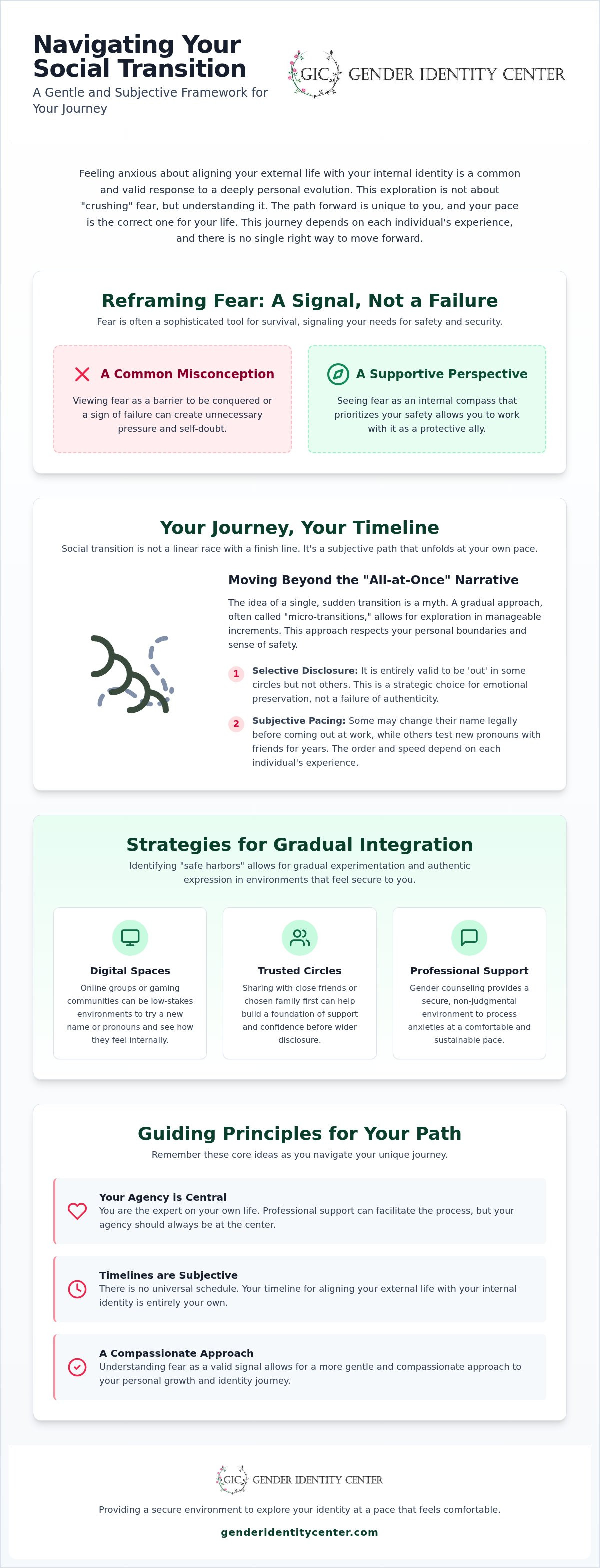
You don't have to do everything today. Micro-transitions offer a way to explore your identity in smaller, more manageable increments. Digital spaces, such as private social media groups or online gaming communities, provide a low-stakes environment to test new names or pronouns. This allows you to gather data on how these changes feel internally before bringing them into your physical social circles. It's also perfectly valid to be "out" in some circles but not others. This selective disclosure isn't a failure of authenticity. It is a strategic choice for emotional preservation.
Identifying Your Personal Boundaries
Determining which milestones feel urgent and which feel daunting is an essential part of overcoming fear of social transition. You might find that symptoms similar to Social Anxiety Disorder arise when you think about specific interactions. This is a signal to check in with yourself. Your boundaries are flexible and can shift as you gain confidence or as your environment changes. If you feel that the weight of these decisions is becoming difficult to manage alone, you might find it helpful to connect with a specialized therapist who can help you navigate these subjective choices.
By centering your own comfort, you reclaim the power over your story. Overcoming fear of social transition isn't about rushing toward a finish line. It's about honoring your needs at every step of the journey. Your path doesn't have to look like anyone else's to be valid and meaningful.
Therapeutic Approaches to Navigating Transition Anxiety
Engaging with professional support can be a transformative step when you are focused on overcoming fear of social transition. Unlike traditional models that might suggest you simply "face your fears" through exposure, specialized therapy acknowledges that the social risks you perceive are often rooted in real-world experiences. By seeking gender identity therapy in Phoenix, you enter a secure environment designed specifically for exploration. In this space, the clinical focus is not on pushing you toward a specific outcome, but on providing the validation you need to move at your own pace. This therapeutic setting serves as a safe harbor where you can untangle your feelings without the weight of external judgment.
The benefits of this process are highly subjective and depend on each individual's experience. You might find that talking through your fears with a clinician helps you identify the specific origins of your anxiety and develop personalized ways to manage it. We view therapy as a true partnership where you remain the expert on your own life. Our specialized therapists act as steady guides, offering tools and perspectives that honor your unique identity while helping you build the resilience needed for your journey.
Utilizing EMDR for Transition-Related Trauma
Many individuals find that past negative social interactions leave a lasting impact on their current confidence. Utilizing EMDR (Eye Movement Desensitization and Reprocessing) can be a helpful way to address these layers of transition-related trauma. This approach allows you to process specific memories that may be fueling your present anxiety in social settings. EMDR serves as a specialized tool for desensitizing the body's "fight or flight" response to perceived social threats. By lowering the intensity of these emotional triggers, you may find it easier to consider new social steps with a greater sense of internal calm and stability.
The Role of Individual Gender Counseling
Individual counseling provides a dedicated space to separate your internal sense of self from the external expectations of family, coworkers, or society. It can be incredibly grounding to have a neutral, professional advocate who understands the nuances of identity and the complexities of overcoming fear of social transition. For local residents, accessing transgender counseling in Tucson offers a way to connect with support that is sensitive to the specific community context of Arizona. Whether you choose in-person visits or the flexibility of telehealth, the goal is always to facilitate your progress in a way that feels safe, authentic, and entirely within your control.
Practical Strategies for Gradual Social Integration
Taking the first steps toward authenticity doesn't require a public announcement to everyone you know. Instead, you might find it helpful to identify "safe harbors," which are specific environments where social experimentation feels less risky. This subjective process of selecting a "first circle" for disclosure allows you to build a foundation of support at your own pace. Overcoming fear of social transition often involves recognizing that you are in control of who gets to see your evolution and when. By prioritizing your comfort, you can manage the expectations of others without feeling responsible for their immediate reactions. Their responses are often a reflection of their own internal processing rather than a definitive judgment of your truth. This depends on each individual's experience and the existing dynamics within their social circles.
Utilizing local transgender resources in Arizona can provide a sense of community and safety during this period of growth. Whether you are looking for inclusive spaces in Phoenix or supportive networks in Tucson, having access to local knowledge is invaluable. These resources offer a way to connect with others who understand the unique social climate of the state, providing a layer of protection as you navigate new interactions. Your path to integration is yours to define, and these tools are here to support your agency, not to dictate your timeline.
Small Steps in Affirming Environments
Small successes can build the resilience needed for larger milestones. You might choose to try out a new name at a local coffee shop where the interaction is brief and low-stakes. For some, participating in an online community offers a way to practice authentic expression before bringing it into physical spaces. Additionally, some individuals find that engaging in gender-affirming speech therapy helps them feel more confident and grounded in social settings. These incremental changes allow you to gather information about what feels right for you without the pressure of a permanent commitment. Each small interaction serves as a building block for your self-assurance.
Building a Sustainable Support Network
Support can take many forms, from chosen family and therapists to online peers. You might explore community groups in Phoenix or Tucson to find others who are navigating similar paths. This "peer-paralleling" allows you to watch how others handle their journeys, which can provide a sense of perspective and reduce feelings of isolation. Recognizing that your support network is a flexible entity is key; it can grow and change as your needs evolve. If you feel ready to discuss your specific goals in a professional and affirming setting, you can schedule a session to begin building your personalized plan for social integration. You don't have to carry the weight of these transitions alone.
Finding Your Path with Professional Support
Acknowledging that the weight of fear can sometimes feel too heavy to carry alone is a courageous act of self-care. While peer support is a vital component for many, professional guidance offers a different kind of stability. This partnership can help. It facilitates a smoother identity and healthcare journey by providing a structured yet flexible environment for exploration. Specialized clinicians understand that overcoming fear of social transition is a deeply personal endeavor that cannot be rushed or forced into a one-size-fits-all model. For those considering medical steps, professional support includes the provision of WPATH referral letters. This ensures your care meets recognized standards while honoring your subjective experience.
Arizona residents can explore various scheduling options to find the type of support that fits their current needs. Whether you prefer the privacy of individual sessions or the community feel of a group setting, the goal is to create a secure environment where you feel acknowledged. This depends on each individual's experience, and what feels supportive for one person might look different for another. There is no single correct way to seek help.
The Value of Group Therapy
Hearing others share their subjective experiences of fear can significantly reduce the sense of isolation that often accompanies transition. Group therapy provides a moderated, clinical environment where social interaction can be practiced in a low-risk setting. It is a space to witness others navigating similar societal challenges in real-time. This can provide a sense of perspective that is hard to find alone. It is always important to remember that group therapy is an invitation, never an obligation. You have the agency to decide if and when this type of communal sharing feels right for your path.
Choosing the Right Support for You
Finding a provider who feels like a steady, guiding hand is essential for your emotional safety. You might consider asking a potential therapist about their specific approach to social transition. How do they handle the nuances of identity? Feeling a "click" or a genuine sense of safety with a provider is often more important than any specific clinical technique. Perspectives vary based on the person, so take the time to ensure the professional relationship feels respectful and affirming. Your journey is yours to define, and we are here to support your pace. Overcoming fear of social transition is a dynamic process, and having a compassionate advocate in your corner can make the road ahead feel much more manageable.
To see how community-based healthcare providers like the Quality Comprehensive Health Center prioritize inclusive and affirming care, you can learn more about their mission and services.
Embracing Your Unique Journey Toward Authenticity
Moving toward a more authentic version of yourself is a deeply personal endeavor that unfolds in its own time. We've explored how fear often serves as a protective signal rather than a barrier, and why your timeline for change is entirely subjective. Whether you find comfort in small digital explorations or prefer a more structured approach to disclosure, the pace you choose is the correct one for your life. Remember that overcoming fear of social transition is a dynamic process. This journey depends on each individual's experience and the specific social environments you navigate every day.
You don't have to navigate these complexities without a steady hand to guide you. Our team provides specialized gender-affirming therapy in Phoenix and Tucson, alongside flexible telehealth options for all Arizona residents. We offer a secure environment for exploration, including the provision of WPATH-compliant referral letters for those who require them. Start your journey at your own pace—schedule a consultation with us today. Perspectives vary based on the person, and we are here to honor your agency as you explore the many possibilities of your future self.
Frequently Asked Questions
Is it normal to be terrified of transitioning socially?
Yes, feeling a significant amount of apprehension is a very common experience for many people. Overcoming fear of social transition is often a process of acknowledging that your brain is trying to keep you safe in the face of the unknown. This depends on each individual's experience and their specific social environment. Many people find that their anxiety levels fluctuate as they explore different aspects of their identity in their own way.
Can therapy help if I am too scared to even talk about my identity?
Therapy can be incredibly helpful even if you aren't ready to speak your truth out loud yet. A specialized clinician provides a non-judgmental environment where you can sit with your feelings in silence or explore them through indirect conversation. This safe harbor allows you to build a sense of internal security at a pace that feels sustainable for you. You're always the expert on your own life and readiness.
How do I know if I am ready to transition socially?
Knowing when you are ready is a subjective determination that only you can make. Some people feel a sense of urgency, while others prefer to wait until they've established a firm support network. You might find it helpful to test small changes in low-stakes environments to see how they feel. This depends on each individual's experience and their unique perception of emotional and physical safety in their community.
What if I transition socially and then change my mind?
It's perfectly acceptable to explore different versions of your social expression and decide that certain changes don't fit. Identity can be fluid, and social transition is not a binding contract. If you decide to shift your path, it's a sign of self-awareness rather than a failure. Having a supportive space to process these evolving feelings can help you remain grounded during your personal exploration and growth.
How do I handle negative reactions from people I care about?
Managing the reactions of others is often about establishing clear boundaries for your own well-being. While you can't control how someone else feels, you can decide how much access they have to your journey. This depends on each individual's experience and the specific dynamics of their relationships. Professional support can help you develop strategies for these difficult conversations while prioritizing your own emotional safety and quiet resilience.
Does the Gender Identity Center provide WPATH letters for surgery?
Yes, our center provides WPATH standards-compliant referral letters for gender-affirming surgical procedures. We understand that these documents are often a necessary part of your healthcare journey. Our clinicians work with you to ensure that your needs are acknowledged and that the documentation accurately reflects your lived experience. This service is part of our commitment to facilitating progress for the community in a respectful and professional manner.
What is the difference between social and medical transition?
Social transition involves changes in how you interact with the world, such as using a different name or pronouns, while medical transition may involve hormonal or surgical interventions. Some people choose one, both, or neither. These decisions are highly personal and subjective. Overcoming fear of social transition is a unique process that exists independently of any medical steps you may or may not take for your body.
Can I do gender therapy online if I live outside of Phoenix or Tucson?
Yes, we offer telehealth services for all residents living within the state of Arizona. This provides a flexible option for those who may not be able to visit our offices in Phoenix or Tucson. Online sessions offer a way to access specialized gender therapy from the comfort of your own secure environment. This can be especially helpful for individuals who feel more at ease starting their journey in a familiar space.